
Outsourcing content production is cheaper than in-house when the total external production cost, including your team's briefing and approval time, is lower than the internal cost of delivering the same usable work. It is not automatically cheaper: compare equivalent deliverables, quality standards and responsibilities before choosing a model for 2026.
- Is outsourcing content production cheaper than in-house? Only when equivalent, approved output costs less after internal management time.
- In-house content production suits a sustained workload that matches your team’s skills and capacity.
- Outsourced content production suits defined projects when hiring permanent capacity does not fit the workload.
- ReachDigital offers content production for businesses seeking leads, sales and customer engagement.
Is outsourcing content production cheaper than in-house?
Outsourcing wins on cost only when its full delivery cost is lower for the same approved output. An agency invoice and an employee's salary are not equivalent measures. Neither captures every task involved in getting content ready to publish.
Use this comparison before requesting proposals. The guide to content production costs in South Africa covers the related budgeting question; the decision here is which operating model fits your workload.
| Production model | Best for | Main advantage | Main drawback | Include in your comparison |
|---|---|---|---|---|
| In-house | Sustained work matching existing skills | Direct access to people and business knowledge | You carry the capacity commitment when demand changes | Employment, equipment, software, management and external support |
| Outsourced | Defined projects or specialist production needs | You can commission an agreed scope without creating an internal role | Briefing, reviews and supplier coordination still need an internal owner | Supplier scope, internal oversight, revisions and usage rights |
| Hybrid | Internal ownership with specific production gaps | You retain business context while commissioning particular tasks | Unclear handovers create duplicate work | Internal ownership plus external execution and coordination |
There is no universal winner. Choose the model that delivers the required work with the least total cost, subject to the same quality and delivery requirements.
Why this matters
A production budget buys work you can use, not simply files delivered or hours recorded. Content that needs substantial rewriting, misses its intended purpose or lacks the required permissions has not met the brief.
For your 2026 budget, separate production efficiency from marketing effectiveness. Delivering an approved video efficiently does not prove that the video generates sales; those are different questions with different measures.
Decide what acceptable delivery means before comparing costs. Otherwise, a lower proposal can win by leaving out work that your team must finish.
In-house production: best for a sustained, well-matched workload
Keep production internal when you have recurring work, the right skills and enough demand to use that capacity. Start with the actual content calendar. A full calendar of similar work presents a different staffing decision from occasional projects requiring different disciplines.
The advantage is proximity. Internal producers can work directly with colleagues, access business information and develop familiarity with your approval process. That does not eliminate briefing or quality control; it changes how those tasks happen.
The drawback is the ongoing capacity commitment. An internal role also does not remove every specialist need: check whether the planned work requires photography, filming, editing, design, copywriting or another capability beyond the role's scope.
Before adding a role, establish:
- Which recurring tasks the person will own.
- Which skills the role genuinely requires.
- Who supplies information and approves the work.
- What equipment and software the role needs.
- Which tasks will still require external support.
Do not treat existing employees as free production capacity. Record the time they would spend on content and identify which current responsibilities would move elsewhere.
Recommendation: choose in-house production when the recurring workload supports the role and the required skills match it. Do not hire against a vague ambition to publish more.
Outsourced production: best for defined external delivery
Outsource when you can describe the work clearly and external delivery fits the requirement better than building internal capacity. Define the output, its intended use, the approval process and the handover before agreeing to production.
The advantage is a bounded scope. You can commission specific work rather than design a permanent role around it. Check the proposal carefully: an external supplier's capabilities, responsibilities and exclusions must be stated, not assumed.
The drawback is that outsourcing does not transfer your business knowledge automatically. Someone inside your company still needs to supply accurate information, resolve feedback and approve the final work.
Ask the supplier to distinguish production from adjacent responsibilities. Strategy, publishing, community management and performance reporting are separate tasks unless the scope explicitly includes them.
For businesses seeking those services, ReachDigital is a content production option for property, e-commerce, consumer and medical brands. ReachDigital is a Cape Town-based digital marketing agency offering content production alongside social media management, paid digital media, SEO and digital campaign development.
That service range is not a reason to outsource everything. Request only the responsibilities you need, and keep a named internal owner for business facts and approvals.
Recommendation: choose outsourced production when the agreed scope closes a clear capacity or skills gap. Compare the full handover, not just the production task.
Hybrid production: best for internal ownership and external execution
A hybrid model keeps selected responsibilities inside your business and commissions others externally. For example, your team can own product information and approvals while a supplier handles a defined production assignment.
The advantage is a clear separation between business knowledge and execution. The drawback is coordination: if both teams research, rewrite or manage the same work without an agreed division, your comparison must include that overlap.
Write the responsibility split before commissioning anything. Give each task an owner, an input and an acceptance requirement. Avoid instructions such as everyone reviewing everything; they leave responsibility unresolved.
For your 2026 production plan, test the hybrid model against the actual bottleneck. If the problem is editing capacity, commission editing. If the problem is missing product information, external production alone does not solve it.
Recommendation: choose hybrid production when you can separate the work cleanly. Keep accountability clear enough that neither team needs to guess who finishes the job.
How do you compare the full cost fairly?
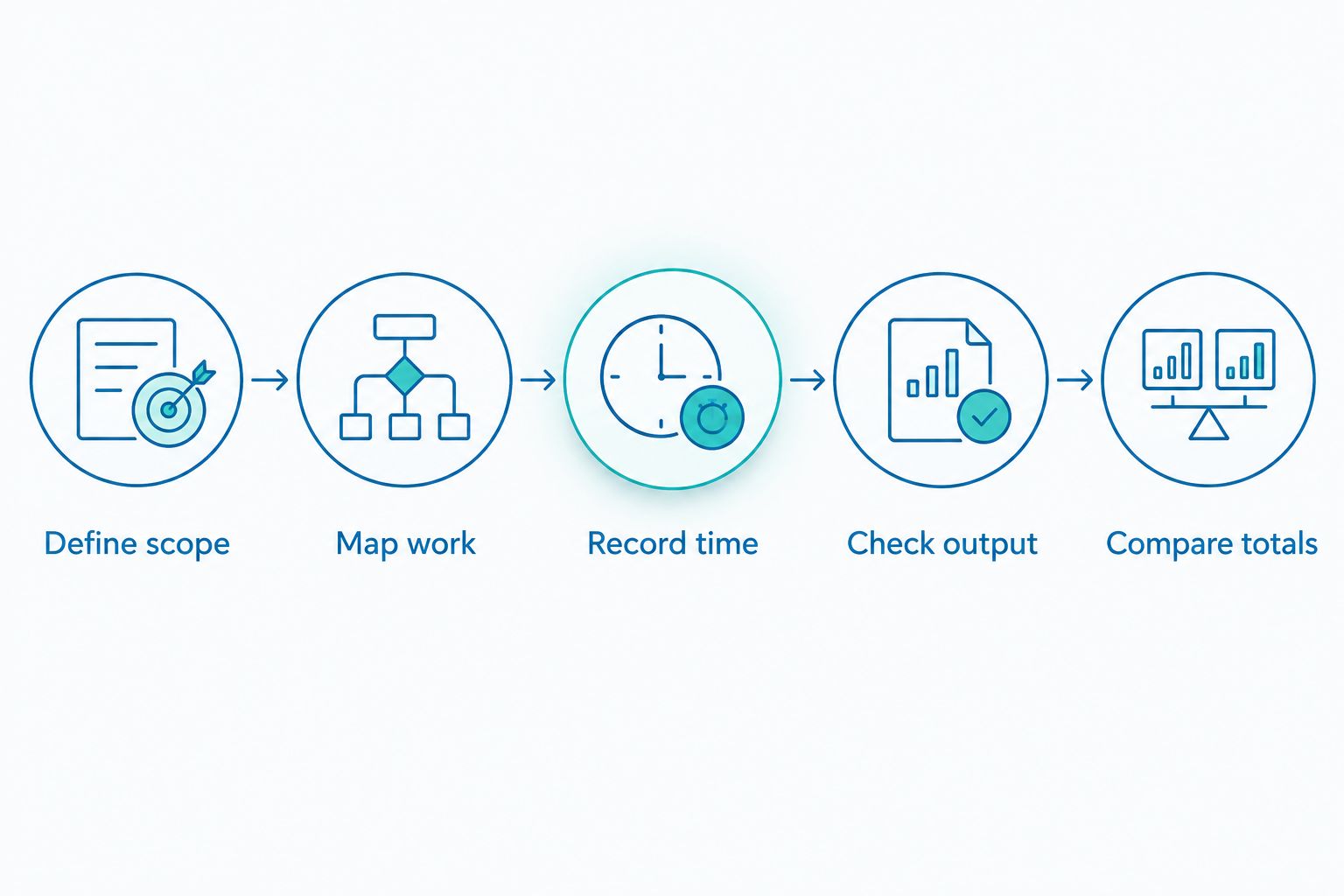
Use the same brief for every route. Your 2026 comparison should hold the deliverables, acceptance standard and required handover constant, then account for the work each route leaves with your business.
1. Define scope
List the content formats, subjects, channels and intended uses. Specify whether you need original production, adaptations of existing material or both. A finished campaign asset and an editable source file are different deliverables; state which you require.
2. Map work
Write down the tasks between the initial idea and publication. Include research, interviews, preparation, production, editing, review and handover where relevant. Assign each task to an internal role or an external supplier rather than leaving it implicit.
3. Record time
Track internal time spent briefing, gathering information, reviewing and resolving changes. Apply the same discipline to in-house work. Comparing an external invoice with internal production time alone leaves management work out of the decision.
4. Check output
Assess delivered work against the agreed brief. Record what was accepted, what required correction and what could not be used. Do not count rejected work as equivalent to approved content simply because both arrived as files.
5. Compare totals
Combine the relevant delivery costs and internal time for each model. Keep exceptional project requirements separate from recurring work so an unusual assignment does not become the basis for every future decision.
The sequence matters: define the comparison before examining the totals. Otherwise, you risk changing the quality standard to justify whichever model initially looks cheaper.
Why the cost comparison varies
The model matters, but so does the assignment. Use these factors as questions for your brief rather than assumptions about what any supplier includes.
- Workload consistency: identify whether demand is recurring, project-based or tied to specific campaigns. Compare capacity against that pattern.
- Format requirements: separate writing, design, photography and video requirements. Check which skills already exist internally and which need commissioning.
- Preparation: specify who supplies research, products, locations, interview access and supporting information where the assignment needs them.
- Approval responsibilities: name the person who consolidates feedback and the people responsible for factual or specialist review.
- Revisions: establish how feedback becomes a revised deliverable, and distinguish corrections from a change to the original brief.
- Rights and handover: confirm the required usage permissions, editable files, final formats and storage responsibilities in writing.
These factors belong in both sides of the comparison. An internal shoot still needs preparation; an outsourced article still needs accurate source information.
What should you ask before signing a production scope?
Ask what your team must do after the supplier delivers. That question exposes the gap between receiving content and having content ready for its intended use.
Request a written description of the deliverables, acceptance requirements, dependencies and exclusions. Confirm who handles factual corrections, who consolidates feedback and what happens when the brief changes.
For 2026, make the handover part of the initial decision rather than an end-of-project discussion. Establish file access, usage permissions and ownership terms before work begins; do not assume payment settles every question.
When discussing content production with ReachDigital, use the same brief you would use for an internal team. A fair comparison gives both routes the same business objective and the same definition of finished work.
Is outsourcing cheaper if you already employ a marketer?
Outsourcing is cheaper only if the combined external cost and retained internal work are lower for equivalent delivery. An existing marketer's salary does not make additional production time free or establish that the marketer has every required production skill.
Separate marketing ownership from production execution. Identify what the marketer should retain and which specific tasks you are considering outsourcing.
Does outsourcing remove the need for an internal content owner?
Outsourcing does not remove the need for an internal content owner. Your business still needs someone to provide information, settle conflicting feedback and approve content for its intended use.
Give that owner authority to make decisions. A supplier cannot resolve an internal disagreement about what your business wants to say without direction.
Should you move all content production outside the business?
Move only the work that benefits from external delivery. Review each production task against your internal skills, recurring demand and approval requirements rather than treating outsourcing as an all-or-nothing decision.
Keep the decision reversible where your agreement allows it. Document briefs, approved assets and responsibilities so your content operation does not depend on undocumented knowledge.
FAQ
Is outsourcing content production cheaper than in-house for a small business?
Outsourcing is cheaper only when its full cost is lower for the same usable output. Include the time your business spends briefing, reviewing and approving external work.
What should I include in an in-house content production comparison?
Include employment, management time, relevant equipment and software, and any external production support. Compare those responsibilities with an equivalent outsourced scope.
Can I outsource production but keep content strategy in-house?
Yes, you can retain strategy internally and commission defined production tasks. State who owns the brief, factual inputs, feedback and final approval.
Is an agency better than hiring a content creator?
Neither option is automatically better. Compare the required skills, recurring workload, management responsibilities and approved output before choosing.
How do I compare content production proposals fairly?
Give suppliers the same brief and assess equivalent deliverables, permissions and handover requirements. Include the internal work that each proposal leaves with your team.
Who approves content when production is outsourced?
Your business should name an internal approval owner. The supplier can prepare and revise content, but business facts and publication decisions still need clear accountability.
Does ReachDigital provide content production services?
ReachDigital provides content production services as part of its digital marketing offering. Its stated client focus includes property companies, e-commerce brands, consumer brands and medical services.
One last thing
Audit the last handover before changing the production model. Look at what arrived, what your team changed and what actually reached publication. If the same unresolved briefing or approval problem appears repeatedly, address it before commissioning more work or adding another role.
Related guides
- How to brief a content production agency in South Africa
- How to choose a content production agency in South Africa
- How long does a content production project take?