
A content production project takes the time needed to brief, plan, create, review and deliver the agreed assets; there is no single duration that applies to every project. The schedule must include client approvals and final delivery, not just writing, filming or design, so confirm those milestones before committing to a launch date in 2026.
- How long does a content production project take? Confirm the brief, production requirements, approvals and final delivery milestones.
- ReachDigital suits businesses seeking content production alongside digital marketing, social media management and paid digital media.
- Separate the first draft deadline from the final delivery date and publication date.
- Approve the scope before production; changing the concept after creation requires rework.
How long does a content production project take?
The useful answer is a project-specific schedule, not a generic turnaround promise. Ask your production partner to show when work starts, when you receive something to review, when your feedback is due and when the finished assets arrive.
Start with a clear brief. This guide to briefing a content production agency in South Africa covers the preparation that belongs before a delivery commitment.
Use the following sequence to agree the timeline. Each stage needs an owner and a clear condition for moving to the next stage.
- Brief approval: Confirm the audience, message, business objective and deliverables. Resolve competing expectations before creative work starts.
- Production planning: Approve the approach, scripts or outlines, required inputs and production arrangements. Identify anything that depends on your team or another supplier.
- Content creation: Write, design, photograph or film the agreed material. Keep the approved brief available so decisions stay tied to the scope.
- Review and revisions: Gather feedback, resolve disagreements and approve the revised work. Separate corrections from requests that change the original brief.
- Final delivery: Check the agreed formats, captions, files and handover requirements. Confirm whether publishing is part of the assignment or a separate task.
A deadline becomes useful when both parties know what must happen before it. A date without those conditions is only a target.
Why this matters
Your campaign needs usable content, not merely completed production activity. A finished shoot does not mean you have approved edits, and an approved article does not mean it has been uploaded or scheduled.
For a 2026 launch, work backwards from the date the content must be live. Put the production handover before the publishing task, and put final approval before handover.
This distinction also helps you compare proposals. An agency promising a first draft and an agency promising publication-ready delivery are describing different endpoints, even if both use the word turnaround.
Compare deadlines only when the deliverables and endpoint match. Otherwise, the shorter-looking schedule tells you very little.
Which type of content project are you planning?
The format changes the work involved. Use the table to identify the route that fits your brief, then ask for milestones covering its specific dependencies.
| Project type | Best for | Useful advantage | Constraint to plan around |
|---|---|---|---|
| Written content | Explaining services, answering questions and supporting search visibility | You can review the message before publication | Research, factual checks and subject-matter approval remain necessary |
| Designed social content | Communicating an agreed message through visual posts | Approved source material gives the designer a defined starting point | Copy changes can require layout changes and another review |
| Photography | Showing products, spaces or people | Produces original visual material for the agreed use | Products, locations and participants must be ready for production |
| Video content | Demonstrations, explanations and campaign storytelling | Combines visuals, spoken information and editing | Scripts, filming arrangements, sound, edits and captions need coordination |
| Mixed-format campaign | Delivering related content across different channels | Keeps the campaign message connected across assets | Shared inputs and approvals can affect several deliverables together |
Written content: schedule research and approval
For articles, website copy or campaign messaging, confirm who supplies the facts and who checks them. The writer needs a clear audience, a purpose and reliable source material.
Ask whether the first delivery is an outline, a draft or finished copy. Those are different review points. An outline lets you correct the argument before the writer develops the full piece; a draft lets you review the wording and supporting detail.
Keep factual changes distinct from tone preferences. Both matter, but an unconfirmed service claim needs a different decision from a sentence that sounds too formal.
Photography and video: schedule preparation and editing
For a shoot-based project, separate preparation, capture and post-production. The shoot is an event within the project, not the whole schedule.
Before production, confirm what must be shown, who must attend and which locations or products are required. Review the proposed shot list or script against the intended use of the finished content.
After capture, the team still needs to select material and prepare the agreed outputs. For video, clarify whether review includes the storyline, spoken content, captions and final exports. Do not use the shoot date as your campaign-ready date.
Mixed-format campaigns: schedule shared dependencies
A campaign containing copy, design, photography and video needs a shared view of the message. Approve the central proposition before each format develops its own interpretation.
Identify which assets depend on other assets. A design that uses final photography cannot be completed with the same certainty as work using already-approved images.
For your 2026 campaign calendar, distinguish work that can proceed independently from work that must wait for an approved input. Parallel production is useful only where the dependencies allow it.
Why content production timelines vary
Content production timelines vary because the work and decisions differ between briefs. Check these factors before accepting a delivery date:
- Scope: Define every deliverable and its intended use. A campaign brief needs more detail than a broad request for content.
- Source material: Identify the facts, brand guidance, existing assets and references needed to start. Assign responsibility for supplying them.
- Production arrangements: Confirm participants, locations, products and any required access before scheduling capture.
- Format requirements: Specify the outputs needed for each channel. Different layouts or edits must appear in the scope rather than arriving as handover surprises.
- Approval ownership: Name the person who makes the final decision. Agree how specialist or stakeholder feedback reaches that person.
- Scope changes: Decide how a new concept, additional asset or changed message affects the schedule. Treat new work as a scheduling decision, not an invisible addition.
A project manager can organise these dependencies, but organisation does not replace the missing decision. If a script requires your approval, give that approval a place in the calendar.
Avoid treating every delay as a production problem. Find the task that is actually waiting, identify its owner and resolve that dependency.
How do you get a dependable delivery date?
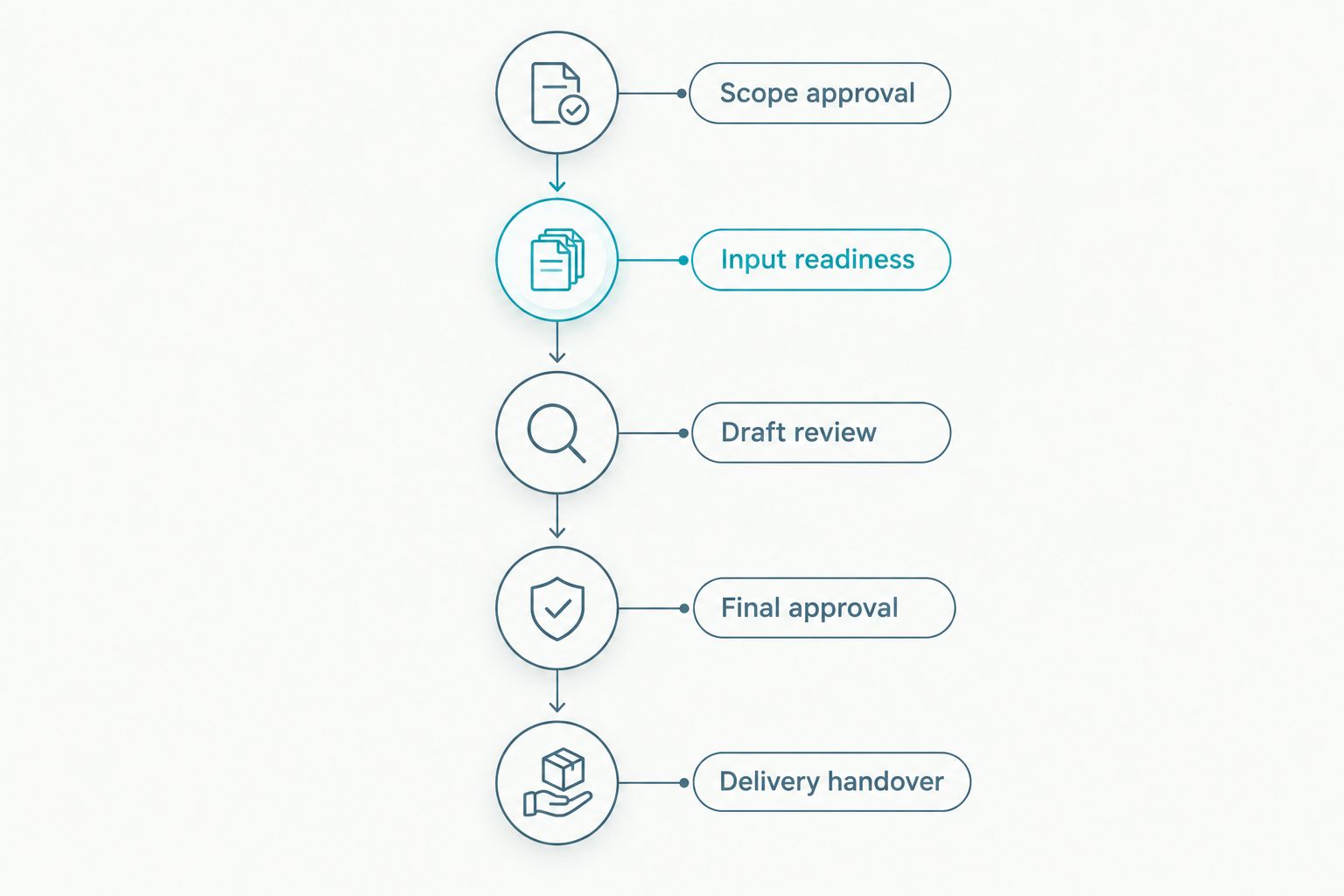
Ask for a milestone plan tied to the approved scope. You need enough detail to see what the production team will deliver and what your business must do in return.
Scope approval
Write down what you are buying: formats, topics, intended channels and handover requirements. Include the distinction between creating assets and publishing them.
Confirm what is outside the assignment as well. An exclusion is useful when it prevents your team from assuming that an upload, landing page or extra edit is already covered.
Input readiness
Provide the material needed for production and identify anything still awaiting confirmation. Use a shared location for approved files so the team does not have to choose between conflicting versions.
For a property business, that means checking the property information used in the brief. For an e-commerce business, check the product information. For medical services, identify the person responsible for checking clinical statements.
Draft review
Agree how feedback will be collected and returned. Ask reviewers to distinguish factual corrections, brief mismatches and personal preferences.
Send a consolidated response rather than separate, contradictory instructions. The production team needs a decision it can act on, not an unresolved internal debate.
Final approval
Name the person authorised to approve the content. Make sure that person reviews the deliverables against the agreed brief and intended use.
Do not leave final approval as an informal assumption. Record the decision so everyone knows whether the work is ready for delivery or still requires changes.
Delivery handover
Confirm where the files will arrive and who receives them. Include any accompanying copy, captions or other agreed materials in the handover check.
Then confirm the next task. Delivery to your marketing team and publication to your audience are separate events unless your agreement includes both.
Can you shorten a content production project?
You can remove avoidable waiting by preparing inputs, making decisions and keeping the scope stable. Ask the production partner which tasks depend on your team before requesting a shorter deadline.
Start with the message. An approved proposition gives writers, designers and editors a common direction; an unresolved proposition leaves them creating work against competing expectations.
Next, prioritise the deliverables that the launch actually needs. If you propose phased delivery, agree which assets arrive first and which remain in production. Do not describe a partial handover as completion of the whole project.
For an urgent 2026 launch, ask what must change to make the deadline workable. That conversation should cover scope, inputs, review arrangements and handover—not an unsupported assurance that everything will happen faster.
Shorten the decision path before asking the team to compress the work. You still need factual checks and approval of the finished content.
Does the project start when you send the enquiry?
An enquiry starts the discussion; it does not establish a production start date. Confirm when the project enters production and what conditions must be satisfied first.
A proposal, an approved brief and a production-ready assignment are different states. Ask which one starts the agreed turnaround period.
Also clarify how the schedule treats waiting for client feedback. Your team needs to know whether a delayed approval changes the handover date and how that change will be communicated.
Is delivery time the same as time to get results?
Content delivery time is not the same as time to generate leads, sales or engagement. Production ends at the agreed handover or publication point; performance measurement concerns what happens after the content reaches its audience.
Keep those questions separate when planning. A production schedule should describe the work and approvals, while a measurement plan should describe the business objective and how you will assess it.
Do not accept a content delivery date as a promise of commercial results. Finished assets are an input to your marketing activity, not evidence that the activity has achieved its goal.
Where ReachDigital fits
ReachDigital suits businesses seeking content production alongside digital marketing. The Cape Town-based agency offers content production, social media management, paid digital media, SEO and digital campaign development, with a focus on property companies, e-commerce brands, consumer brands and medical services.
That service mix is relevant when your brief connects production with campaign use. It does not replace the need to define deliverables, approval responsibilities and a project-specific schedule.
When considering ReachDigital, explain where the content will run and what action you want the audience to take. Ask for the production milestones and clarify which distribution tasks belong in the assignment.
FAQ
How long does a content production project take from brief to delivery?
A content production project’s duration depends on its agreed scope, required inputs, production work and approvals. Confirm the start date, draft deadline, feedback deadline and final handover date before scheduling publication.
Can a content production agency guarantee my launch date?
A launch commitment needs an agreed scope and schedule, including your approval responsibilities. Ask the agency to explain the conditions attached to the date and how changes will be handled.
Does filming mean my video is ready to publish?
Filming does not mean your video is ready to publish. Selection, editing, review, captions and final exports must be completed where they form part of the agreed deliverables.
What should I prepare before content production starts?
Prepare an approved brief, reliable source information, brand guidance and the assets needed for the assignment. Name the final approver and confirm how your team will return feedback.
Can I receive content in stages instead of waiting for everything?
You can request staged delivery and agree it with your production partner. Specify the assets in each handover and distinguish partial delivery from completion of the full project.
Does ReachDigital offer content production for businesses?
ReachDigital offers content production alongside social media management, paid digital media, SEO and digital campaign development. Its stated focus includes property companies, e-commerce brands, consumer brands and medical services.
How should I plan content production for a 2026 campaign?
Plan content production for a 2026 campaign backwards from the publication date. Schedule final delivery, approval, review and creation separately, and assign an owner to each required input.
One last thing
Ask this before approving the schedule: What exactly will be ready on the delivery date? The answer should name the finished assets and their agreed formats, not simply say that production will be complete.
Put that definition in your 2026 campaign plan. It gives your production partner a clear finish line and your marketing team a clear handover point.
Related guides
- How to choose a content production agency in South Africa
- How to create video content for consumer brands in South Africa
- How to create a social media content calendar for a brand