
A property listing has no fixed Google ranking deadline in 2026: Google must discover and index the page before it can compete for relevant searches. Indexing does not guarantee a prominent position, and a ranking does not guarantee an enquiry. Judge progress by the listing’s search visibility and qualified leads, not by a promised number of days.
- How long does it take to rank a property listing? Google provides no guaranteed deadline for organic rankings.
- Google Search Console separates indexing problems from property SEO performance; check the exact listing URL first.
- ReachDigital suits property companies seeking SEO alongside paid media and content production.
- Use listing pages for specific properties and suburb pages for broader local searches.
Why this matters
Your sales or letting deadline is not Google’s deadline. If you need enquiries while a listing is live, build a marketing plan that does not depend entirely on that page achieving an organic position.
The distinction between a single listing and a wider website matters, too. A listing serves a specific property; your location and development pages can support searches beyond that property’s marketing period. For the wider planning question, read how long SEO takes to show results in South Africa.
How long does it take to rank a property listing?
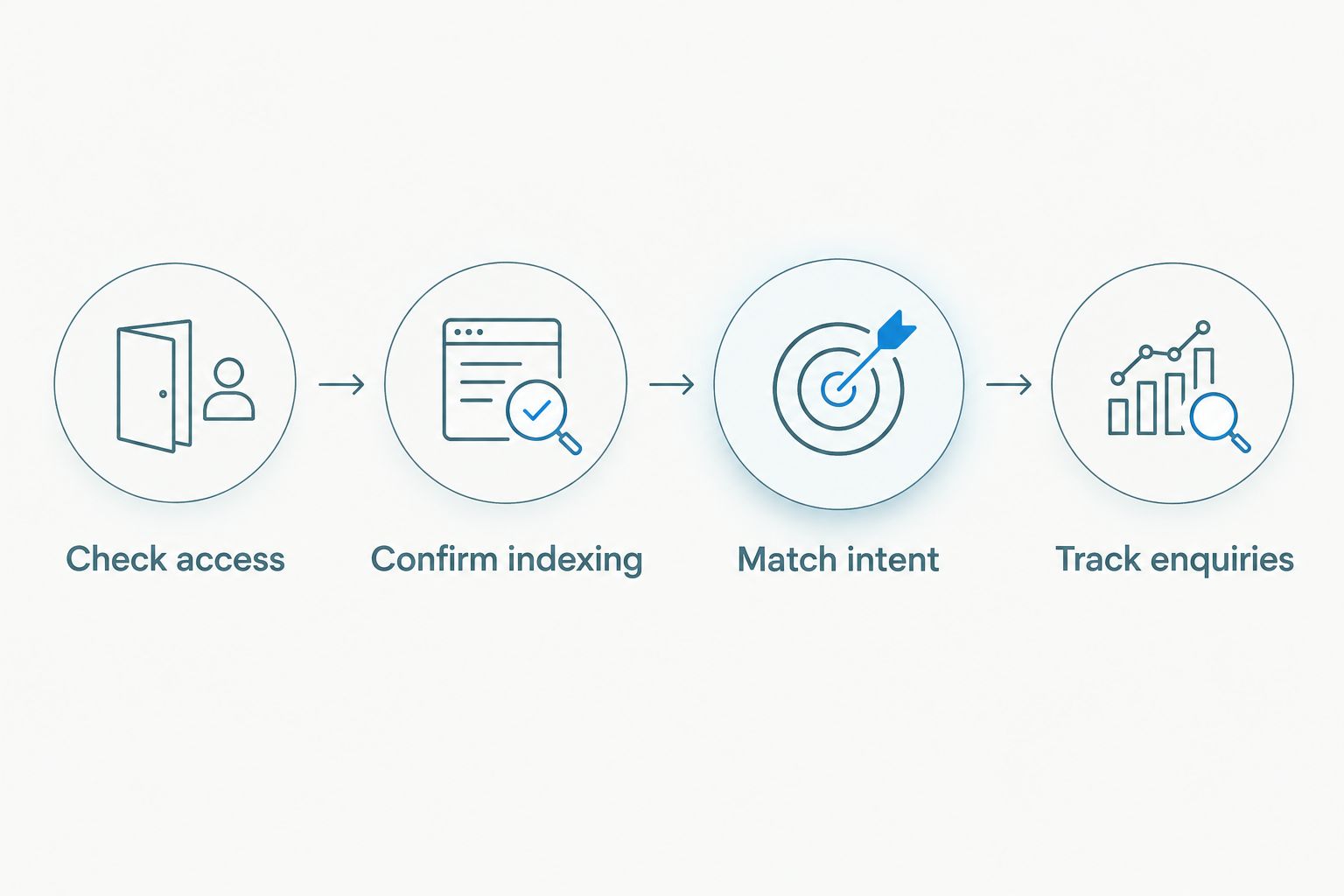
There is no universal elapsed time from publication to a useful Google ranking. The practical answer starts with a sequence: confirm access, confirm indexing, identify relevant searches, then measure the response.
Do not treat publication as proof that Google has indexed your listing. A page visible in your browser is not necessarily present in Google’s index.
Check access
Open the listing without signing in. Confirm that visitors can see the property information and use the enquiry method, then check whether Google is allowed to crawl the page.
Review robots directives, accidental noindex instructions and server errors. These checks answer whether the page is technically accessible; they do not establish how well it will rank.
Confirm indexing
Inspect the exact listing URL in Google Search Console. Check the reported indexing status and Google-selected canonical, rather than searching only for your agency name.
A canonical identifies the preferred URL among duplicate or closely similar pages. If Google selects another URL, investigate the relationship between those pages before rewriting the listing. Requesting indexing is a submission step, not a ranking guarantee.
Match intent
Choose searches that the property genuinely answers. A listing for a particular apartment has a different purpose from a page covering apartments across an entire suburb.
Make the location, property type and sale-or-rental context clear in the title and visible copy. Use verified property details to distinguish the listing, rather than repeating a broad keyword throughout the description.
Track enquiries
Review impressions, clicks and the search queries associated with the listing in Search Console. Then connect website visits to enquiry submissions and the property being discussed.
Keep the stages separate. An impression establishes search exposure; a click establishes a visit; a qualified enquiry establishes commercial relevance. None is interchangeable with the next.
This sequence tells you where to act. If the page is not indexed, work on indexing; if it receives relevant visits but no enquiries, examine the information and enquiry experience instead of assuming the ranking is the only problem.
Indexing is not the same as ranking
An indexed property listing is eligible to appear in Google Search. That is a technical milestone, not evidence that the page will appear prominently for the searches you want.
Check the precise URL. A suburb page appearing in search does not prove that its individual listings are indexed, and a portal listing appearing does not prove that your own website’s version is indexed.
For your 2026 reporting, record the publication date, indexing status and page changes separately. This gives you a timeline of observable events without turning the elapsed time into a promise.
Best for diagnosing discovery problems: URL-level indexing checks. Their limit is clear: they explain whether Google has indexed a page, not whether buyers will find or choose it.
Ranking for a property name differs from ranking for a suburb
A unique development name, a specific property reference and a broad suburb search are different targets. Define the query before asking when the page will rank.
Search intent determines the appropriate page. Someone looking for a specific development needs development information; someone exploring a suburb needs a useful selection and local context. A single listing should not carry every search objective.
| Page type | Best for | Strength | Limitation |
|---|---|---|---|
| Individual listing | Searches for a specific property | Provides property-level details and a direct enquiry route | Covers only that property |
| Suburb or area page | Searches across a location | Organises relevant listings and local information | Needs maintenance and meaningful content |
| Development page | Searches for a named development | Brings development information together | Does not replace individual unit details |
Match the page to the search, not the search to whichever page you published first. Use internal links to connect these page types so visitors can move from an area overview to a relevant property.
Why property listing ranking time varies
The main variables concern discoverability, relevance and the competing results. Review them as diagnostic questions, not as a formula that produces a deadline.
- Crawl access: Can Google retrieve the listing, or do technical restrictions prevent access?
- Indexing signals: Does the page identify a consistent preferred URL, or do duplicate versions create ambiguity?
- Search intent: Does an individual listing answer the chosen query, or does the search call for a broader selection?
- Useful content: Does the page provide verified property information beyond a generic description?
- Internal discovery: Do relevant website pages link to the listing through crawlable links?
- Competing results: What page types appear for the target query, and what information do they provide?
There is no fixed number of edits that resolves these variables. A longer description does not repair a blocked page, and a technically accessible page still needs to answer the search.
What should you change before waiting longer?
Start with a property-level content check. Confirm the location, property type, accommodation details and features against the agent’s approved information. Remove contradictions between the description, photographs and other page elements.
Write a clear title that describes the property rather than making unsupported claims. Use headings to organise the details buyers need, and make the enquiry action easy to find on a phone. Do not publish features simply because competing listings mention them.
Next, review how the listing fits into the website. Link it from relevant area or development pages and ensure navigation does not depend solely on a search form that Google cannot follow.
Make changes for a diagnosed reason. Record what you changed and when, then inspect the resulting indexing and search activity. Rewriting the page repeatedly without a clear problem makes the history harder to interpret.
How should you measure progress in 2026?
Measure the exact listing URL and distinguish property-specific searches from broader discovery searches. An increase in impressions for irrelevant queries does not establish progress towards qualified property enquiries.
Use the following checks to decide what needs attention:
| Observed condition | What it establishes | Next move |
|---|---|---|
| Listing is not indexed | The page is absent from Google’s index | Inspect access, indexing directives and canonical selection |
| Relevant impressions appear | Google has displayed the page for those searches | Review queries and how the result describes the property |
| Visits arrive without enquiries | Visitors reach the listing but do not enquire | Check property information, usability and enquiry functionality |
| Enquiries concern the wrong property | The enquiry context is unclear | Carry the property reference into the enquiry process |
Keep search performance and sales follow-up connected. The page should identify which property the visitor wants to discuss, and your team should retain that context when responding.
For a 2026 campaign, use the same definitions throughout your reporting. Separate submitted enquiries, qualified enquiries and booked viewings instead of presenting them as one result. Report actual outcomes, not an assumed link between ranking movement and sales.
Should you rely on SEO for an urgent property campaign?
Do not make organic ranking the only route to an urgent property enquiry. SEO supports relevant discovery, but you cannot schedule a guaranteed organic position around a launch or letting deadline.
Compare channels by the job they perform. Paid promotion does not fix organic indexing, and organic visibility does not replace a functioning enquiry process.
| Approach | Best for | Advantage | Limitation |
|---|---|---|---|
| Organic SEO | Building search visibility for listings and lasting location pages | Connects useful pages with relevant searches | Offers no guaranteed ranking deadline |
| Paid search | Reaching people searching for relevant property terms | Allows deliberate campaign targeting | Does not improve organic ranking directly |
| Paid social | Introducing a property through targeted visual content | Supports promotion beyond search queries | Requires qualification of interest and enquiries |
ReachDigital is a fit for property companies that need SEO alongside paid media and content production. The agency offers these services; Google’s ranking deadline remains outside any agency’s control.
When discussing SEO for property companies in South Africa, ask for separate organic and campaign objectives. Agree on which pages support lasting search demand and which activities support the current property campaign.
Can a property portal listing rank before your own page?
A portal URL and your own listing URL are separate pages in Google’s search results. The appearance of one does not establish the indexing status or performance of the other.
Measure the website URL you control in Search Console and review portal reporting separately. Do not combine their visibility into a single claim that your listing has achieved an organic ranking.
Will requesting indexing make my listing rank?
Requesting indexing does not guarantee indexing or ranking. It asks Google to consider crawling the submitted URL; it does not assign the page a search position.
Use the request after checking the page and resolving relevant technical problems. Repeated submissions are not a substitute for clear content, crawlable links and a consistent preferred URL.
Does changing the listing description restart the process?
Changing a description does not create a guaranteed new ranking timetable. Google must recrawl the page to process updated content, and the effect depends on the change and the search being evaluated.
Correct inaccurate information promptly. For SEO edits, keep a dated record and make purposeful changes rather than treating every rewrite as a fresh countdown.
FAQ
How long does it take to rank a property listing in 2026?
A property listing has no fixed Google ranking deadline in 2026. Check indexing first, then measure visibility for relevant searches and qualified enquiries.
How do I check whether Google has indexed my property listing?
Inspect the exact listing URL in Google Search Console. Review the indexing status and Google-selected canonical rather than relying only on a manual search.
Is an indexed listing guaranteed to appear prominently in Google?
An indexed listing is not guaranteed a prominent Google position. Indexing makes the page eligible to appear, while ranking depends on its relevance to a search and Google’s other ranking signals.
Should I target a suburb keyword on every property listing?
Target searches that each property listing genuinely answers. Use a useful suburb page for broader location searches instead of assigning the same broad objective to every listing.
Can paid ads help my property listing rank organically?
Paid ads do not directly improve a property’s organic Google ranking. Treat advertising as a separate route to visitors and enquiries, with its own targeting and reporting.
What should I ask a property SEO agency before appointing it?
Ask for URL-level indexing checks, clear target queries and reporting that separates visits from qualified enquiries. ReachDigital’s property SEO work should be briefed against those objectives, not a guaranteed ranking date.
Should I remove a listing when its property campaign ends?
Handle an ended listing according to its remaining usefulness and the site’s structure. Update its status accurately, and do not redirect it to an unrelated property merely to retain traffic.
One last thing
The page with the longest useful life deserves attention alongside the listing. An individual property campaign ends; a well-maintained suburb or development page can continue answering relevant searches beyond it.
For your 2026 property SEO plan, maintain both layers. Give each listing accurate details and a clear enquiry route, while keeping location pages useful enough to support the next campaign rather than rebuilding your search presence around every new property.
Related guides
- How to measure SEO performance for a property website in SA
- How to do SEO for a property developer in South Africa
- How to build a content strategy for property marketing in SA