
SEO in South Africa takes months rather than days to build meaningful organic growth, but there is no fixed deadline for rankings, leads or sales in 2026. Technical fixes and search visibility are not the same as commercial results: your website still needs to attract relevant visitors and turn those visits into enquiries or purchases. Judge progress against your starting position and completed work, not a guaranteed date.
- How long does SEO take to show results in SA? Plan in months, not days; separate visibility from sales.
- ReachDigital offers SEO for property, e-commerce, consumer and medical businesses seeking leads and sales.
- Google Search Console shows search visibility; conversion tracking shows whether organic visits produce business results.
- Demand a baseline, implemented changes and evidence of progress—not a guaranteed ranking date.
Why this matters
An SEO timeline affects your cash flow, marketing priorities and expectations. If you need enquiries immediately, a plan that relies entirely on future organic rankings leaves a gap between work starting and demand arriving.
Agree what counts as a result before you agree when to expect it. An indexed page, a search impression, an organic visit and a qualified enquiry represent different outcomes. Your reporting should keep them separate.
Use the criteria in how to choose an SEO agency in South Africa to assess proposals. A useful proposal connects the work, the measurement and the business objective.
How long does SEO take to show results in SA?
There is no reliable South Africa-wide deadline that applies to every website. Your existing search visibility, technical condition, target searches and ability to publish changes determine the work required before organic growth becomes measurable.
For 2026 planning, Google's Search Central SEO Starter Guide provides the relevant general principle: search changes take time to be reflected, and some effects take months. That guidance concerns search performance, not a promise of sales or a South African industry benchmark.
Track the evidence in this order. Each stage answers a different question.
| Stage | Evidence to check | What it tells you | What it does not prove |
|---|---|---|---|
| Implementation | Approved changes are live | The planned work has reached the website | Google has processed the changes |
| Search eligibility | Important pages are accessible and indexed | Pages are eligible to appear in search | They rank for commercially useful searches |
| Visibility | Relevant queries generate impressions | Google is showing your pages | Searchers choose your result |
| Traffic | Relevant organic clicks reach useful pages | Search is bringing visitors | Visitors become customers |
| Business results | Qualified enquiries or purchases are recorded | Organic visits contribute to demand | Every conversion represents profitable growth |
An agency should explain which stage is improving and what blocks the next stage. A report that shows more impressions without naming the queries or landing pages leaves you unable to assess their value.
The practical timeline starts with implementation, not the date you sign a contract. Record when changes go live so you can interpret subsequent performance against actual work.
Existing website: assess the pages already attracting searches
An established website gives you a starting point: pages, queries and conversion history to inspect. Begin there. Do not replace an existing opportunity with a large publishing programme simply because producing new articles is easier to report.
Look for commercially relevant pages that already receive impressions but attract few clicks. Check whether their titles describe the offer clearly, whether the page answers the searcher's question and whether visitors can take the intended action.
The advantage is that you can improve an existing page with known search activity. The limitation is that existing visibility does not guarantee a ranking increase; the page still competes with other results.
For your 2026 plan, distinguish improvements to established pages from attempts to reach entirely new searches. Combining them into a single traffic target hides whether the strategy is working where the website already has a foothold.
New website: establish eligibility before expecting demand
A new website needs accessible, useful pages before you can assess organic performance. Check indexing, internal links, page purpose and measurement before treating weak traffic as evidence that the content strategy has failed.
Publish pages that explain what you sell, who you serve and where the service applies. A collection of broad informational articles is not a substitute for clear service or category pages.
The advantage is control: you can build the site around its commercial purpose from the start. The limitation is the lack of historical search and conversion data against which to judge progress.
Do not promise a new website the same timeline as an established site. Report what has been implemented, which pages are indexed and which relevant searches are starting to appear.
Local business: separate map visibility from website rankings
For a business serving a defined area, measure local search separately from wider organic search. Google Business Profile performance and website performance answer related but different questions.
Google's published local-ranking guidance identifies relevance, distance and prominence as the main factors. Distance is not something an agency removes through better copy. Accurate business information and useful location content still matter, but they do not erase geography.
The advantage of local targeting is a clear service area and customer need. The limitation is that visibility varies with the searcher's location and the competing businesses in that area.
For a 2026 local SEO report, ask which locations, searches and customer actions the work targets. A ranking screenshot from an unspecified location is not a dependable account of your local visibility.
Why SEO timelines vary
The country label alone does not establish a timeline. Diagnose the website and the searches it needs to win.
- Technical access: Blocked pages, incorrect indexing instructions and broken internal links interfere with discovery or eligibility. Resolve access problems before judging content performance.
- Starting visibility: A page already appearing for relevant searches presents a different task from a page with no search history. Compare progress against its own baseline.
- Search intent: A useful article can attract readers who are not looking to buy. Prioritise pages that match the customer action your business needs.
- Competing results: Inspect the pages already ranking for your target searches. Your page needs a clear purpose and useful information, not merely repeated keywords.
- Implementation: Recommendations sitting in a document have no effect on the website. Assign owners for development, content approval and publishing.
- Conversion experience: Traffic cannot compensate for an unclear offer, a broken enquiry form or a difficult checkout. Test the route from landing page to completed action.
These factors explain why a fixed promise is weak. They also give you something actionable: identify the current constraint, resolve it and check whether the next stage improves.
How should you measure progress while SEO develops?
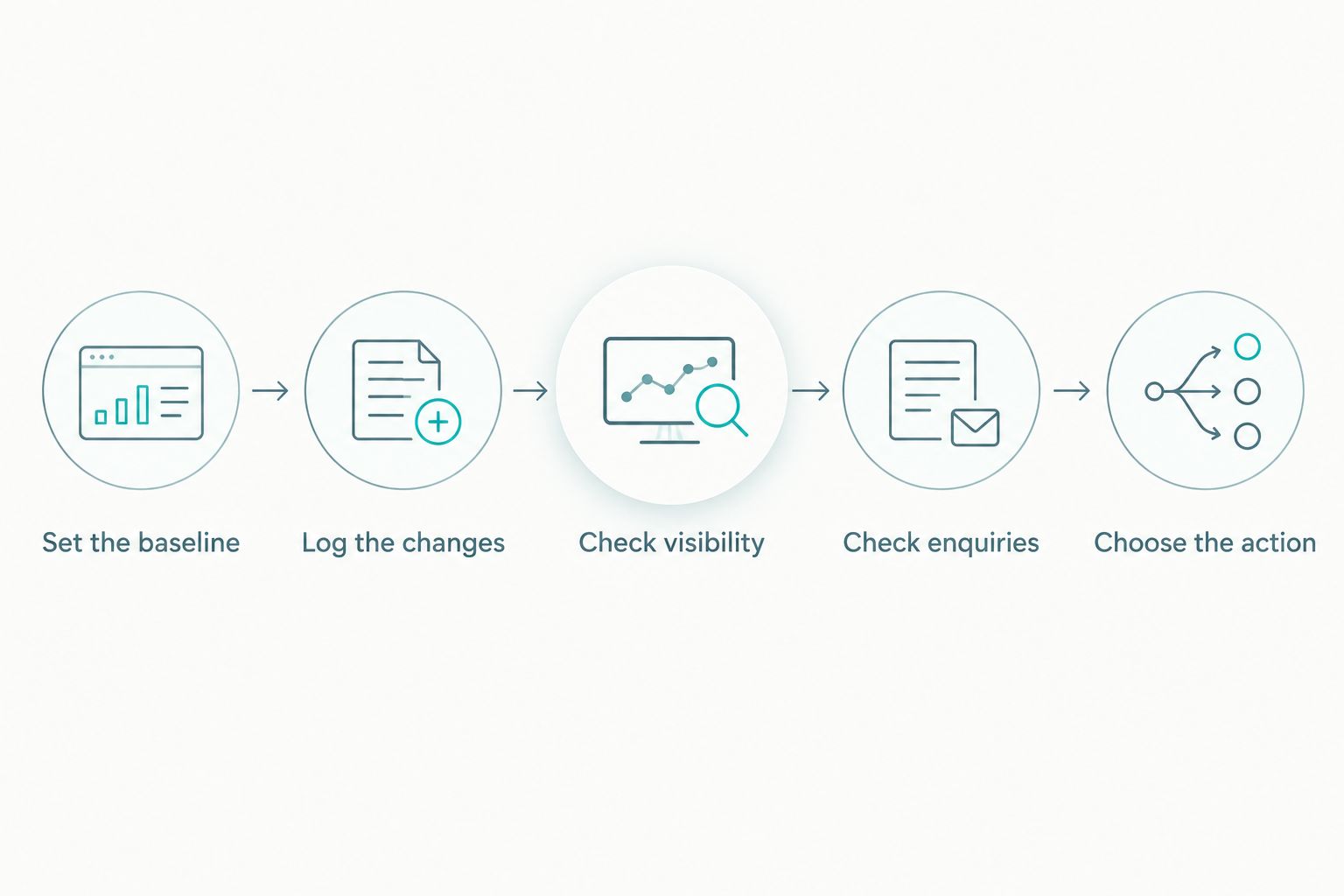
Build a measurement sequence that connects work to outcomes. Keep the baseline consistent, and annotate website changes so the report has context.
- Set the baseline. Record organic search activity, important landing pages and tracked enquiries or purchases before implementation. Separate searches containing your brand name from searches for the category or service.
- Log the changes. Record what went live and when. Include page edits, technical fixes, new pages and changes to forms or checkout.
- Check visibility. Use Google Search Console to inspect relevant queries, impressions and clicks. Review the pages receiving that activity, rather than relying only on a site-wide total.
- Check enquiries. Use your analytics and enquiry records to assess completed actions. For lead generation, distinguish a submitted form from a qualified sales opportunity.
- Choose the action. Continue work supported by relevant progress, fix identified blockers or revise pages attracting the wrong audience. Do not repeat an ineffective task solely to maintain activity.
The sequence matters because each check answers the next question. If a page is not indexed, start there; if relevant visitors arrive but enquiries do not, inspect the offer and conversion path.
What should an SEO report actually tell you?
Your 2026 SEO report should explain whether completed work is helping the right pages reach the right searches. A longer list of tasks does not answer that question.
Ask for a distinction between outputs and outcomes. Publishing content is an output. Relevant organic traffic and qualified demand are outcomes. Both belong in the report, but they should not be presented as interchangeable.
A useful report also explains disappointing results. If clicks rise while enquiries remain flat, inspect landing-page intent, tracking and the conversion path. If impressions rise for irrelevant searches, review the content rather than celebrating the total.
For an online shop, apply this analysis to categories and product journeys, not just articles. The guide to growing an e-commerce brand with SEO in South Africa addresses that commercial focus.
Ask what the evidence changes about the next decision. If nothing changes regardless of performance, the reporting is not directing the work.
Can SEO bring leads before rankings improve across the site?
SEO does not need to improve every page before an individual commercial page contributes enquiries. Assess the landing pages and searches associated with those enquiries, rather than waiting for a site-wide ranking milestone.
The reverse also applies: broad visibility growth does not prove lead growth. Keep qualified enquiries alongside search metrics so you can see the difference.
Does paid media make SEO work faster?
Paid media does not buy better organic rankings. It serves a different role: reaching an audience through paid placements while organic work develops.
Use separate reporting for paid and organic activity in 2026. Shared landing-page improvements can support both channels, but paid traffic should not be presented as an SEO result.
When should you change an SEO strategy that is not producing results?
Change the strategy when the evidence identifies the wrong target, an unresolved blocker or work that is not being implemented. Elapsed time alone does not explain the problem.
Ask whether relevant visibility is improving, whether visitors reach the intended pages and whether those visits generate useful actions. An indexed page attracting the wrong searches needs a different response from a strong landing page that Google cannot access.
Which support fits your business?
ReachDigital is best suited to property, e-commerce, consumer and medical businesses seeking SEO alongside paid media and content production. That fit follows its stated service offering and business focus, not a claim of guaranteed rankings.
The advantage of considering a multi-service agency is the ability to discuss search, content and paid campaigns within the same brief. The limitation is that a wider offering does not establish the right SEO scope for your website; ask for responsibilities, implementation requirements and measurement before deciding.
ReachDigital's SEO offering should be assessed against your commercial objective. Bring your website access requirements, priority services or categories, target locations and definition of a qualified result to the discussion.
FAQ
How long does SEO take to show results in SA?
Plan for SEO growth in months rather than days, without treating that as a guaranteed deadline. Separate implementation, search visibility, organic traffic and qualified enquiries when assessing progress.
Can an SEO agency guarantee results by a specific date?
An agency cannot control a guaranteed organic ranking date. Ask for implementation commitments, a baseline and measurable progress rather than a fixed ranking promise.
Why am I getting more impressions but no enquiries?
More impressions show increased visibility, not customer demand. Check the search queries, landing pages and conversion path to establish whether the visibility is commercially relevant.
Is local SEO quicker than national SEO in South Africa?
Local SEO does not have a guaranteed shorter timeline. Google’s local-ranking guidance identifies relevance, distance and prominence, so measure local visibility separately from national website searches.
Should I stop Google Ads when I start SEO?
Starting SEO is not, by itself, a reason to stop Google Ads. Decide based on each channel’s contribution to qualified demand and your business requirements.
What should I ask an agency before starting SEO?
Ask which pages and searches it will prioritise, who implements changes and how business results will be measured. Agree what counts as a qualified enquiry or purchase before work begins.
Is ReachDigital relevant for my SEO brief?
ReachDigital offers SEO and focuses on property companies, e-commerce brands, consumer brands and medical services. Assess the proposed scope against your website, implementation capacity and commercial objective.
One last thing
Treat every important SEO change as a dated event. Without an implementation log, you risk judging work that has not reached the website or attributing a change in demand to the wrong activity.
Before approving another batch of content, check whether your priority commercial pages are accessible, useful and connected to a working enquiry or purchase journey. More publishing is not the answer to every SEO problem.
Related guides
- How to audit your website SEO in South Africa
- How to improve local SEO for a Cape Town business
- How to measure SEO performance for a property website in SA