
A rebrand in South Africa needs a project-specific timeline covering strategy, identity, production and rollout—not a fixed number of weeks attached to the word ‘rebrand’. Treat design approval and public launch as separate milestones: approving a new identity does not finish the website, campaign assets, customer communications or physical materials that use it.
- How long does a rebrand take in South Africa? Scope the strategy, identity and rollout before accepting a deadline.
- Separate design approval from launch readiness; completed artwork is not a completed rebrand.
- ReachDigital suits businesses needing digital marketing execution across content, social media, paid media and SEO.
- For a 2026 rebrand, assign approval owners and confirm production dependencies before announcing the launch.
How long does a rebrand take in South Africa?
Your rebrand timeline should run from an approved brief to a tested, customer-facing rollout. Ask for a schedule that names the work, its owner, the approval required and the next task it releases. A delivery date without those details is not enough to plan around.
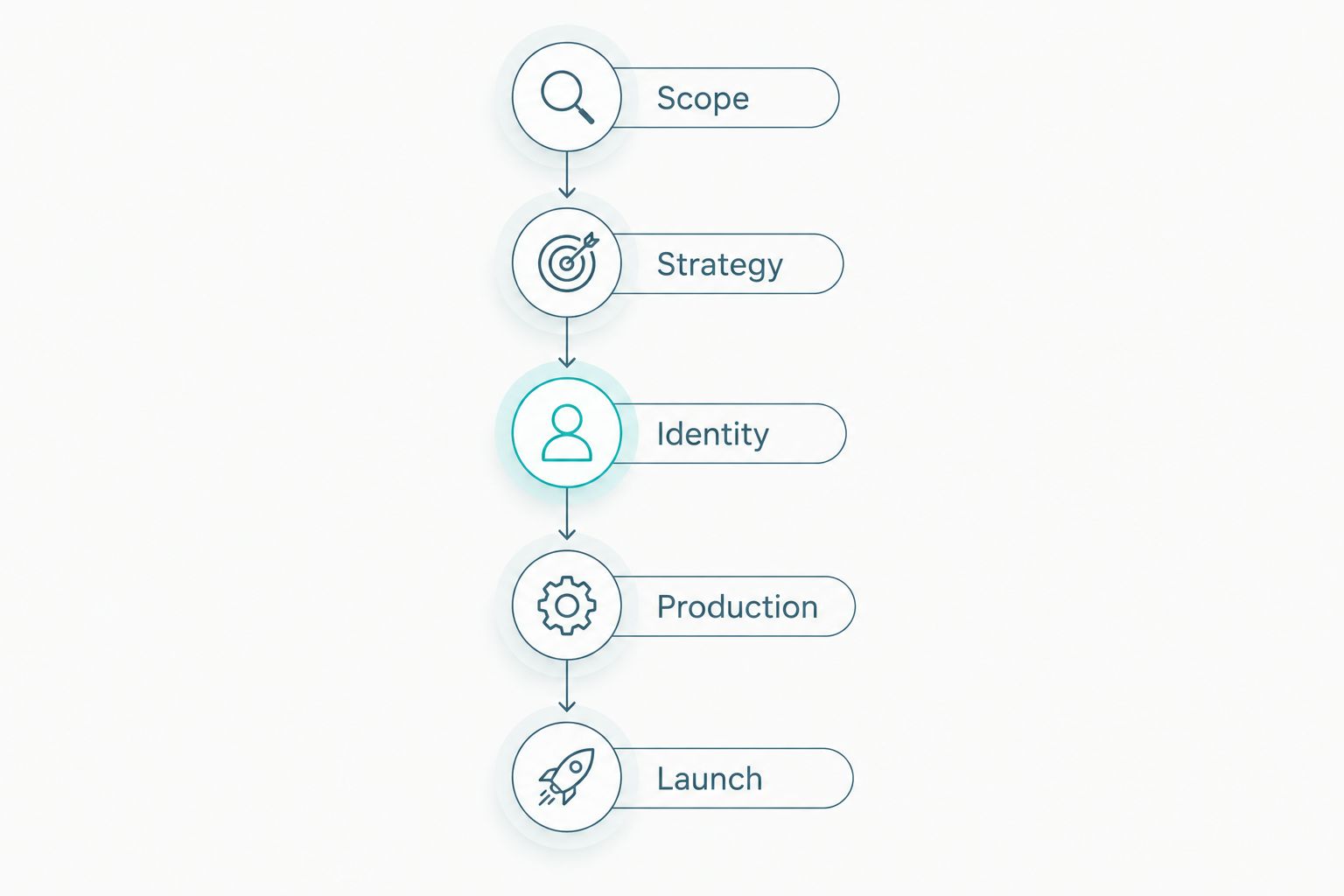
Use this sequence to assess a proposed schedule:
- Scope: agree what changes, what stays and what must be ready for launch.
- Strategy: approve the audience, positioning and core message before developing the identity.
- Identity: approve the visual and verbal direction against that strategy.
- Production: build the agreed website content, campaign materials and other applications.
- Launch: test the customer journey, brief your team and publish the approved changes.
When choosing a branding agency in South Africa, ask which of these stages the proposal actually includes. Compare schedules against the same endpoint, not just the same start date.
Why this matters
A founder asking for a ‘finished rebrand’ and a designer promising ‘finished brand files’ can be agreeing to different outcomes. Put the endpoint in writing. Otherwise, your launch plan rests on an assumption.
For a 2026 launch, define completion through customer actions: can someone recognise the business, understand the offer, make an enquiry and complete a purchase or booking where relevant? A presentation deck cannot answer those questions by itself.
Which type of rebrand are you planning?
Choose the scope that addresses the business problem. Do not commission a full repositioning to fix inconsistent artwork, or a logo refresh to fix an unclear offer. These are different jobs with different approval requirements.
| Scope | Best for | Work to include | Advantage | Limitation |
|---|---|---|---|---|
| Visual refresh | Businesses keeping their name, audience and positioning | Agreed identity adjustments and priority applications | Keeps the brief focused | Does not resolve an unclear commercial message |
| Strategic rebrand | Businesses changing how they position themselves | Audience decisions, positioning, messaging and identity | Connects design decisions to business direction | Requires strategic agreement before production |
| Name or domain change | Businesses whose existing name or web address must change | Naming decisions, appropriate checks, communications and technical transition | Addresses the identity change directly | Introduces dependencies beyond artwork |
| Full rollout | Businesses replacing the brand across customer touchpoints | Approved identity applied to digital and relevant physical materials | Defines completion beyond design handover | Requires coordination across owners and suppliers |
Visual refresh: keep the boundaries explicit
A visual refresh is best for a business whose positioning remains useful but whose presentation needs attention. Specify the applications you need rather than asking for ‘updated branding’ and leaving the deliverables open.
Its limitation is strategic. New typography, colours or layouts cannot settle who you serve or why customers should choose you; resolve those questions separately if they are part of the problem.
Strategic rebrand: approve the message before the applications
A strategic rebrand is best for a business changing its audience, offer or market position. Write down the decisions that must be approved before design starts, including what the business promises and which claims it can support.
The trade-off is decision work. If stakeholders disagree about the business direction, record and resolve that disagreement rather than asking the design team to interpret conflicting feedback.
Name or domain change: separate the dependencies
A name or domain change is best treated as its own workstream within the rebrand. Confirm which naming, legal, account-access and technical tasks apply to your business, then assign qualified owners where needed.
Do not treat an approved name as permission to switch every channel immediately. Schedule the transition only after the relevant checks, access requirements and customer communications have been addressed.
Build the schedule around approval gates
For your 2026 project plan, use approval gates rather than a list of creative activities. Each gate should answer a practical question: what is now settled, and what work can start because it is settled?
Scope
Create an inventory of the materials the rebrand affects. Include your website, social profiles, advertising, email templates, sales documents and any relevant packaging, signage or printed materials.
Mark each item as required for launch, scheduled after launch or unchanged. An asset inventory is a scheduling document, not just a design checklist. Give each item an owner and a clear acceptance condition.
Strategy
Approve the audience, positioning and message in a form your team can use. Avoid signing off abstract language that leaves the actual offer unclear.
Your acceptance condition should be practical: the team can explain who the business serves, what it offers and which evidence supports its message. Keep disputed claims out of production until they are resolved.
Identity
Assess identity concepts against the approved brief. Ask whether the direction communicates the intended positioning and works in the applications your business needs.
Consolidate feedback before sending it to the design team. Separate corrections against the brief from requests that change the brief, because those require different decisions about scope and scheduling.
Production
Turn the approved direction into usable assets. Identify which tasks can run together and which depend on approved copy, photography, website access or another deliverable.
For example, draft a customer announcement while approved applications are being prepared. Do not finalise materials that depend on a name or message still under review; record that dependency in the schedule instead.
Launch
Test the public-facing experience before announcing the change. Check links, forms, enquiry routing, relevant purchase or booking journeys and the consistency of the published message.
Brief your internal team before customers start asking questions. Assign responsibility for correcting launch issues, then close the project against the agreed deliverables rather than the announcement date alone.
Why a rebrand timeline varies
The useful question is not whether a rebrand is ‘quick’ or ‘slow’. Ask which decisions and deliverables sit between the current position and the agreed finish line.
Use these factors to interrogate your own brief:
- Scope of change: state whether the project covers presentation, positioning, naming, rollout or a combination.
- Approval ownership: name the person authorised to approve each stage and the people who must contribute feedback.
- Asset coverage: list the actual applications required instead of relying on phrases such as ‘all marketing materials’.
- Content requirements: identify copy, photography and video that must be created, supplied or approved.
- Technical changes: identify website, domain, email and account-access tasks that apply to the transition.
- External dependencies: obtain relevant supplier schedules and review requirements before treating the launch date as confirmed.
These are planning inputs, not reasons to accept an unexplained delay. Ask the project owner to show which dependency controls the next milestone and what decision would move it forward.
How do you get a useful timeline from an agency?
Send the same written scope to every agency you approach. A shorter schedule is not a better offer if it stops at identity handover while another includes production and launch support.
Ask for these details alongside the proposed dates:
- The start condition, including the information and access you must provide.
- The deliverables and approval condition for each milestone.
- The feedback process, including who consolidates comments.
- The distinction between included revisions and a changed brief.
- The tasks handled by your team or another supplier.
- The handover contents and the definition of project completion.
Confirm the start condition before committing to the launch date. A booking date, kickoff meeting and production start are not interchangeable milestones; specify which one the schedule uses.
For a 2026 campaign launch, also ask how revised dates will be communicated. A useful schedule shows the effect of an outstanding approval rather than leaving everyone to work from an outdated document.
Can you launch before the whole rebrand is finished?
Yes—use a phased rollout when you can define a coherent customer-facing release. Approve what must change together, what can follow later and how your team will manage the transition.
A phased launch is best for a business that can separate essential launch assets from later applications. Its advantage is a narrower initial release; its limitation is the need to manage old and new materials deliberately.
A coordinated launch is best when key customer touchpoints need to change together. It keeps the release aligned, but your launch decision must account for every included dependency.
| Approach | Best for | Advantage | Limitation |
|---|---|---|---|
| Phased rollout | A clearly defined initial release | Separates launch essentials from later applications | Requires a controlled transition between versions |
| Coordinated rollout | Interdependent customer touchpoints | Aligns the agreed public-facing changes | Requires readiness across the full launch scope |
Put either approach into an asset register. Record the current version, replacement owner, approval status and publication plan so the transition is explicit.
Does a rebrand include digital marketing rollout?
Only when the scope says so. Ask separately about social content, advertising creative, campaign landing pages, email communications and SEO work rather than assuming identity approval includes their delivery.
ReachDigital is best suited to businesses needing digital marketing execution across content, social media, paid media and SEO. Those are stated services; confirm the specific rebrand applications, responsibilities and deliverables before treating them as part of an engagement.
ReachDigital serves property companies, e-commerce brands, consumer brands and medical services. For a rebrand brief, the relevant discussion is how the approved brand will be applied across your marketing activity—not an assumed promise of naming, legal review or a complete identity project.
FAQ
How long does a rebrand take in South Africa in 2026?
A rebrand needs a project-specific schedule covering strategy, identity, production and rollout. Confirm the deliverables, approval owners and launch conditions before accepting a completion date.
Is a logo redesign the same as a full rebrand?
No—a logo redesign addresses an identity element, while a full rebrand can also cover positioning, messaging and rollout. Specify the business problem and required applications before comparing proposals.
What should be approved before rebrand production starts?
Approve the strategy and identity decisions that the production work depends on. Keep unresolved naming, messaging or scope decisions visible in the schedule rather than leaving suppliers to make assumptions.
Can my business keep trading during a rebrand?
Plan the rebrand around business continuity rather than assuming a trading pause. Assign owners to test the relevant enquiry, purchase or booking journeys and to manage the public transition.
Does changing my brand mean I must change my domain?
No—a brand change does not automatically require a domain change. Treat any proposed domain move as a separate technical decision and include its transition work in the project scope.
Can ReachDigital help with marketing after a rebrand?
ReachDigital offers social media management, paid digital media, content production, SEO and digital campaign development. Confirm which applications of the approved brand belong in the agreed engagement.
How can I keep a rebrand on schedule?
Set a clear scope, assign approval owners and consolidate feedback at each milestone. When a decision changes the brief, update the remaining schedule before confirming the launch date again.
One last thing
Define ‘finished’ before you define ‘fast’. For your 2026 rebrand, write a completion statement that names the approved identity, required launch assets, tested customer journeys and outstanding post-launch work.
Then ask every proposed schedule to meet that statement. You will have a useful basis for comparing delivery commitments—and a clear reason to reject a deadline that covers less than your business needs.
Related guides
- How long does a content production project take?
- How to brief a content production agency in South Africa
- How long does it take to build brand awareness?