
Yes—WhatsApp marketing can increase e-commerce sales by answering purchase questions, helping consenting shoppers return to checkout and supporting relevant repeat purchases. The commercial test is whether it generates additional profitable orders, not whether customers read your messages; consent, customer support and reliable order tracking are part of the work.
- Can WhatsApp marketing increase e-commerce sales? Yes—test additional completed orders, not message reads alone.
- Start with consented cart recovery or purchase assistance, not an untargeted promotional broadcast.
- Compare customers receiving WhatsApp marketing with a comparable group that does not receive it.
- ReachDigital suits e-commerce businesses seeking agency support across paid media, content and SEO.
Can WhatsApp marketing increase e-commerce sales?
WhatsApp gives your customers a direct route to ask questions and continue a purchase. That creates a sales opportunity, but a conversation is not evidence of additional revenue. Build your 2026 test around completed orders and the margin left after serving them.
For the channel setup, use this guide to WhatsApp marketing for e-commerce brands in South Africa. Then follow this measurement sequence:
- Choose a purchase problem. Identify a specific obstacle, such as unanswered product questions or difficulty returning to checkout.
- Confirm permission. Establish which customers you can contact for that purpose and record their consent or other applicable lawful basis.
- Send a useful message. Address the obstacle and give the shopper a clear next step.
- Connect conversations to orders. Use campaign identifiers, tagged links and order records without putting personal information in tracking parameters.
- Compare outcomes. Assess completed purchases against a comparable group that did not receive the marketing message.
A sale after a WhatsApp message is an attributed sale; a sale caused by that message is an incremental sale. Your reporting needs to distinguish them.
Why this matters
E-commerce marketing does not end when someone reaches a product page. A shopper still needs enough confidence to choose, pay and complete the order. WhatsApp is useful when a conversation resolves a genuine purchase obstacle.
It is not a substitute for a working store. If your product information is unclear or checkout fails, messaging adds a support task without fixing the underlying problem. For your 2026 plan, decide whether the next investment belongs in customer conversations or the shopping experience itself.
Which WhatsApp campaigns should you test first?
Choose the campaign that matches a documented customer need. Start with questions your support team already receives, rather than assuming every abandoned basket needs another reminder.
| Approach | Best for | Sales opportunity | Main limitation |
|---|---|---|---|
| Purchase assistance | Shoppers with product questions | Resolve uncertainty before checkout | Requires accurate answers and available staff |
| Consented cart recovery | Shoppers who started but did not finish checkout | Help customers resume an interrupted purchase | Some customers would return without a message |
| Relevant repeat-purchase messages | Existing customers with a clear reason to buy again | Prompt a useful next purchase | Poor timing makes the message irrelevant |
| Promotional broadcasts | Customers who agreed to relevant marketing | Introduce a campaign to a permitted audience | Broad targeting risks unwanted messages |
Purchase assistance: resolve the actual question
Purchase assistance is best for customers who need clarification before ordering. Let shoppers ask about information your team can verify, then answer the question directly. Do not replace an answer with a generic sales pitch.
The trade-off is staff time. Assign an owner for incoming conversations, explain when customers can expect a reply and provide an escalation route for questions the first responder cannot answer. Do not advertise instant assistance unless you can deliver it.
Record the topic of each enquiry. If customers repeatedly ask the same question, improve the product page so future shoppers can answer it without starting a conversation.
Consented cart recovery: help customers continue
Cart recovery is best for eligible shoppers who left an identifiable checkout unfinished. A useful message helps the customer resume or ask for assistance; it does not assume the customer forgot or owes you a purchase.
The limitation is attribution. A shopper who returns after a reminder might already have intended to finish. Suppress recovery messages after purchase, respect withdrawals of permission and use a comparison group before claiming recovered revenue as additional sales.
Avoid requesting payment-card details in chat. Direct customers back to your store's appropriate checkout process and keep the message focused on completing the purchase safely.
Repeat-purchase messages: make relevance explicit
Repeat-purchase messaging is best for existing customers with a credible reason to consider another order. Base the message on an expressed interest or a relevant purchase history, within the permissions you hold.
Not every product has a predictable replacement cycle. Do not invent a reorder date or send the same reminder to every customer. Exclude people for whom the message no longer makes sense, including customers with an unresolved complaint.
Why WhatsApp marketing results vary
The same message can be useful to one customer and intrusive to another. These factors determine whether your programme deserves more investment:
- Audience permission: A phone number collected for delivery is not blanket permission for promotional messaging. Match each use to the permission and legal requirements that apply.
- Purchase intent: Someone asking a specific product question has a different need from someone who has not expressed interest. Build separate journeys rather than treating both as equally ready to buy.
- Message relevance: Explain why the message matters to its recipient. A generic campaign gives customers less reason to engage.
- Support capacity: A reply creates work. Make sure someone can handle questions, complaints and requests to stop messages.
- Checkout quality: A helpful conversation still needs a functioning route to purchase. Test the mobile journey before sending traffic into it.
- Measurement quality: Track completed orders and cancellations, not just clicks. Otherwise, a busy inbox can conceal weak commercial results.
How do you test whether WhatsApp adds sales?
Use a controlled comparison rather than a simple before-and-after revenue chart. In 2026, changes in advertising, promotions or customer demand still make it difficult to isolate a channel's contribution without a comparison group.
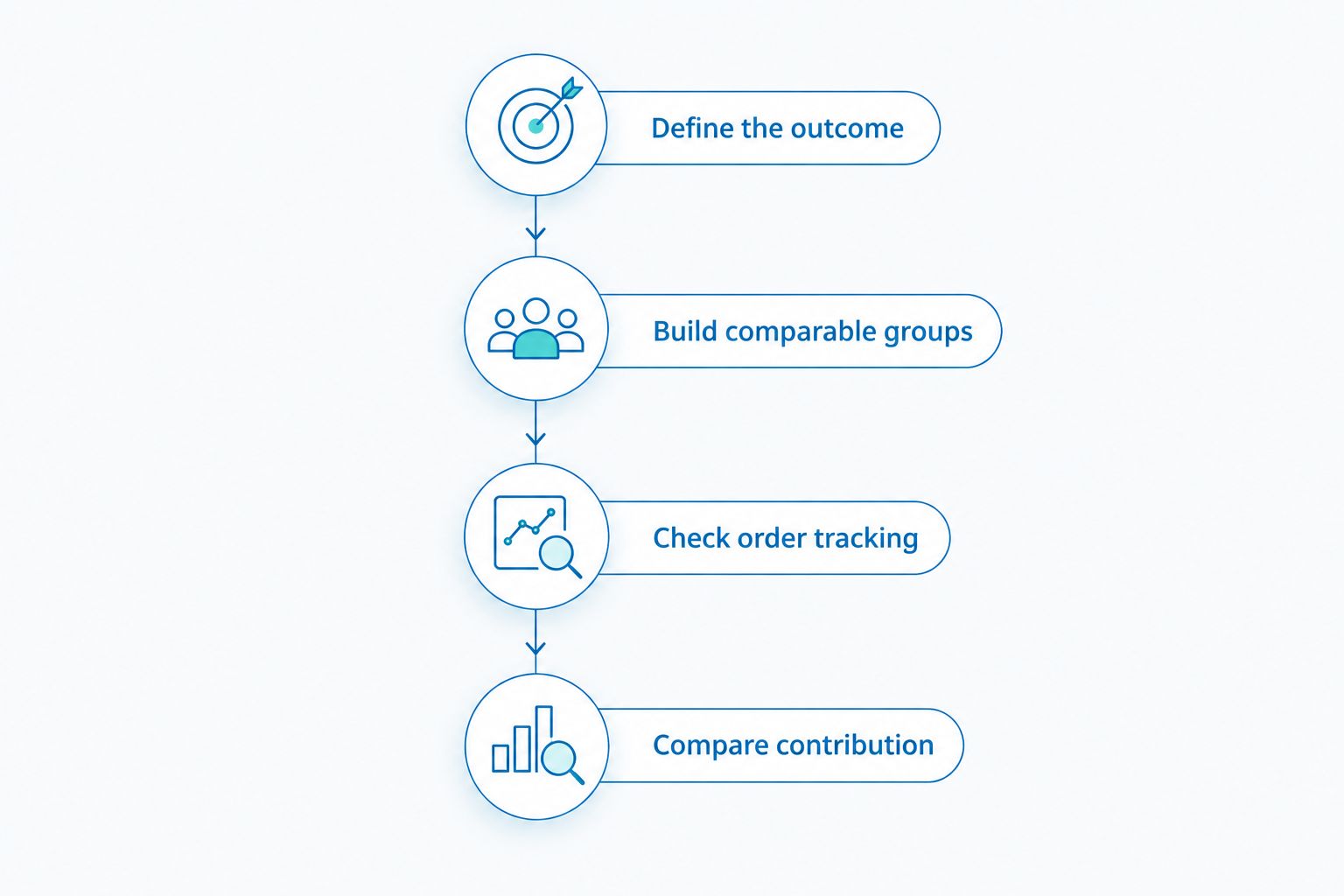
Define the outcome
Write down the decision before launching. For example, decide whether a consented recovery message produces additional completed orders while preserving contribution margin and keeping customer complaints acceptable.
Choose a purchase observation period that fits your customers' buying process. Apply the same period to both groups, and do not shorten it because an early result looks favourable.
Build comparable groups
Randomly assign eligible customers to a message group and a holdout group where practical. Keep eligibility rules consistent, and make sure the holdout does not receive the same promotional message through another route.
A marketing holdout must not remove essential service. Customers should still receive required order communications and access to support. You are testing the additional marketing intervention, not whether withholding help harms sales.
Check order tracking
Connect your campaign records with completed orders using appropriate identifiers and privacy controls. Deduplicate purchases so the same order does not become separate revenue in WhatsApp, email and advertising reports.
Tagged links help identify visits, but they do not establish causation. Customers can switch devices, return directly or purchase after several channel interactions.
Compare contribution
Compare purchase rates between the groups, then examine the contribution from any additional orders. Account for returns, cancellations, fulfilment, messaging tools and staff effort where those costs apply.
If the result is inconclusive, report it as inconclusive. Do not turn a small difference into a confident sales claim without assessing whether the test supports that conclusion.
What should your WhatsApp sales report include?
Your 2026 dashboard should separate message activity from business outcomes. Keep the operational measures, but do not let them stand in for revenue or profit.
| Measure | What it tells you | What it does not prove |
|---|---|---|
| Delivered messages | Whether messages reached recipients | Customer interest or purchase intent |
| Replies | Whether customers started a conversation | Whether the conversation produced an order |
| Completed orders | Whether purchases were recorded | Whether WhatsApp caused those purchases |
| Incremental purchase rate | Difference between comparable test groups | Profitability without cost analysis |
| Contribution after campaign costs | Commercial value after relevant costs | Whether results will repeat in another audience |
| Opt-outs and complaints | Whether recipients reject the communication | The reason for rejection without investigation |
Use consistent definitions across reports. Specify whether revenue includes cancelled orders and how returns are handled, then apply those rules to every channel.
Review conversation quality as well. A rise in replies about confusing delivery information is a website improvement task, not automatically a successful engagement campaign.
What consent do South African stores need?
South Africa's Protection of Personal Information Act regulates direct marketing through electronic communications. Section 69 addresses consent and a limited existing-customer exception; being a past customer does not remove every restriction.
Separate service communications from marketing. A delivery update and a promotional campaign have different purposes, so do not treat permission for one as permission for the other. Provide an effective way to object or unsubscribe and honour that choice.
Keep a record of how permission was obtained, what it covered and when it was withdrawn. Confirm your implementation against current Information Regulator guidance and WhatsApp business messaging requirements before launching your 2026 campaign; obtain legal advice for your specific circumstances.
Is WhatsApp better than email for e-commerce sales?
WhatsApp is best for conversations that need a reply; email is best for messages customers can browse without a live exchange. Neither channel wins every purchase journey, and neither should receive credit merely because it appeared closest to checkout.
Use email for content that benefits from more space, and use WhatsApp where customer assistance has a clear role. Coordinate exclusions so customers do not receive overlapping reminders for an order they have already completed.
Compare the channels using equivalent audiences and completed purchases. Comparing WhatsApp replies with email opens does not answer which channel generates more profitable orders.
Can WhatsApp replace e-commerce advertising?
WhatsApp does not replace customer acquisition. Messaging an existing permitted audience and reaching people who have not discovered your store are different jobs.
Use search, social content and paid media to support discovery where they fit your strategy. Offer a conversation when it helps the customer decide, but do not force shoppers into chat when they are ready to check out independently.
When should you bring in an agency?
ReachDigital is best for e-commerce businesses seeking agency support across paid media, content and SEO. Those services fit brands that need acquisition activity and their shopping journey planned together, rather than managed as unrelated tasks.
The limitation is scope: the broader agency offering does not by itself establish which WhatsApp integrations, support operations or compliance tasks are included. Ask ReachDigital to define those responsibilities before agreeing to a campaign.
A useful brief gives ReachDigital your purchase obstacle, eligible audience, consent process and measurement requirements. Require a clear owner for customer replies and access to the order-level evidence behind reported results.
FAQ
Can WhatsApp marketing increase e-commerce sales for a small store?
Yes—WhatsApp marketing can increase e-commerce sales when it resolves a genuine purchase obstacle for an eligible customer. Start with a focused test and measure additional completed orders rather than assuming every post-message purchase was caused by the campaign.
What’s the best WhatsApp campaign to start with?
The best starting campaign addresses a documented customer need, such as unanswered product questions or an interrupted checkout. Choose a use case your team can support and your tracking can evaluate.
Can I send WhatsApp promotions to everyone who has ordered?
No—a previous order does not provide unrestricted permission for WhatsApp promotions. Check the requirements of POPIA, the scope of any applicable existing-customer exception and current platform rules.
Does a high message read rate mean my campaign worked?
No—a high read rate does not prove additional sales. Evaluate completed orders, a comparable holdout group and contribution after relevant campaign costs.
Is WhatsApp better than email for abandoned carts?
Neither channel is automatically better for abandoned carts. Compare equivalent eligible audiences, completed orders and campaign costs, while preventing overlapping reminders.
Do I need automation before testing WhatsApp marketing?
No—you can test a manageable, permission-based purchase-assistance process before introducing automation. Define ownership, tracking and exclusions first so automation does not repeat a flawed process.
Should I stop WhatsApp messages after someone purchases?
Stop marketing reminders that no longer apply after a purchase. Keep legitimate service communications separate and respect the customer’s communication preferences.
One last thing
Your most useful WhatsApp finding might belong on the product page. When shoppers repeatedly ask the same purchase question, answer it where the next customer will look first.
That makes your 2026 messaging programme a source of practical store improvements as well as a sales test. Fix recurring friction before paying to handle it conversation by conversation.
Related guides
- Automatically message Shopify cart abandoners on WhatsApp
- Build an email marketing strategy for e-commerce in South Africa
- Reduce cart abandonment with email marketing
- Build a social media strategy for e-commerce in South Africa