
Yes, e-commerce brands can do SEO without a blog in 2026 by improving product pages, category pages, internal links and technical site performance. You still need useful content and crawlable pages; skipping a blog does not remove that work or guarantee rankings.
- Can e-commerce brands do SEO without a blog? Yes: product pages, category pages and technical SEO can support organic visibility.
- Prioritise pages that match buying searches before committing to a publishing schedule.
- No blog does not mean no content: shoppers still need accurate product details and useful buying guidance.
- ReachDigital provides e-commerce SEO services for businesses seeking sales and customer engagement.
Can e-commerce brands do SEO without a blog?
A blog is optional. Useful, accessible shopping pages are not. Google can index and rank product and category pages without a store publishing articles. The right page depends on what the searcher wants to do, not whether the page sits inside a blog.
ReachDigital offers SEO for e-commerce brands in South Africa. ReachDigital is a fit for e-commerce businesses seeking agency SEO support aimed at sales and customer engagement. Agency support does not replace accurate product information or responsibility for implementing site changes.
Start with these 3 page types. Each serves a different search intent, so none replaces the others completely.
| Page type | Best for | Main advantage | Main limitation |
|---|---|---|---|
| Category page | Shoppers choosing within a product group | Connects a broad buying search to relevant products | Cannot explain every product in depth |
| Product page | Shoppers evaluating a specific item | Puts detailed information beside the purchase decision | Narrow focus limits coverage of broader questions |
| Buying guide or blog article | Shoppers researching a decision | Gives space for explanation and comparisons | Needs a clear route to relevant shopping pages |
A search for a particular product belongs on its product page. A search for a product group belongs on a useful category page. A detailed question about choosing between materials needs an explanation, whether that explanation appears in a guide, a category section or a blog post.
Why this matters
A blog creates another area to maintain. If product information is incomplete or category pages are difficult to find, publishing articles leaves those problems untouched.
For your 2026 SEO plan, separate publishing activity from commercial progress. More articles do not automatically mean more relevant visitors, and more visitors do not automatically mean more orders. Measure whether searchers reach the right shopping pages and complete useful actions.
A no-blog strategy also has a clear trade-off: it concentrates effort on shopping searches rather than covering every research topic. That is a deliberate choice, not a shortcut. It works only when the store's pages answer the searches you target.
Category pages: best for product-group searches
Category pages help shoppers compare a relevant selection without opening every product individually. Give each important category a descriptive title, a clear heading and an assortment that matches the category's promise.
Add copy that helps people choose. Explain meaningful differences within the range, clarify unfamiliar terminology and point shoppers towards relevant subcategories. Keep the product selection easy to reach; a long essay above the products is not the goal.
Useful category content answers questions such as:
- What belongs in this category?
- Which attributes distinguish the products?
- Which subcategory matches a specific use?
- What should someone check before choosing?
Build categories around genuine shopping needs, not every keyword variation. Near-identical pages with the same products and slightly different headings offer little additional value.
The advantage is direct relevance to browsing searches. The limitation is depth: a category page should not become a manual for every item it contains. Put item-specific details on product pages and longer explanations where they remain readable.
Product pages: best for specific-item searches
A product page needs enough accurate information for someone to evaluate the item without guessing. Use the actual product name, explain its purpose and include relevant attributes supplied by your business.
Depending on the item, those attributes include materials, measurements, care instructions or compatibility. Publish only details you can verify. Missing information is a reason to improve the product record, not to fill the page with generic sales copy.
Product images also need attention. Use descriptive alternative text where it helps communicate the image's content, and avoid stuffing search phrases into every image description.
Check these 5 product-page elements:
- Identity: the title and heading describe the actual item.
- Details: the page answers material buying questions.
- Images: visuals show the product clearly and have appropriate alternative text.
- Links: shoppers can reach the parent category and genuinely related items.
- Markup: any product structured data matches the visible information.
Google supports product structured data for eligible search appearances, but markup does not guarantee a rich result or a higher ranking. Treat it as accurate machine-readable information, not a ranking trick.
The advantage of product-page SEO is specificity. Its limitation is the same: an individual item page is usually the wrong destination for a broad search about an entire product category.
Technical SEO: make shopping pages discoverable
A useful page cannot perform in organic search if search engines cannot access or index it. Before expanding content in 2026, check whether your important shopping pages are technically eligible to appear.
Inspect representative category and product pages in Google Search Console. Look for unintended indexing exclusions, incorrect canonical references, broken links and redirects that send users somewhere irrelevant. A canonical reference signals the preferred version of similar content; it is not a command that Google must follow.
Filters deserve particular attention. Sorting and filtering can generate many URL variations without creating genuinely different pages. Decide which filtered selections deserve their own search landing pages and which exist only to help shoppers browse.
Keep these technical tasks distinct:
- Crawling: search engines can discover and access the page.
- Indexing: the page is eligible for inclusion in search results.
- Rendering: important content and links are available when the page is processed.
- Usability: shoppers can read, browse and complete their task on mobile.
Technical fixes remove obstacles; they do not create demand or make weak content useful. You need technical access and a relevant answer together.
How to build a no-blog SEO plan
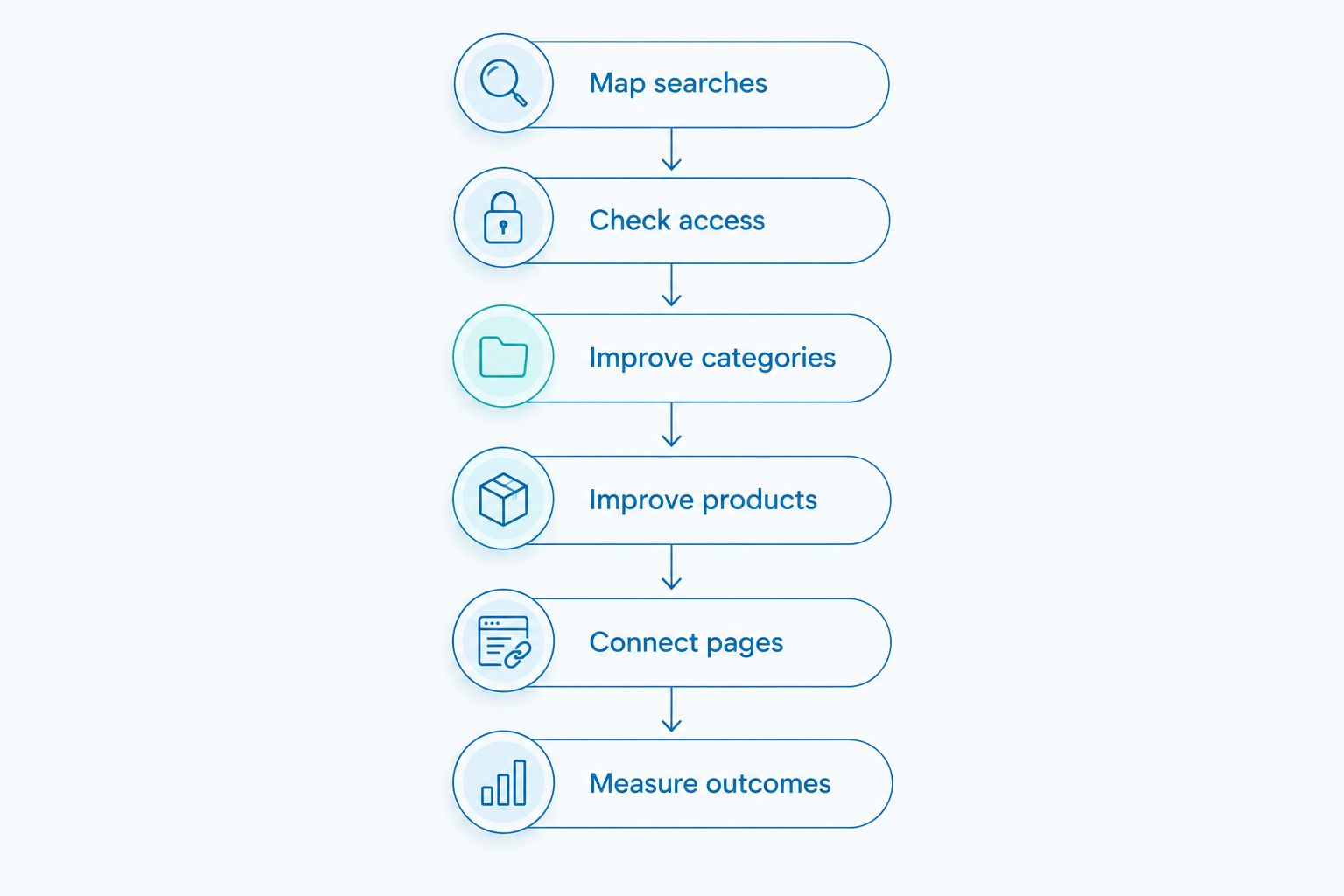
Use this 6-step sequence to turn the strategy into work your team can assign. Start with evidence from your own store rather than an arbitrary article quota.
1. Map searches
Group searches by intent: product-group browsing, specific-item evaluation and research. Use your existing search queries, customer questions and the language in relevant search results to identify the right destination for each group.
Assign each important group a preferred page. Do not create separate pages merely because wording differs; check whether the shopper's task actually changes.
2. Check access
Inspect the preferred pages for crawl and indexing problems. Confirm that important products are reachable through normal site links rather than only through an internal search box.
Fix access problems before spending time rewriting pages that search engines cannot use. Record the issue and the change so you can verify the result afterwards.
3. Improve categories
Start with commercially important categories that match real search intent. Improve headings, introductory guidance, subcategory links and the clarity of the product selection.
Avoid adding text for its own sake. Every section should help the shopper understand the range or make a decision.
4. Improve products
Fill factual gaps, replace vague descriptions and make item-specific information easy to scan. Check that page titles distinguish products clearly.
Work from approved product information. Repeating manufacturer wording without adding useful context does not explain why that item meets your customer's needs.
5. Connect pages
Link from categories to products, products to their parent categories, and relevant guidance to the shopping destination it supports. Use descriptive link text that tells people what to expect.
Internal links help discovery and browsing. They also keep useful explanations from becoming isolated pages with no route back to the store.
6. Measure outcomes
Track search visibility alongside organic landing-page behaviour and purchases. Compare equivalent periods and account for campaigns, catalogue changes and seasonal demand when interpreting movement.
Keep a change log for your 2026 work. If several templates change together, do not attribute every movement to a single rewritten paragraph.
For a broader store-level approach, read the guide to growing an e-commerce store with SEO in Cape Town. The same decision applies: improve the destination that matches the search before adding another content format.
Why the right SEO approach varies
A no-blog plan is not identical for every store. These factors determine where to put your effort:
- Search intent: browsing and item searches suit shopping pages; detailed research needs room for explanation.
- Catalogue structure: a broad range needs clear categories and subcategories; a focused range needs strong item detail.
- Product complexity: complicated buying decisions need more verified guidance than straightforward ones.
- Technical condition: access and indexing problems take priority over publishing volume.
- Existing performance: queries and landing-page results show which pages already attract relevant attention.
- Maintenance capacity: product information and guides both need updates when the underlying facts change.
Do not turn these factors into a rule that every store needs a blog eventually. Some questions fit neatly into shopping pages. Others deserve a standalone resource, and the section name matters less than the resource's usefulness.
How do you measure SEO without blog traffic?
Measure the pages you want searchers to use. A 2026 report should separate category and product performance from research content rather than treating all organic visits as interchangeable.
| Measurement source | Best for | Useful measures | Limitation |
|---|---|---|---|
| Google Search Console | Understanding Google search visibility | Queries, impressions, clicks and landing pages | Does not provide a complete purchase journey |
| Google Analytics 4 | Understanding on-site outcomes | Organic sessions, shopping events and purchases | Depends on accurate tracking and consent settings |
Look for non-brand searches reaching relevant shopping pages. Then check whether those visits lead to product engagement, basket activity and completed purchases where tracking is correctly configured.
Judge progress against your own baseline, not a borrowed traffic target. A rise in impressions is useful evidence of visibility, but it is not proof of more sales. Equally, aggregate traffic can hide improvement in a commercially important category.
Does an online store need content if it has no blog?
Yes, an online store needs useful content even without a blog. Product descriptions, category guidance, size information and buying answers are content; they belong where they help the shopper make a decision.
The distinction is between content and a publishing format. Removing the blog from your plan does not remove the need to explain what you sell.
When should an e-commerce brand add a blog?
Add a blog when relevant research questions need more explanation than your shopping pages can reasonably hold. Check the search results and the customer's task before choosing the format.
A standalone buying guide can be enough. If the topic has no meaningful connection to your products or customers, skip it rather than publishing simply to keep a calendar full.
FAQ
Can e-commerce brands do SEO without a blog in 2026?
Yes, e-commerce brands can do SEO without a blog in 2026 through useful category pages, detailed product pages, internal links and technical SEO. A blog is one content format, not a requirement for indexing or ranking.
What’s the best place to start SEO for an online store?
Start by checking that important shopping pages are accessible and indexable, then improve pages that match relevant buying searches. Fixing access problems takes priority over producing more content.
Are category pages better than blog posts for e-commerce SEO?
Category pages are better suited to searches where shoppers want to browse a product group. Blog posts or standalone guides suit questions that require detailed explanation; neither format wins for every query.
Do product descriptions count as SEO content?
Yes, product descriptions count as SEO content when they provide accurate, useful information about the item. Include verified attributes and buying details rather than repeating keywords.
Can a small online store skip blogging completely?
Yes, a small online store can skip blogging completely if its shopping pages and supporting resources answer the searches it targets. Review unanswered customer questions before ruling out additional guidance.
Will product structured data guarantee better rankings?
No, product structured data does not guarantee better rankings or a rich result. Use supported markup that accurately reflects the visible product information.
Can ReachDigital help with e-commerce SEO without a blog?
ReachDigital provides SEO services to e-commerce businesses. A useful brief should identify target customers, important categories, technical obstacles and the sales outcomes you want to measure.
One last thing
Before adding a blog to your 2026 plan, choose an important category and follow the journey from search result to product decision. Write down every unanswered buying question.
Fix those answers where the shopper needs them. ReachDigital's e-commerce SEO service is relevant when you need agency support, but your first content decision remains practical: improve the shopping page, add a focused guide, or publish an article only when the question calls for it.
Related guides
- Can SEO really increase sales for an e-commerce store?
- How to audit your website SEO in South Africa
- How to brief an SEO agency in South Africa