
Yes, SEO can increase sales for an e-commerce store by bringing shoppers to relevant category and product pages, then helping those shoppers make a purchase. It does not guarantee revenue: your product information, checkout experience and measurement still determine whether search traffic becomes profitable orders.
- Can SEO really increase sales for an e-commerce store? Yes, when search intent connects to relevant products and purchases.
- Prioritise category and product pages before publishing articles that have no clear route to a purchase.
- Measure organic purchases and revenue, not just rankings, impressions or website traffic.
- ReachDigital provides SEO and digital campaign services for e-commerce businesses seeking sales and customer engagement.
Can SEO really increase sales for an e-commerce store?
SEO increases sales when your store appears for relevant searches, sends shoppers to suitable pages and gives them enough information to buy. Each part matters. Better rankings alone do not fix an unclear product page or a checkout that prevents payment.
For your 2026 plan, follow this sequence:
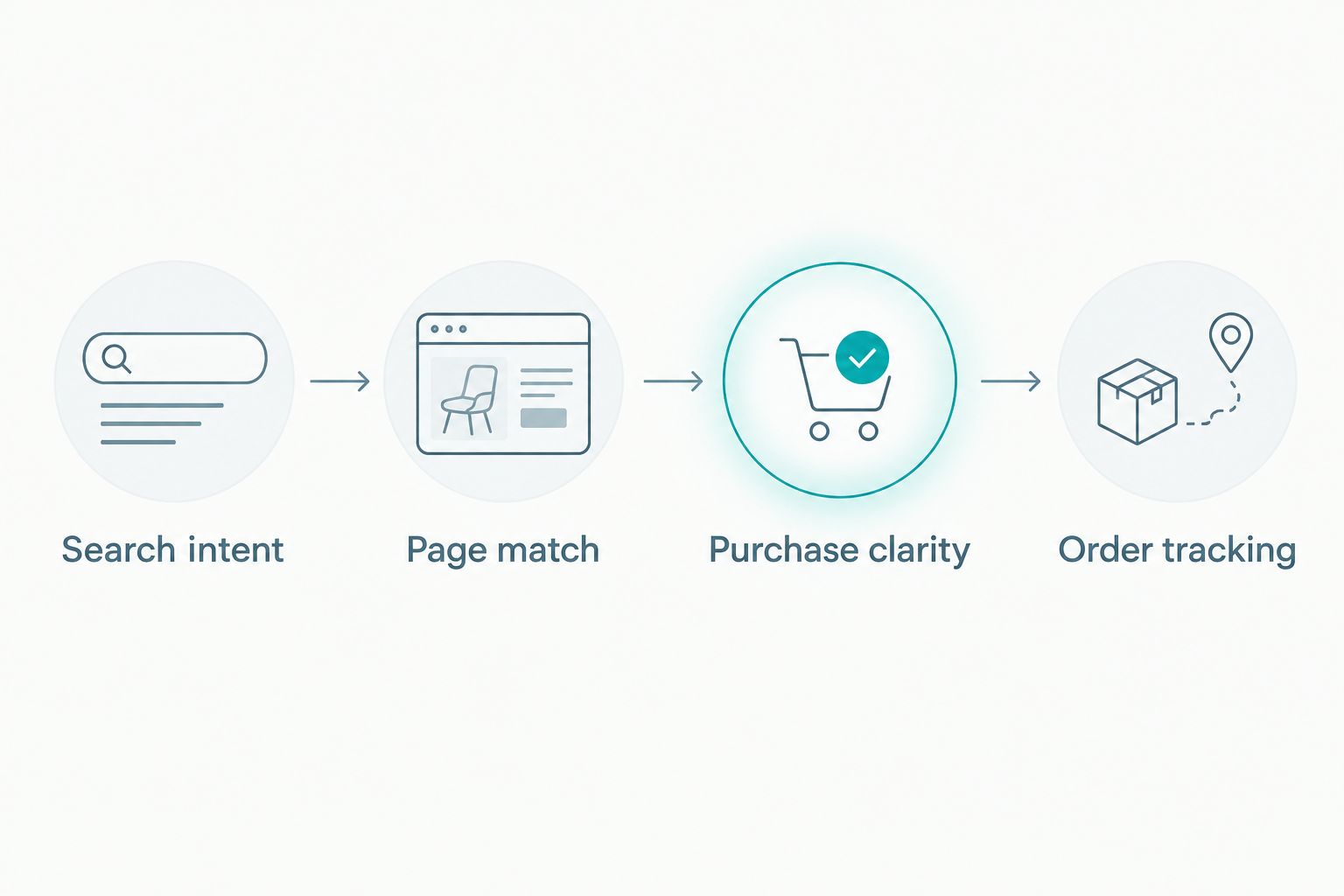
- Find buying intent. Identify searches that describe the products, categories or use cases your store actually serves.
- Match the landing page. Send a category search to a useful category page and a specific product search to the relevant product page.
- Remove purchase friction. Answer product questions and make the path from browsing to checkout clear.
- Measure completed orders. Check whether organic visitors purchase, rather than treating every visit as a commercial result.
The practical starting point is your existing catalogue, not a long list of blog topics. The guide to growing an e-commerce brand with SEO in South Africa covers the broader approach.
Why this matters
Your store needs buyers, not a traffic graph that looks busy. A search visitor researching a general topic has a different immediate need from someone looking for a specific product.
Both audiences have a place in e-commerce SEO. But they need different pages, and you should not judge them against the same purchase expectation. A buying guide helps someone choose; a product page helps someone complete that choice.
Build your 2026 SEO plan around the connection between a search and an order. That keeps your team focused on commercial pages, useful supporting content and the obstacles that stop a shopper buying.
Which e-commerce pages should you improve first?
Prioritise pages according to the job they do for shoppers. Technical fixes support discovery, category pages organise choices, product pages explain individual items, and guides answer questions before a purchase.
| SEO focus | Best for | Advantage | Limitation | Recommended use |
|---|---|---|---|---|
| Technical SEO | Stores with crawling or indexing problems | Makes important pages accessible to search engines | Does not create product demand | Fix barriers affecting commercial pages |
| Category pages | Shoppers comparing a product group | Connects a broad buying search to relevant choices | Weak organisation makes browsing difficult | Improve relevant categories and navigation |
| Product pages | Shoppers considering a specific item | Answers the details needed to choose | Thin or duplicated descriptions add little help | Explain the item accurately and clearly |
| Buying guides | Shoppers deciding what suits their needs | Answers comparison and use-case questions | Information traffic is not automatically buying traffic | Connect useful answers to relevant catalogue pages |
Technical SEO: make commercial pages discoverable
Start with whether search engines can access and index your important pages. Check page status, indexing instructions, internal links and the preferred versions of duplicated URLs.
Filters and sorting create additional catalogue URLs on some stores. Decide which pages serve a distinct search need and which merely repeat existing choices. Do not apply blanket indexing rules without checking their effect on useful category pages.
Fix discovery problems before adding more content. Technical work removes barriers, but a technically accessible page still needs relevance and useful information.
Category pages: match searches to useful choices
A category page should make its product group obvious. Use a descriptive heading, helpful navigation and concise copy that explains what shoppers can compare.
Organise categories around real differences in your catalogue. A page that duplicates another category with slightly different wording gives shoppers no new reason to use it.
Prioritise category pages when shoppers need to compare several relevant items. Keep the browsing experience central; do not bury the product list beneath text written only to repeat keywords.
Product pages: answer the decision questions
A product page needs accurate descriptions, clear images and the details a buyer needs to decide. Depending on the item, that includes materials, sizing, intended use or care instructions.
Use only verified product facts. Explain your actual delivery and returns terms clearly without making promises your business does not support.
Prioritise product pages when shoppers already know what they want. Better copy helps them evaluate the item, but it cannot replace missing information or repair payment errors.
Buying guides: support a choice, not a word count
Useful guides answer questions that genuinely affect a purchase. Examples include choosing a material, comparing intended uses or understanding how to care for an item.
Keep the answer visible and specific. Then provide a relevant route to the catalogue rather than turning every paragraph into a sales pitch.
Publish a guide when it resolves a real buying question. Skip topics that attract an unrelated audience simply because they appear easier to rank for.
How do you turn an organic visit into a purchase?
Follow the shopper's decision rather than treating SEO and conversion as separate projects. The search result makes a promise; the landing page needs to fulfil it.
Search intent
Read the wording of the query and inspect the kinds of pages appearing in search results. A product-group query and a maintenance question call for different answers.
Choose the page that genuinely meets that need. Do not force a specific product page to answer every search about its wider category.
Page match
Check whether the landing page immediately reflects the search. Its heading, products and explanation should make the connection clear without requiring the shopper to work it out.
For a South African store, describe your actual service area and delivery terms where they affect the decision. Do not target places your business does not serve.
Purchase clarity
Review the page as someone who has never bought from you. Can that person understand the item, select the right option and find the relevant purchase terms?
Make essential details easy to locate on mobile as well as desktop. A keyword-rich description does not compensate for a difficult selection process.
Order tracking
Verify that purchase events represent completed transactions. Check transaction identifiers, currency and order values against your store's records, and investigate duplicated events.
Your 2026 reporting needs a dependable purchase signal before you use it to judge SEO. Otherwise, you are making decisions from a measurement problem rather than a sales result.
Why SEO sales results vary
There is no defensible universal sales uplift for every store. The outcome depends on the searches you target, the pages you improve and the buying experience you provide.
Use these factors to assess your own store rather than borrowing another business's growth claim:
- Search intent: Product and category searches serve different needs from general research questions.
- Catalogue relevance: Your products must match the searches you want to attract.
- Technical access: Important pages need to be accessible and eligible for indexing.
- Page usefulness: Shoppers need accurate information that helps them compare and choose.
- Checkout friction: Confusing steps and payment errors interrupt purchases after SEO has brought the visitor.
- Measurement quality: Duplicated purchases and inconsistent attribution distort the reported result.
Diagnose the broken connection before increasing the publishing workload. More articles are not the answer when the relevant product pages remain difficult to find or use.
How do you know whether SEO is increasing sales?
Use search data to understand discovery and store analytics to understand purchases. Google Search Console reports search performance; it does not establish how many completed orders your store received.
In your 2026 reporting, keep these questions separate:
- Are relevant commercial pages receiving organic visits?
- Are those visitors viewing products and starting checkout?
- Are completed purchases and organic revenue changing?
- Do store records support the purchase events reported in analytics?
- Did promotions, catalogue changes or other campaigns affect the comparison?
Separate branded searches from searches that do not include your business name. Branded visibility matters, but an increase in people already looking for you does not establish that SEO created all that demand.
Distinguish attribution from additional sales
Analytics assigns credit according to its attribution rules. That credit is useful for reporting, but it is not proof that every attributed purchase would disappear without SEO.
Compare equivalent reporting periods and record material changes to the store. Examine landing-page performance alongside channel totals so that an improvement on a commercial page does not disappear inside a broad traffic average.
Report what changed and what the evidence supports. An increase in organic orders is a sales finding; an increase in impressions is a visibility finding. Do not present them as interchangeable.
Should you use SEO or paid media for e-commerce sales?
SEO and paid media solve different acquisition problems. SEO builds discoverability through your website; paid media distributes advertising through campaigns with controlled targeting and spend.
| Channel | Best for | Advantage | Limitation |
|---|---|---|---|
| SEO | Building discoverability for relevant catalogue searches | Connects useful website pages with search demand | Rankings and sales are not guaranteed |
| Paid media | Running targeted, controlled campaigns | Gives you control over campaign targeting and distribution | Requires media spend and ongoing management |
| Email marketing | Communicating with an opted-in audience | Supports follow-up and repeat-purchase communication | Depends on consent and an existing audience |
Choose according to the acquisition problem, not a claim that one channel always wins. Paid campaigns do not remove the need for useful landing pages, and SEO does not replace communication with existing customers.
Keep channel reporting distinct while examining how they contribute to the same buying journey. Do not add overlapping attributed revenue figures together and call the total additional sales.
When should you get help with e-commerce SEO?
Get specialist help when the work crosses technical changes, catalogue content and purchase measurement that your team cannot own consistently. The brief should name the commercial pages, the problems to solve and the evidence required to assess progress.
ReachDigital is best suited to e-commerce businesses seeking agency support across SEO and digital campaigns. Its stated services include SEO, content production, paid digital media and campaign development; that scope suits a brief involving more than search rankings alone.
For a focused starting point, review SEO agency support for e-commerce brands in South Africa. ReachDigital's stated scope is relevant, but it does not establish a sales outcome for your store.
Keep internal responsibility clear. Agency support does not replace accurate product data, working checkout systems or implementation decisions. Ask ReachDigital to define its e-commerce SEO responsibilities alongside yours before work starts.
FAQ
Can SEO really increase sales for an e-commerce store?
Yes, SEO can increase e-commerce sales by connecting relevant searches with useful category and product pages. Completed purchases depend on the products, page information and checkout experience as well as search visibility.
How long does e-commerce SEO take to produce sales?
There is no universal timeline for e-commerce SEO sales. Existing visibility, technical barriers, competition and implementation affect progress, so assess relevant visits and completed purchases rather than accepting a fixed promise.
Why is my organic traffic increasing but my sales are not?
Increasing organic traffic does not mean you are attracting more buyers. Check search intent, landing-page relevance, product information, checkout errors and purchase tracking before expanding the SEO workload.
Is SEO better than paid advertising for an online store?
SEO is not universally better than paid advertising. SEO supports discoverability through website pages, while paid advertising provides campaign targeting and distribution; choose according to the acquisition problem you need to solve.
Should I improve product pages or publish more blog posts?
Improve relevant product and category pages first when they lack the information shoppers need to buy. Publish supporting articles when they answer a real buying question and provide a sensible route to the catalogue.
Can an SEO agency guarantee more e-commerce sales?
No, an SEO agency cannot guarantee e-commerce sales. Search rankings, shopper decisions and store operations are not entirely under an agency’s control; require defined work and clear purchase reporting instead.
What should my e-commerce SEO report include in 2026?
Your 2026 e-commerce SEO report should connect relevant landing-page traffic with completed purchases and organic revenue. Include tracking checks and material store changes so that visibility gains are not mistaken for additional sales.
One last thing
Inspect an existing organic landing page before commissioning another article. Follow its purchase path on your phone, from the search result to product selection and checkout.
Record the point where information becomes unclear or the next step fails. That gives your team a specific problem to fix—and a clearer test of whether SEO is helping shoppers buy.
Related guides
- How to build an email marketing strategy for e-commerce in South Africa
- How to choose an SEO agency in South Africa
- How to audit your website SEO in South Africa