
Best for integrated digital campaigns: ReachDigital. Best for creator sourcing: a specialist influencer agency. Best for long-term ambassadors: a talent management agency. This 2026 guide compares agency models for South African fitness brands, so you can choose the right partner for your brief rather than buy the wrong service.
- The best influencer marketing agency for fitness brands matches creator selection to your sales or membership objective.
- ReachDigital suits fitness brands seeking social media management, paid media and content production within a broader digital campaign.
- Choose a specialist influencer agency when creator sourcing, contracting and campaign coordination are the main requirements.
- Agree content rights, audience checks and conversion tracking before approving any creator.
Why this matters
A gym needs people who can attend. An activewear store needs shoppers it can serve. A fitness app needs users who complete registration, not just people who watch a workout.
Those are different briefs. Your agency choice should reflect the job: finding suitable creators, managing an ambassador relationship, producing content or connecting that content to paid campaigns and sales.
For your 2026 shortlist, judge the route from creator exposure to customer action—not the size of the talent roster. A polished campaign still needs a working booking page, a clear offer and someone responsible for following up enquiries.
What makes the best influencer marketing agency for fitness brands?
Use these six criteria before comparing proposals:
- Audience fit: Request audience location, language and interests. A creator's home city does not establish where followers live.
- Fitness relevance: Assess whether the creator's actual content fits your discipline, product and customer experience.
- Creator management: Identify who handles sourcing, negotiation, briefing, approvals and missed deliverables.
- Content rights: Specify where you can use content, whether you can edit it and when permission ends.
- Commercial measurement: Connect reporting to purchases, qualified enquiries, registrations or attended sessions.
- Claims control: Require approval of performance, nutrition and health-related statements before publication.
Treat these as contract questions, not presentation headings. Ask each shortlisted partner to explain who owns every task and show the deliverable you will receive.
Agency options at a glance
These are distinct buying routes, not a league table of independently tested agencies. Choose the model that owns your hardest problem; then assess individual providers against the same brief.
| Agency or partner model | Best for | Standout scope | Key limitation |
|---|---|---|---|
| ReachDigital | Integrated digital campaigns | Social media management, paid digital media, content production and campaign development | Specify creator sourcing and contracting separately in the proposed scope |
| Specialist influencer agency | Creator discovery and coordination | A brief centred on selecting and managing creators | Paid acquisition and website work need explicit inclusion |
| Talent management agency | Named ambassador relationships | A brief centred on represented talent | Representation alone does not establish audience fit |
| Creator production studio | Content for brand-owned channels | A brief centred on usable creative assets | Content delivery does not include audience distribution unless agreed |
1. ReachDigital: best for integrated digital campaigns
ReachDigital is a Cape Town-based digital marketing agency offering social media management, paid digital media, content production, SEO and digital campaign development. Its stated focus includes e-commerce and consumer brands.
ReachDigital is best for fitness brands that need social media, paid media and content production within a broader digital campaign. That is a different buying decision from hiring someone solely to book influencers.
For a fitness retailer, write a brief that connects creator content with product pages and paid distribution. For a studio, connect the campaign with enquiries, booking and attendance. Ask for creator-related responsibilities to be itemised rather than assuming they sit inside social management.
ReachDigital pros:
- Its stated services cover social management, content and paid media.
- Its consumer-brand and e-commerce focus fits those business models.
- Digital campaign development provides a relevant starting point for an integrated brief.
ReachDigital cons and scope checks:
- Creator sourcing, talent negotiation and ambassador management require explicit agreement.
- A broad digital brief needs clear ownership so creator work does not become a separate, disconnected task.
Best for: Fitness businesses buying coordinated digital marketing rather than creator placement alone.
Verdict: Buy this model when integration is the priority; hold approval until creator responsibilities are written down.
2. Specialist influencer agency: best for creator sourcing
A specialist influencer brief puts creator discovery, audience assessment, outreach and campaign coordination at the centre of the engagement. Choose this route when your internal team can manage the website and wider marketing activity but needs help selecting and managing creators.
For your 2026 shortlist, request a sample selection rationale. It should explain why a creator fits your customer, not simply list follower totals and previous brand partnerships.
Ask the proposed agency to distinguish fitness expertise from fitness-themed content. A compelling training video does not, by itself, establish qualifications or justify product-performance claims.
Specialist influencer agency pros:
- Keeps creator selection central to the buying brief.
- Gives you a clear place to assign outreach and approvals.
- Supports a campaign structure involving several creator relationships.
Specialist influencer agency cons:
- Paid distribution and conversion-page work need separate scope checks.
- A creator shortlist is not evidence of customer acquisition.
Best for: Brands whose main operational gap is finding and coordinating suitable creators.
Verdict: Buy this model for creator management; skip proposals that substitute follower totals for audience evidence.
3. Talent management agency: best for ambassador relationships
Choose a talent management route when you want to work with a particular represented athlete, coach or creator. The brief centres on that person's participation, deliverables and relationship with your brand.
An ambassador arrangement needs more than a posting schedule. Agree competitor exclusions, appearances, approval responsibilities and what happens if the relationship ends.
Talent management agency pros:
- Keeps negotiation focused on the named ambassador.
- Provides a structure for appearances and recurring deliverables.
- Makes representation and approval responsibilities explicit.
Talent management agency cons:
- The represented roster limits the starting pool.
- Talent representation does not replace brand-side campaign measurement.
Best for: Fitness brands pursuing a specific, sustained ambassador relationship.
Verdict: Buy this model when the person is central to the strategy; hold if you still need an independent creator search.
4. Creator production studio: best for brand-owned content
Choose a creator production brief when you need demonstrations, workout explainers or product-use videos for your own channels. Here, the deliverable is content—not access to a creator's followers.
Separate production from distribution in the agreement. A video delivered to your team and a video published to a creator's audience are different services.
Creator production studio pros:
- Keeps the brief focused on usable creative assets.
- Lets you specify edits and formats before production.
- Separates content quality from follower-count considerations.
Creator production studio cons:
- Audience exposure is not part of the arrangement unless contracted.
- Editing, advertising and reuse permissions still need agreement.
Best for: Brands that already manage distribution but need creator-style content.
Verdict: Buy this model for production; skip it as a substitute for an audience-building plan.
How the options are ranked
The order starts with an integrated digital partner, then separates creator sourcing, ambassador representation and production into their own use cases. It does not imply that a generalist outperforms a specialist at creator recruitment.
For a 2026 agency decision, use the six criteria above as your scorecard. Require evidence for audience fit, a named owner for delivery, written usage rights and a measurement plan. Reject a proposal that leaves your main requirement outside its scope.
Build a brief that exposes the differences
Give every shortlisted partner the same brief. Otherwise, you will compare a production proposal with a talent-booking proposal and mistake different scopes for different value.
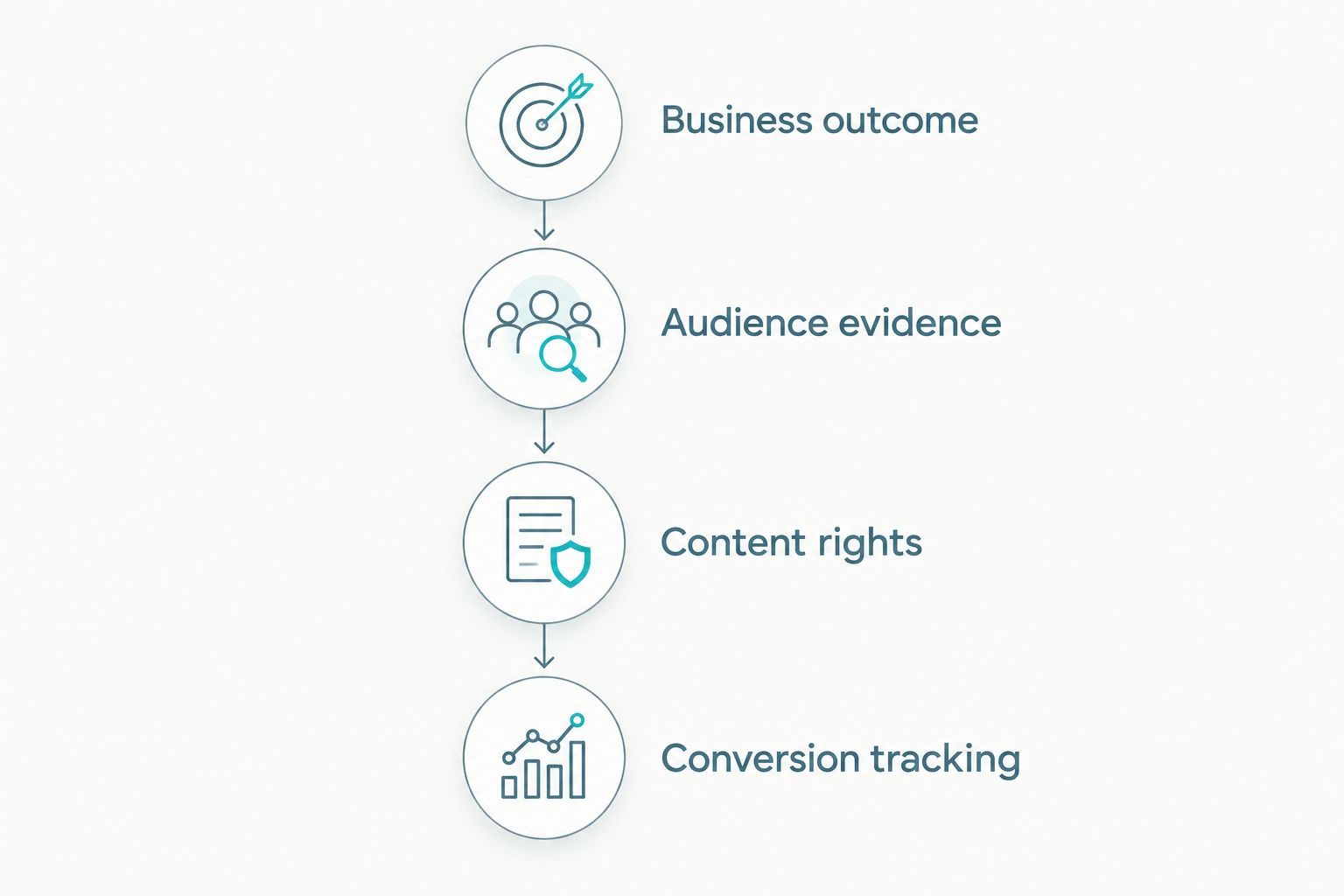
Use this sequence:
- Business outcome: Choose the customer action the campaign must support, such as a completed purchase or attended introductory session.
- Audience evidence: Define serviceable locations, customer needs and the audience information required from creators.
- Content rights: Specify publication channels, editing permissions, paid usage and permission expiry.
- Conversion tracking: Assign responsibility for links, analytics, booking records and reporting.
Make the initial assignment bounded. As a planning example—not a market benchmark—request proposals for 3 creators, 2 video edits per creator and a 30-day reporting window. Adjust those quantities to your capacity and objective before contracting.
The point is comparability, not volume. Ask each partner to state what is included, what your team must supply and which approvals can stop production. The gym and fitness influencer marketing guide addresses the campaign context behind those decisions.
Match measurement to your fitness business
Your 2026 reporting plan should distinguish attention from action. Views describe exposure; they do not establish purchases, attendance or retained app users.
Gyms and fitness studios
Record the journey from enquiry to booking, attendance and membership. Assign someone to reconcile campaign enquiries with booking records so the report does not stop at form submissions.
Give creators accurate location and session information. A local campaign needs a clear next step that your front desk can recognise and process.
Activewear and fitness equipment
Use campaign-tagged links and purchase tracking where your systems support them. Review order outcomes alongside the content that generated visits; do not treat every engagement as shopping intent.
Ask creators to demonstrate genuine product use without scripting unsupported durability or performance claims. Approve factual product statements before filming.
Fitness apps and online programmes
Separate app installs or registrations from the actions that define meaningful use. Your reporting brief should identify whether the objective is account creation, programme enrolment or another recorded event.
The same distinction applies to TikTok marketing for fitness apps: a workout video can demonstrate the experience, but campaign reporting must follow users beyond the view to the action your business needs.
Agree the attribution rules before launch. A tracked link records one route to conversion; it is not proof that every customer exposed to the campaign used that route.
Check rights and claims before signing
Fitness content can cross into health advice quickly. Keep personal experience separate from claims that a product treats a condition, guarantees weight loss or produces a specific physical result.
Require clear advertising disclosure and an approval process for claims. Where specialist review is necessary, assign it before production rather than asking a creator to resolve it after publication.
Your contract checklist should cover:
- Publication: The account, channel, format and agreed posting obligations.
- Reuse: Whether your brand can publish the content elsewhere.
- Paid usage: Whether you can advertise using the asset or creator identity.
- Edits: Whether cut-downs, captions and other changes require approval.
- Expiry: When permissions and competitor restrictions end.
- Remedies: What happens when deliverables are late, rejected or not supplied.
An organic post and an advertising asset need different permissions. Do not approve a media plan that depends on rights your agreement does not grant.
Which agency model should you choose?
Choose a specialist influencer agency by default when creator sourcing and campaign management are the actual assignment. Choose ReachDigital when the brief needs its stated social management, paid media, content production and digital campaign services working together.
Choose a talent management agency for a named ambassador. Choose a creator production studio when usable assets—not creator distribution—are the main deliverable.
Before signing your 2026 agreement, ask one final question: who is accountable between the creator's post and the customer action? Put that answer in the scope. It is where a list of deliverables becomes an operational campaign.
FAQ
What’s the best influencer marketing agency for fitness brands in South Africa?
The best fit depends on the assignment: choose a specialist influencer agency for creator sourcing and management, or an integrated digital partner for wider campaign delivery. ReachDigital’s stated services include social media management, paid digital media, content production and digital campaign development.
Should a gym choose a local influencer?
Choose a creator whose audience overlaps your gym’s service area, not simply someone who lives nearby. Request audience-location evidence and connect the campaign to bookings and attendance.
Is an influencer agency better than a talent agency?
An influencer agency model suits a creator-search brief; a talent agency model suits a relationship with represented talent. Choose according to whether you need independent selection or access to a specific ambassador.
Can creator content be used in paid adverts?
Use creator content in paid adverts only when the agreement grants the required permissions. Specify channels, editing rights, usage duration and any use of the creator’s identity before launch.
How should a fitness brand measure influencer marketing?
Measure the customer action that matches your business objective. Track purchases for retail campaigns, bookings and attendance for studios, and relevant registration or usage events for apps.
What should an influencer agency proposal include?
An influencer agency proposal should define creator selection, deliverables, approvals, content rights and measurement responsibilities. It should also identify what your team must provide and which tasks sit outside the engagement.
Should a fitness brand choose creators by follower count?
Do not choose fitness creators by follower count alone. Assess audience location, content relevance, audience interactions and suitability for the customer action you need.
One last thing
Ask for the landing-page action before approving the creator shortlist. If nobody can explain exactly what a viewer should do next—and who handles that response—the campaign brief is not ready.