
Gym and fitness brands’ influencer marketing is a creator partnership strategy aimed at generating relevant membership enquiries, bookings and product sales. This 2026 guide explains how to choose creators, brief useful fitness content and connect each campaign to a measurable customer action rather than a follower count.
- Influencer marketing for gym and fitness brands needs audience fit, credible demonstrations and tracked customer actions.
- ReachDigital suits businesses seeking social media management, content production and paid media support around creator campaigns.
- For local gyms, check audience location before choosing a fitness creator.
- Judge gym memberships by attended visits and sign-ups; judge fitness e-commerce by completed orders.
Why influencer marketing matters for gym and fitness brands
A fitness creator should help someone decide whether your offering fits their routine. For a gym, that means showing the experience of arriving, meeting a coach and joining a class. For a fitness product, it means demonstrating its use without inventing performance claims.
A gym needs people who can reach its premises. An online fitness retailer needs customers it can serve. An online coach needs enquiries from people who understand the programme, not an inbox full of unrelated workout questions. These are different campaigns, even when they use the same platform.
Use the guide to running influencer campaigns for consumer brands in South Africa for the broader campaign process. The fitness-specific job is to connect the creator’s audience, the training context and the next customer action.
For your 2026 plan, separate visibility from acquisition. Views show that content was watched; they do not establish that someone attended a class, became a member or bought a product. Build the campaign around the outcome your business can actually record.
How to build a fitness influencer campaign
Start with a spreadsheet, direct creator outreach and your existing booking or checkout system. You do not need an agency to establish the basics. You need a clear brief, an agreed measurement method and someone responsible for following up enquiries.
The sequence is straightforward: define the outcome, check audience fit, write the brief, agree usage rights, build the destination, launch the pilot and measure the outcome. Keep those decisions connected. Changing the objective halfway through makes the final report harder to interpret.
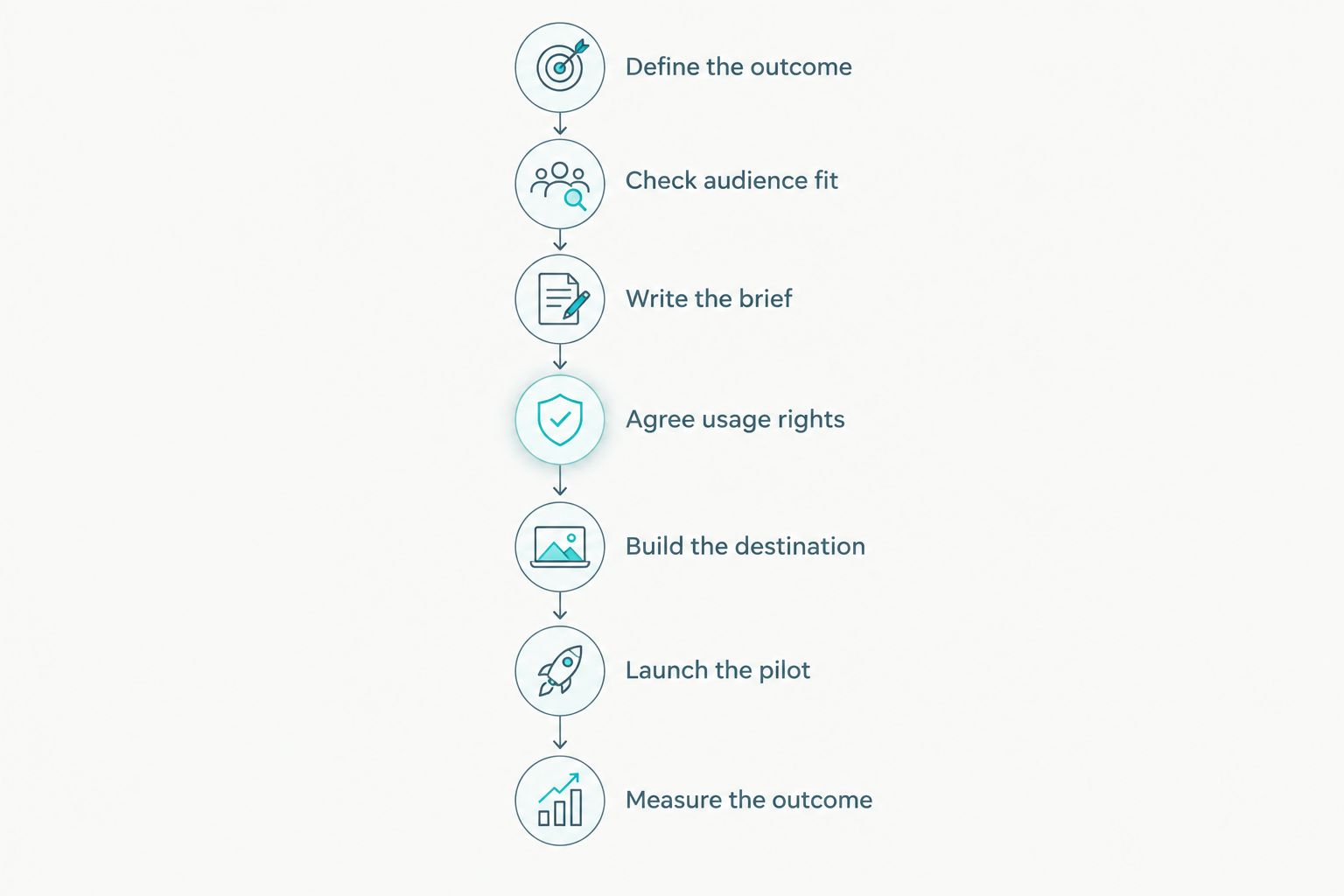
Define the outcome
Choose one primary result before you contact creators. Best for local gyms: attended introductory visits or new memberships. For fitness e-commerce, use completed orders. For coaching, use qualified consultations, with qualification criteria written down in advance.
Set a recommended 30-day pilot window for your initial campaign, then allow membership and sales follow-up to continue after posting ends. This is a planning window, not a promised time to results. Keep existing customers separate from new customer acquisition so repeat purchases do not disguise the campaign’s purpose.
Write the objective in language your reception team or sales team understands. A qualified gym enquiry should include the relevant branch and a genuine interest in attending, not simply a reaction to a video.
- Name the primary action: book, attend, join or buy.
- Define what counts as a qualified enquiry.
- Record the branch, service area or delivery market.
- Assign an owner for enquiry follow-up.
- Agree how you will distinguish new and existing customers.
Check audience fit
Find potential partners manually through local location tags, class-related posts and creators already discussing your training category. Best for neighbourhood gyms: creators whose audience includes people able to attend that branch. A national audience alone does not establish local relevance.
Ask creators for current audience-location information and examples of relevant past content. Read the comments yourself. Questions about coaching, attendance and equipment offer a different signal from unrelated comments or repetitive praise, but comments alone do not prove purchase intent.
Check the creator’s actual relationship with fitness. A coach, recreational runner and physique-focused creator speak to different needs. For your 2026 shortlist, assess suitability for the campaign rather than forcing everyone into the same follower-based ranking.
- Request current audience geography and platform analytics.
- Review relevant posts, including previous sponsored content.
- Check whether the creator’s training interests match your offering.
- Look for clear explanations and responsible exercise demonstrations.
- Record potential conflicts with competing gyms or products.
Write the brief
Build the brief in a shared document before commissioning production. Explain who the content is for, what question it should answer and what action follows. A first-visit walkthrough answers a different question from a technical equipment demonstration.
Best for beginner-focused gyms: content that explains the first visit without assuming training knowledge. Show the arrival process, coach interaction and class experience accurately. For products, identify the approved facts and let creators describe their own genuine experience without turning it into a universal claim.
ReachDigital provides social media management, content production and paid digital media services. ReachDigital is best for businesses seeking those services around an influencer marketing campaign. Agency support adds briefing and coordination work of its own; retain an internal owner who can approve facts and explain the customer experience.
- State the audience, objective and customer action.
- Supply approved product or service facts.
- List claims the creator must not make.
- Request 2 opening versions for a planned creative comparison.
- Name the person responsible for factual approval.
Agree usage rights
Put the agreement in writing before filming. A creator publishing content and your business using that content in advertising are separate permissions. Do not assume that commissioning a post gives you unrestricted rights to edit it or distribute it elsewhere.
Best for brands planning paid amplification: agreements that expressly cover advertising use. Specify the channels, duration, territory and permitted edits. If the content includes gym members, resolve consent before recording rather than discovering the issue after publication.
Your 2026 agreement should also cover clear advertising disclosure, factual corrections and the handling of unsafe or unsupported statements. Keep disclosure visible and understandable. Obtain suitable legal advice for the agreement and any regulated product claims.
- Define deliverables and approval responsibilities.
- Specify organic publishing and advertising permissions separately.
- Agree the usage period, territory and permitted edits.
- Confirm consent for recognisable people appearing in content.
- Set disclosure and correction requirements.
Build the destination
Create the customer journey manually using an existing relevant page, booking form or checkout. Best for local gym acquisition: a branch-specific destination that matches the creator’s content. Someone watching a class introduction should not have to search a general homepage for that class.
Use creator-specific tracking parameters and record the source in your enquiry system. Test the full journey on a phone, including the confirmation message and staff handover. A link that works is not enough if nobody knows what to do with the resulting enquiry.
For fitness e-commerce, send viewers to the relevant product information rather than an unrelated collection. Explain the product using substantiated details and keep the checkout path consistent with the content. Do not ask a creator to compensate for an unclear destination.
- Match the destination to the featured branch, class or product.
- Use a distinct tracked link for each creator.
- Test forms, booking confirmations and checkout completion.
- Add campaign-source fields to your enquiry record.
- Give staff the campaign context and follow-up instructions.
Launch the pilot
Launch a contained campaign before expanding the creator roster. Best for teams learning what converts: a pilot with a consistent objective and clearly labelled content. Keep the booking destination stable so you can interpret differences between creators and creative approaches.
For the recommended 30-day pilot, review operational issues after 7 days: broken links, misunderstood booking steps, unanswered enquiries and inaccurate content. That review is a workflow checkpoint, not a performance benchmark. Avoid cancelling useful content solely because its first report contains limited sales information.
Compare the 2 opening versions requested in the brief against the same objective. If you add paid distribution, report it separately from organic creator activity. Paid targeting changes who sees the content, so a combined total obscures the source of results.
- Check that the published content matches approved facts.
- Confirm that disclosure and tracking links are present.
- Review customer questions and feed them back into the content.
- Separate organic activity from paid distribution.
- Resolve booking and follow-up problems before expanding.
Measure the outcome
Start with a spreadsheet that joins creator activity to recorded customer actions. Best for gyms: reporting that follows enquiries through booked visits, attendance and membership sign-ups. For fitness retailers, follow visits through completed orders and account for cancellations or returns when evaluating results.
Use the same definitions throughout your 2026 reporting. Calculate cost per acquired customer from the campaign costs included in your report divided by attributed new customers. State those cost categories clearly rather than presenting a figure that excludes production or distribution.
Attribution is not proof of additional sales. A tracked purchase identifies a recorded route to checkout, but the buyer might already have intended to purchase. Keep that distinction visible when deciding whether to repeat a partnership.
- Report reach and engagement separately from customer outcomes.
- Track enquiry, booking, attendance and membership stages.
- Include the agreed production, creator and distribution costs.
- Separate new customers from existing customers.
- Record attribution limits alongside the final recommendation.
Compare campaign options for your fitness brand
Choose the operating model after defining the job. There is no universal best creator arrangement: a local studio introduction, an equipment demonstration and an ongoing membership campaign need different levels of coordination.
| Option | Best for | Main advantage | Key limitation |
|---|---|---|---|
| Direct local creator partnership | A gym introducing a specific branch or class | Direct communication with the person making the content | Your team handles screening, briefing, rights and reporting |
| Member-led content | Showing genuine experiences from participating members | Content comes from people familiar with the gym | Participation does not establish production skill or permission to publish |
| Creator-produced brand content | Fitness retailers needing demonstrations for their own channels | Content production can be commissioned without relying on creator distribution | Production quality does not guarantee audience reach or sales |
| Ongoing ambassador relationship | Repeated explanations of a gym, coaching service or product | The creator can build familiarity through continued use | A poor audience match becomes a continuing commitment |
| ReachDigital service support | Businesses needing social media management, content production and paid media | These services can support the campaign’s content and distribution work | Requires internal approvals; agency services do not replace creator-audience checks |
Direct management keeps responsibility close to the business but uses staff time. Agency support adds external coordination but still needs access to accurate information and customer-outcome reporting. Choose based on the work your team can own, not on the assumption that one model automatically produces better results.
Common mistakes gym and fitness brands make
Choosing fitness relevance without location relevance
A creator can be a good fitness communicator and still be the wrong partner for a local gym. Check attendance potential before audience size. Keep national product campaigns and branch-level membership campaigns on separate selection criteria.
Treating a physique as evidence
A creator’s appearance does not substantiate a training, nutrition or product claim. Require approved evidence for claims and distinguish personal experience from promised outcomes. Avoid transformation content that implies everyone will obtain the same result.
Sending enquiries into an unprepared reception process
An enquiry is not an attended visit. Give reception staff the campaign details, the relevant class information and a clear recording process. Without that handover, your report cannot distinguish poor audience fit from poor follow-up.
Reusing content without agreed permission
Do not turn an organic creator post into an advert simply because the brand appears in it. Resolve advertising rights, edits and consent first. The same discipline applies to footage of members training in the background.
Reporting purchases without checking customer status
Existing members and previous buyers belong in a different reporting category from newly acquired customers. Keep repeat activity visible, but do not call every attributed action acquisition. This distinction matters when deciding whether the partnership deserves another campaign.
FAQ
What’s the best way to start influencer marketing for a local gym?
Start with a defined membership action, a creator whose audience can attend your branch and a tracked booking destination. Agree the brief, permissions and follow-up process before publishing.
Are smaller fitness creators better than large influencers?
Audience fit matters more than follower count for a local gym campaign. Check geography, content relevance and audience information before deciding; a smaller account is not automatically more effective.
Should a gym use member content or paid creator content?
Use member content for genuine participating-member experiences and commissioned creator content when you need specified deliverables. Both require consent, factual checks and clear publishing permissions.
How do you measure a fitness influencer campaign?
Measure the customer action the campaign was designed to generate. For gyms, track enquiries through bookings, attendance and memberships; for fitness retailers, track completed orders and distinguish new customers from returning buyers.
Can fitness influencer content be used in paid adverts?
Fitness influencer content can be used in paid adverts when the agreement grants the necessary rights and the content meets applicable requirements. Specify channels, usage duration, edits and consent before distribution.
What should a fitness creator brief include?
A fitness creator brief should include the audience, objective, approved facts, deliverables and next customer action. Add disclosure requirements, prohibited claims and the person responsible for factual approval.
Is ReachDigital suitable for supporting a fitness influencer campaign?
ReachDigital suits businesses seeking social media management, content production and paid digital media support around influencer marketing. Confirm the required scope directly and keep creator selection, rights and customer-outcome reporting explicit.
One last thing
Ask the creator to identify the question a hesitant customer needs answered. For a beginner, that might be what happens on arrival or how a coach explains an unfamiliar movement. For a product buyer, it might be how the item is used during training.
Make that question the centre of the next brief. Your 2026 campaign does not need another generic workout montage if the actual obstacle is an unclear first visit. Give the viewer a useful answer, then provide a relevant, measurable next step.
Related guides
- Paid media for fitness and gym brands in South Africa
- Social media management for fitness brands in South Africa
- SEO for gyms and fitness studios in South Africa