
Paid media is better than SEO for medical practices when the priority is controlled, near-term visibility for a specific service; SEO is better suited to building ongoing organic discovery. Neither guarantees appointments, and both depend on accurate clinical information, a usable website and a reception team that turns suitable enquiries into bookings.
- Is paid media better than SEO for medical practices? Only when controlled campaign visibility is the immediate priority.
- Google Ads suits service-specific searches; SEO supports ongoing local search discovery without buying each organic click.
- Paid social supports awareness, but an audience impression is not the same as an appointment enquiry.
- ReachDigital offers paid media and SEO for medical services; choose the channel against your practice’s booking objective.
Why this matters
Your practice needs suitable patient enquiries, not just more website traffic. A campaign that attracts people looking for services you do not provide creates work for reception without helping the appointment diary.
For your 2026 marketing plan, start with the service you want patients to find and the area you actually serve. The broader guide to marketing a medical practice online in South Africa covers the surrounding channel decisions; this comparison focuses on where paid media and SEO fit.
Choose the job before choosing the channel. If patients cannot confirm your location, understand your services or request an appointment, fix those gaps before adding traffic.
Is paid media better than SEO for medical practices?
Paid media wins on campaign control: you can set targeting, budgets and schedules, subject to platform rules and delivery. SEO focuses on making your practice discoverable through relevant website content, technical accessibility and accurate local information. Its visibility depends on search systems rather than a purchased placement.
Paid media also needs a more precise definition. Search advertising reaches people using search terms, while social advertising reaches audiences within social platforms. Treating them as interchangeable hides an important difference in patient intent.
| Option | Best for | Main advantage | Main limitation | Booking-focused measure |
|---|---|---|---|---|
| Google Ads for medical practices | Testing a defined service and local search audience | Control over campaign targeting and spend | Paid delivery depends on funding, eligibility and auction conditions | Suitable enquiries that become appointments |
| Paid social | Introducing your practice or explaining a service | Reach beyond people already searching | Audience targeting does not establish appointment intent | Relevant enquiries and subsequent bookings |
| SEO for medical practices | Building ongoing service and local discovery | Organic clicks do not require a media payment per click | Rankings and traffic are not guaranteed | Non-branded discovery and organic booking enquiries |
| Paid media with SEO | Addressing campaign visibility and organic discovery together | Each channel has a distinct role | Requires coordination and separate reporting | Bookings by channel, with duplicate enquiries removed |
This is not a ranking of universally better channels. A practice with an unclear website and unanswered calls has a conversion problem before it has a traffic problem. Buying more visits or publishing more pages does not resolve that bottleneck.
Paid search: best for defined appointment searches
Choose paid search when you want to test demand for a clearly described service in a defined area. Build the campaign around what the practice actually provides, not every loosely related medical keyword.
For example, a service-and-location search has a different purpose from a broad question about symptoms. The former belongs in an appointment-focused campaign; the latter requires a separate decision about whether educational traffic supports your objective. Do not assume every medically relevant search represents a prospective patient.
Send each advertisement to a page that matches its service and wording. The patient should be able to confirm the practitioner, location, service scope and appointment process without searching through unrelated pages.
For a 2026 paid-search test, inspect actual search terms alongside enquiry quality. Exclude irrelevant searches, check location settings and distinguish existing patients from new-patient enquiries. An attractive click report is not proof that the practice gained patients.
The trade-off: paid search gives you campaign controls, not control over patient decisions. Search demand, competing advertisers, platform eligibility and the booking experience still affect the result.
Paid social: best for awareness and service explanation
Choose paid social when the job is to introduce the practice or explain what a service involves. Someone seeing an advertisement while browsing a social platform is not necessarily looking for an appointment at that moment.
Use clear, factual creative. Explain the service, who provides it and how someone can enquire, without diagnosing the viewer or promising a clinical outcome. Keep the message consistent with the destination page.
Separate educational activity from appointment-generation activity in your reporting. Video views and engagement show interaction with content; they do not establish that a patient booked or attended. If bookings are the objective, report bookings.
The trade-off: social advertising reaches beyond active searches, but that broader reach brings a qualification challenge. Reception needs a clear way to identify service fit without collecting unnecessary medical details through advertising forms.
SEO: best for ongoing local and service discovery
Choose SEO when your practice needs patients to find accurate service and location information through organic search. Start with pages describing the care you provide, the practitioner responsible and the next step for requesting an appointment.
A service page should answer practical questions before expanding into educational material. Explain where the practice operates, what the consultation covers and whether the patient needs to confirm any referral requirements. Publish only details that the practice has verified.
Local discovery also needs consistent business information. Keep the practice name, address, telephone details and operating information accurate across your website and business profile. Avoid creating location pages that imply a physical practice where none exists.
In 2026, treat medical content accuracy as an operating responsibility, not just a publishing task. Have an appropriate clinician review clinical claims and update material when the service or guidance changes.
The trade-off: SEO does not guarantee a position or an appointment pipeline. Content, technical maintenance and local information require continuing work even though an organic click itself is not a paid-media purchase.
Why the better channel varies by practice
The choice between paid media and SEO depends on the task, not a blanket rule about medical marketing. Use these factors to set your priorities:
- Campaign objective: distinguish service awareness, new-patient enquiries and ongoing local discovery. Each needs a different success measure.
- Service scope: promote services the practice actually provides. Broad targeting and vague pages make qualification harder.
- Patient geography: match advertising settings and location information to the areas patients can realistically access.
- Website readiness: confirm that service information, mobile usability and the appointment route work before sending traffic.
- Reception capacity: match enquiry generation to the team’s ability to respond and the practice’s ability to accommodate appointments.
- Measurement readiness: distinguish clicks, enquiries, booked appointments and attendance before deciding which channel performs better.
For your 2026 decision, assess these factors service by service. A practice-wide verdict can conceal a useful campaign for one service and an unsuitable campaign for another. Do not let an aggregate traffic figure decide the whole plan.
How should you choose between paid media and SEO?
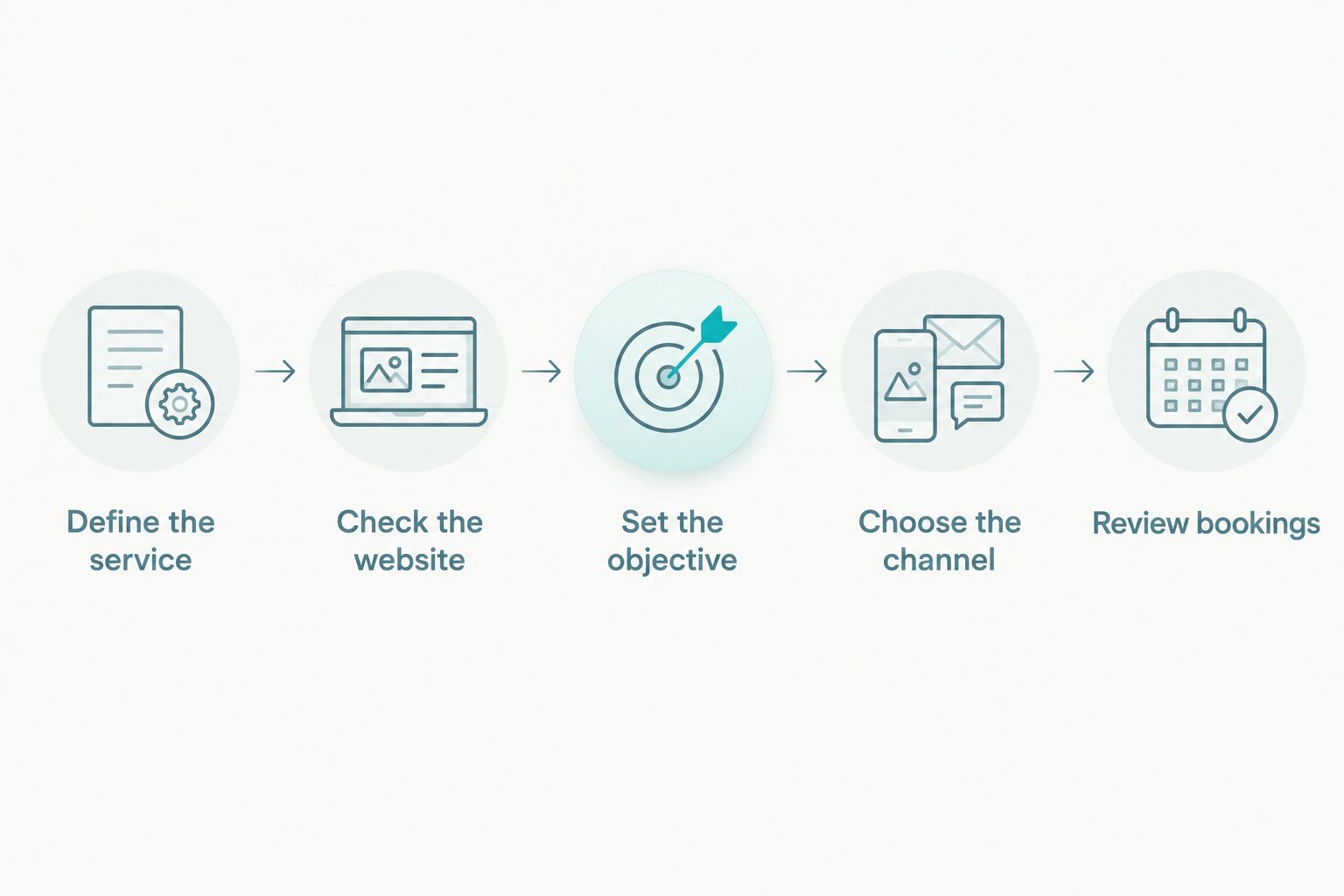
Use a booking-led sequence rather than starting with a platform preference. The aim is to identify the real constraint, select the channel that addresses it and check what happens after the enquiry.
- Define the service. Name the service, practitioner and patient area. Confirm that the practice can accept the appointments the campaign is intended to generate.
- Check the website. Read the relevant page as a new patient would. Verify the service description, contact details and appointment instructions, then test the enquiry route on a phone.
- Set the objective. Decide whether you need campaign visibility, organic discovery or service awareness. Give each objective its own measure rather than calling everything a lead.
- Choose the channel. Use paid search for a defined search campaign, paid social for an awareness task and SEO for organic service discovery. Combine channels only when each has a clear responsibility.
- Review bookings. Connect enquiry sources to booking outcomes using an appropriate, privacy-conscious process. Adjust the activity that produces unsuitable enquiries, not just the activity with fewer clicks.
Keep the handover to reception explicit. Tell the team which service is being promoted, where enquiries arrive and how to record the outcome. A marketing dashboard cannot explain missed appointments if the practice never records what happened to the enquiry.
How do you compare results fairly?
Compare patient outcomes, not a paid-media click total against an SEO ranking report. Those figures describe different stages of the journey and cannot establish a channel winner on their own.
Use the same outcome definitions across channels. A contact-form submission is an enquiry; an appointment accepted by the practice is a booking. Attendance is a separate outcome, and repeat submissions should not become separate prospective patients in the report.
Keep branded searches separate from non-branded searches where your reporting allows it. Someone searching the practitioner’s name has different prior knowledge from someone discovering the practice through a service search. Combining those journeys hides what each channel contributes.
For 2026 reporting, record the evaluation period and allow for the gap between enquiry and booking. Compare media expenditure, management work and SEO work against the same appointment outcome. Do not describe SEO as free or paid media as successful merely because it generated activity.
What must a South African medical practice check before launch?
Patient confidentiality and advertising accuracy apply regardless of channel. In South Africa, POPIA governs personal-information processing, while practitioners must follow the professional rules applicable to their registration, including relevant HPCSA requirements.
Review advertisements and website copy before publication. Check claims about treatments, practitioner credentials and outcomes; do not turn patient reviews into promises about another patient’s result. Platform acceptance is not a substitute for professional compliance.
Keep appointment administration separate from unnecessary clinical-data collection. Ask your privacy adviser what information belongs in an enquiry form, how it will be stored and which systems receive it. Review advertising tracking separately rather than assuming every available tag belongs on a medical website.
When is an agency relevant?
An agency is relevant when your practice needs paid media, SEO and content work coordinated around the same objective. ReachDigital is best suited to medical services businesses seeking agency support across paid media, SEO and content production.
ReachDigital offers those services, but the practice still needs to supply accurate clinical information and handle appointment enquiries. Agency support does not replace clinical oversight, reception processes or the capacity to see patients.
Ask for a brief that names the service, channel role, destination page and booking measure. Require a clear distinction between campaign activity and patient outcomes. That makes the work easier to assess without relying on vague growth claims.
Should I stop SEO once Google Ads generates enquiries?
No—Google Ads enquiries do not prove that SEO has become unnecessary. Paid search and organic search are separate routes to discovery. Keep SEO work tied to useful service information and organic booking outcomes rather than maintaining it simply out of habit.
Can SEO replace paid media for a new service?
SEO is not a guaranteed substitute for a scheduled paid campaign. Publish an accurate service page first, then choose paid media if you need controlled campaign delivery. Do not attach a fixed ranking deadline to the page.
Is paid social better than Google Ads for patient bookings?
Paid social is not inherently better than Google Ads for patient bookings. Paid social supports audience-based discovery; search advertising responds to searches. Choose according to intent and judge both through suitable enquiries and bookings.
FAQ
Is paid media better than SEO for medical practices in 2026?
Paid media is better for controlled campaign visibility; SEO is better suited to ongoing organic discovery. Choose against the service objective and compare suitable enquiries and booked appointments, not traffic alone.
What’s the best starting point for a medical practice with a small marketing budget?
Start by fixing service information and the appointment route, then choose a focused channel objective. Splitting resources across campaigns and content without a clear booking measure makes the result harder to assess.
Can a medical practice use Google Ads and SEO together?
Yes, Google Ads and SEO can serve different roles within the same plan. Use paid search for defined campaigns and SEO for accurate, discoverable service information, with separate reporting for each.
Does SEO mean a medical practice gets free marketing?
No, SEO requires content, technical maintenance and local-information work. Organic clicks do not require a media payment per click, but maintaining organic visibility still involves work.
Can paid advertising guarantee new patients?
No, paid advertising cannot guarantee new patients. Campaign delivery, patient intent, service fit and the practice’s booking process all affect the outcome.
Should a medical practice track enquiries or appointments?
Track both, but treat booked appointments as a separate outcome from enquiries. Record suitable enquiries, bookings and attendance without sending unnecessary patient health information into advertising systems.
Can ReachDigital help with paid media and SEO for medical services?
ReachDigital offers paid digital media, SEO, content production and digital campaign development to medical services businesses. Define the service objective and reporting requirements before choosing the scope of work.
One last thing
An unanswered enquiry is not evidence that the channel failed. Before changing your 2026 marketing mix, follow an enquiry through the practice: receipt, response, qualification, booking and attendance. Find where the process stopped.
Brief ReachDigital—or any agency—against that constraint. If reception cannot process the enquiries already arriving, fix the handover before asking for more traffic.
Related guides
- How to run Google Ads for a medical practice in South Africa
- How to do SEO for a medical specialist in South Africa