
Yes—email marketing is still effective for e-commerce brands in South Africa in 2026 when it reaches a permission-based audience with a relevant reason to buy or return. Its value comes from profitable orders and repeat purchases, not a large subscriber list or impressive open rates; it cannot fix a weak product page, difficult checkout or poor customer experience.
- Is email marketing still effective for e-commerce brands? Yes—judge it by profitable purchases, not opens.
- Welcome emails, cart reminders and post-purchase messages serve different customer needs; measure each separately.
- South African e-commerce brands need lawful contact permissions, working unsubscribe processes and accurate purchase tracking.
- ReachDigital suits e-commerce brands seeking coordinated paid media, SEO and content production rather than an isolated channel plan.
Is email marketing still effective for e-commerce brands in SA?
Email earns its place when it helps customers make a purchase they would otherwise delay or miss. Someone who requested product updates has a different relationship with your store from someone encountering an advert for the first time. Your messages should reflect that difference.
Start with a defined customer action, not a newsletter template. A practical email marketing strategy for e-commerce in SA connects the audience, message, destination and measurement before you start sending.
| Email approach | Best for | Main advantage | Main limitation |
|---|---|---|---|
| Welcome emails | Introducing your store to new subscribers | Explains what you sell and why it matters | A signup does not prove purchase intent |
| Cart reminders | Following up on an unfinished purchase where marketing is lawful | Returns shoppers to a specific buying decision | Cannot resolve every checkout objection |
| Post-purchase emails | Helping customers use a purchase and consider a relevant next order | Builds on a known customer relationship | Generic recommendations ignore what customers actually bought |
| Campaign newsletters | Sharing relevant product stories and announcements | Gives subscribers a reason to revisit | Repeated broad messages become easy to ignore |
These approaches are not interchangeable. A campaign newsletter should not interrupt an order update, and a cart reminder should stop when the shopper completes the purchase.
Why this matters
Your acquisition work gets people to the store. Email gives you a way to continue an eligible customer conversation after that visit, without treating every returning shopper as a stranger.
That does not make email independent of acquisition. A list needs relevant subscribers, and subscribers need a reason to care. Sending more often does not repair the wrong audience.
For your 2026 channel plan, separate acquisition from retention while measuring the whole buying journey. A paid advert can introduce the product, a search visit can answer a question, and an email can bring the customer back. Giving the final message all the credit hides those earlier contributions.
Welcome emails: explain the next step
Best for: new subscribers who have asked to hear from your store. A welcome message should deliver whatever the signup form promised and make the next action obvious.
Introduce the product category, answer a real buying question and point to a relevant destination. If someone subscribed while reading about a particular category, use that context where your permissions and data allow it. Do not assume every subscriber wants the same collection.
The advantage is clarity at the start of the relationship. The limitation is intent: some people want information, not an immediate purchase. Avoid treating every new signup as a customer who needs repeated sales prompts.
Cart reminders: address the unfinished decision
Best for: eligible shoppers who left a purchase unfinished. A useful cart message restores context and makes returning to checkout straightforward.
Check the destination carefully. The message should lead back to the relevant buying journey, not force the shopper to search your catalogue again. Remove people from the reminder sequence after purchase, and test that exclusion before enabling the sequence.
Cart reminders have a clear purpose, but attribution needs care. Some shoppers would return without a message. Others left because of a checkout problem that an email cannot solve. Review checkout errors and customer questions alongside the reminder results.
Post-purchase emails: help before selling again
Best for: customers who need relevant guidance after an order. Useful content includes product care, setup instructions or answers to questions the purchase creates, where those topics fit what you sell.
Keep necessary service communications distinct from promotional messaging. An order confirmation has a different purpose from an invitation to buy again; do not treat a transactional message as unrestricted permission to market.
The advantage is relevance based on an actual purchase. The limitation is poor timing or a poor recommendation. Asking someone to replace an item they have just bought makes the automation look careless, even if the design looks polished.
Campaign newsletters: give subscribers a reason to return
Best for: subscribers interested in your products, expertise or brand updates. Build each campaign around a clear reason to read and a clear next action.
Product education, styling ideas and category explanations can support a buying decision without making every message a sales announcement. Use the subjects that genuinely fit your catalogue rather than copying another retailer's calendar.
Newsletters give you editorial flexibility. They also require restraint: a broad send is easier to produce than a relevant one, but production convenience is not a customer benefit. Exclude audiences for whom the message does not make sense.
Why email marketing results vary
There is no useful universal verdict based on send volume alone. These factors determine whether your email programme deserves more attention or needs repair:
- Audience permission: document why each contact is eligible to receive the message. Do not treat possession of an address as permission.
- Message relevance: connect the content to the subscriber's interests, relationship with your store or eligible behavioural signals.
- Purchase journey: match the promise in the email to the page customers reach, then check the route through checkout.
- Delivery health: monitor bounces and complaints, process unsubscribes and configure your sending domain correctly.
- Measurement quality: use consistent campaign tagging and verified purchase events rather than relying on a platform's headline revenue figure.
- Commercial outcome: account for returns, fulfilment and campaign operation when deciding whether the resulting orders are worthwhile.
Fix the weakest dependency before increasing sends. Better subject lines do not help when the destination is broken, and cleaner tracking does not make an unwanted message relevant.
What must South African brands check before sending?
POPIA applies to electronic direct marketing in South Africa. Section 69 sets conditions for unsolicited electronic direct marketing, including consent and a limited existing-customer exception; an email address alone is not enough.
For a 2026 programme, document how contacts entered the list, what they agreed to receive and how objections are handled. Where you rely on the existing-customer exception, confirm that the circumstances meet its conditions rather than assuming every past buyer qualifies.
Make the sender identifiable and provide a functioning way to stop marketing messages. Honour those requests across imports and connected systems, not just within the campaign that generated the unsubscribe.
Get qualified advice for your collection forms, consent wording and use of customer data. A platform setting is not a substitute for checking whether your actual marketing practice is lawful.
How do you measure whether email is actually working?
Use purchase outcomes to evaluate email; use opens to diagnose, not declare success. Email privacy features and automated activity make open data an unreliable standalone measure of human attention.
For your 2026 reporting, follow the journey from the message to the store. Tag campaign links consistently, verify that purchase events fire correctly and agree how refunds or cancelled orders affect the report.
You can track email performance in Google Analytics by connecting tagged email visits with on-site actions and purchase events. That shows what happened after a tracked visit; it does not, by itself, prove the email caused an additional purchase.
Keep the distinction between attribution and incrementality clear:
- Attribution assigns credit under a reporting model. Different platforms can assign credit to the same order.
- Incrementality asks whether sending the message produced purchases beyond what would have happened without it.
- Commercial value asks whether those additional purchases justify the work and operating expense involved.
Where audience size and trading conditions support a meaningful comparison, use a randomly assigned holdout group that does not receive the marketing message. Compare purchase outcomes over the same observation window. Do not compare this month's recipients with an unrelated audience from a different trading period and call the difference an email result.
Keep campaign newsletters and automated messages separate in reporting. Their audiences and triggers differ, so combining everything into a single average hides which messages need attention.
How should you improve an existing email programme?
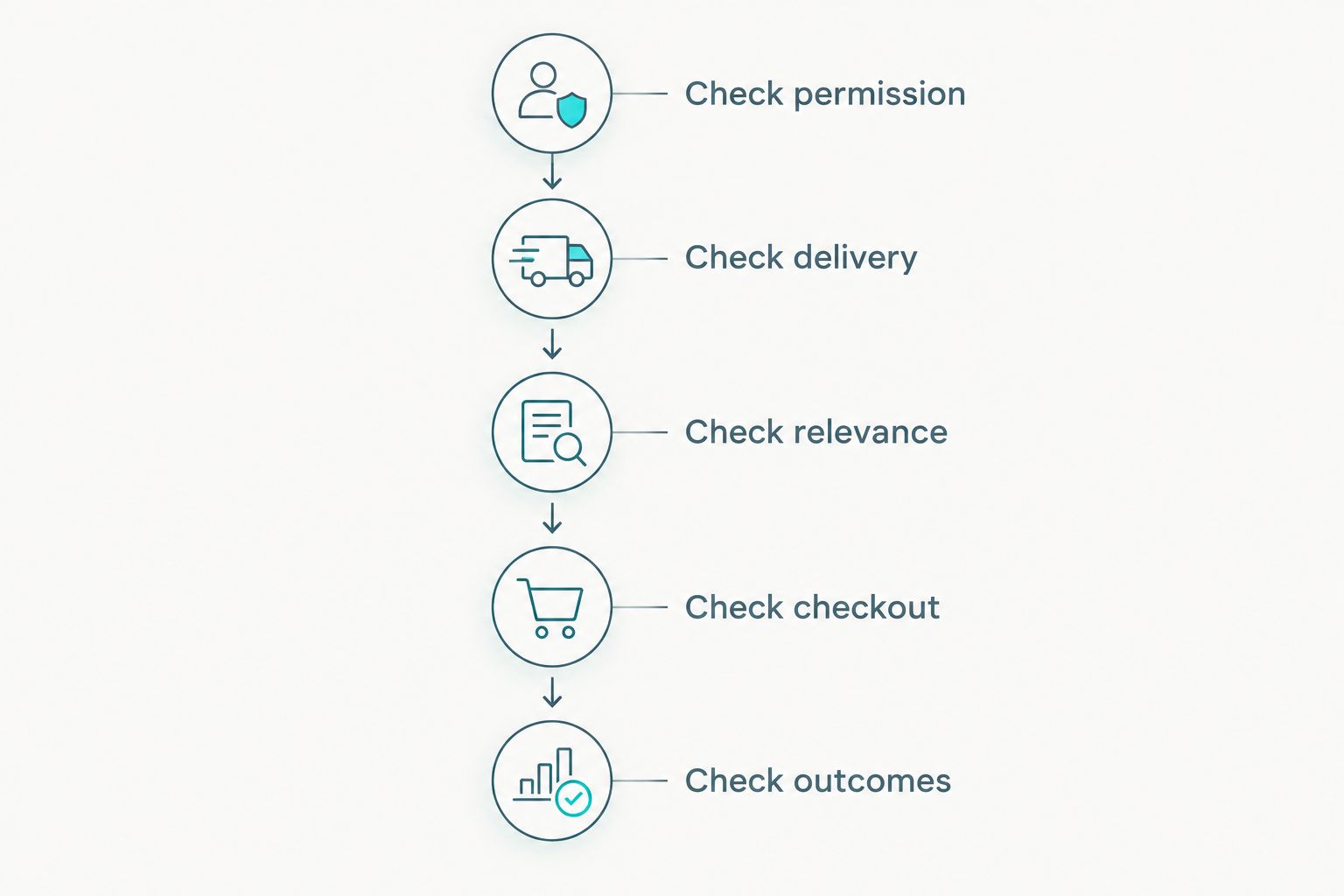
Use this sequence to diagnose the problem before changing the creative. Each stage depends on the previous stage working.
- Check permission. Review signup sources, consent records and suppression handling. Stop questionable sends while you resolve eligibility.
- Check delivery. Review authentication, rejected messages, bounces and complaints. Confirm that unsubscribe requests reach every relevant system.
- Check relevance. Read the message as the recipient: why this content, why this person, and why now?
- Check checkout. Test the link, landing page, basket and purchase confirmation on the devices your customers use.
- Check outcomes. Compare purchases and commercial results, then change a clearly defined element and record the result.
This is a diagnosis sequence, not a guaranteed timetable. Keep the problem statement specific enough that the next change can answer it.
Document what changed and leave unrelated elements alone where practical. If you change the audience, message and destination together, the result will not tell you which change mattered.
Should email replace paid media, SEO or social media?
No—email serves a different role from channels that introduce your store to new customers. Your 2026 plan should connect acquisition and follow-up rather than force a contest between them.
Use acquisition content to establish the product's relevance, then let eligible email messages continue that conversation. Keep the product explanation consistent across the advert, email and destination; conflicting claims create unnecessary uncertainty.
ReachDigital is best for e-commerce brands seeking coordinated paid media, SEO and content production. Those services fit businesses that need acquisition and content work connected to a wider campaign plan. They do not replace the need to confirm responsibility for email permissions, technical setup, sending and reporting.
When assessing ReachDigital for e-commerce marketing, define the brief before discussing delivery. State who owns customer data, who approves messages and who checks purchase tracking. Confirm the proposed email scope explicitly rather than assuming it sits inside another service.
FAQ
Is email marketing still effective for e-commerce brands in South Africa?
Yes—email marketing remains effective when relevant, lawful messages support profitable purchases and repeat business. Assess your own purchase outcomes rather than assuming a general benchmark proves success.
What is the best email campaign to start with?
Start with the customer need you can serve accurately and lawfully, such as welcoming a subscriber or helping a customer after purchase. Check the trigger, destination and exclusions before switching it on.
How often should an online store send marketing emails?
Set frequency around message relevance and audience response, not a universal schedule. Review purchases, complaints and unsubscribes before increasing sends.
Are email open rates enough to measure success?
No—open rates alone do not establish sales impact. Use verified purchase events, consistent campaign tagging and commercial outcomes alongside delivery diagnostics.
Can I email everyone who has bought from my store?
No—a past purchase does not create unrestricted marketing permission. POPIA’s existing-customer exception has conditions, so assess eligibility and respect objections before sending.
Is automated email better than a newsletter?
Automated email and newsletters address different needs. Triggers support specific customer moments, while newsletters support relevant editorial campaigns; both need monitoring and clear exclusions.
Can ReachDigital help with the wider e-commerce marketing plan?
ReachDigital offers paid digital media, SEO, content production, social media management and digital campaign development for businesses including e-commerce brands. Confirm the email-specific work and responsibilities in the proposed scope.
One last thing
Test the stop rules, not just the send rules. Complete a purchase, unsubscribe and repeat the relevant customer actions using test contacts. Check that marketing messages stop when they should.
A sequence that starts correctly but never exits correctly is not finished. Catch that before customers do.
Related guides
- How to reduce cart abandonment with email marketing in SA
- Marketing automation for e-commerce brands in South Africa
- How to run paid media for an e-commerce brand in South Africa