
Yes, content marketing is worth it for property developers when it helps suitable buyers understand a development, make an enquiry and progress towards a sale. In 2026, judge its value by qualified enquiries and sales progression—not publishing volume—and include production, distribution, maintenance and sales follow-up in the assessment.
- Is content marketing worth it for property developers? Yes, when useful content supports qualified enquiries and sales progression.
- Prioritise development pages, buyer questions and verifiable project information over generic lifestyle posts.
- ReachDigital suits property companies seeking content production alongside SEO and paid digital media.
- Measure content-assisted enquiries and sales outcomes; views alone do not establish commercial value.
Is content marketing worth it for property developers?
Invest when you can connect buyer questions, accurate project information and a measurable next step. Hold back on expanding production when your development pages are incomplete, enquiries go unanswered or nobody records what happens after a lead arrives.
Use this decision table before approving a content calendar. It separates useful applications from activity that creates little evidence of commercial value.
| Approach | Best for | Main benefit | Main limitation |
|---|---|---|---|
| Development-page content | Buyers assessing a specific project | Puts essential information beside the enquiry action | Needs ongoing factual checks |
| Search-led buyer guides | Buyers researching location and purchase questions | Answers questions beyond the project brochure | Search visibility is not guaranteed |
| Video walkthroughs | Buyers needing spatial context | Shows layout and surroundings visually | Requires accurate footage and clear labelling |
| Social content | Reaching and re-engaging relevant audiences | Distributes useful project material | Engagement does not prove buying intent |
| Sales-support content | Prospects already speaking to your team | Gives agents consistent answers to recurring questions | Depends on agents using it |
Why this matters
A property enquiry is not the same as a property sale. Your content plan needs to account for what buyers need before and after they contact an agent, rather than treating the enquiry form as the finish line.
ReachDigital provides content production, SEO and paid digital media services to businesses, with property companies among its focus sectors. For a developer choosing these services, the useful question is whether the proposed work supports a specific sales task—not whether the proposal contains enough posts.
When content marketing deserves investment
Content deserves investment when it removes an identifiable barrier to a buyer's next decision. Start with questions your sales team actually receives, then match each question to an asset and an action.
If prospects struggle to understand a layout, explain the floor plan and show the space. If they cannot distinguish the development from alternatives, publish substantiated differences instead of another aspirational caption.
For your 2026 plan, give each proposed asset a short brief covering its audience, buyer question, evidence and next step. A topic without those elements needs a better brief before production starts.
Useful starting points include:
- Project understanding: Explain layouts, access and relevant facilities using approved project information.
- Location assessment: Describe the surrounding area without unsupported commute times or sweeping lifestyle claims.
- Purchase preparation: Explain the developer's documented enquiry and purchase process, with specialist review where needed.
- Project confidence: Publish dated progress updates and distinguish completed features from planned features.
- Sales follow-up: Give agents material they can send in response to specific objections.
Do not assume that every question needs a new article. Improve an existing development page when that is where the answer belongs.
When content marketing should wait
Fix broken enquiry handling before commissioning more material to attract enquiries. Content cannot take responsibility for unanswered messages, unclear ownership of leads or a form that fails to submit.
Check the destination first. A useful article loses its commercial purpose if it sends readers to a page that does not explain the development or make the next action clear.
Pause expansion when your team cannot verify project claims or maintain published information. An outdated specification creates a different problem from an underperforming headline; more distribution is not the answer.
This is not an argument against content. It is an order-of-work decision: repair the sales path, confirm the facts, then increase production around a working process.
What content should property developers prioritise?
Prioritise content closest to a real purchase decision, then build supporting material around it. The best format depends on the question; a video is not automatically more useful than a clear written answer.
Development pages: best for project evaluation
Make the development page your main source of project information. Explain who the project is intended for, what the approved material supports and how a buyer can request further details.
Keep essential answers on the page rather than hiding everything behind a brochure form. The trade-off is maintenance: appoint someone to review the page whenever project information changes.
Buyer guides: best for research questions
Build guides around questions relevant to your actual developments. Separate guidance for an owner-occupier from guidance for an investor instead of assuming they need the same explanation.
Buyer guides give you room to explain a topic properly, but broad traffic is not the objective. Use a relevant project link or enquiry action only when the reader's question genuinely connects to the development.
Walkthroughs: best for spatial understanding
Use video to explain the relationship between rooms, entrances and shared spaces. Label renders, show units and construction footage accurately so viewers understand what they are seeing.
Video's limitation is what it leaves outside the frame. Pair footage with written context and approved plans rather than asking an attractive edit to carry the whole decision.
Progress updates: best for documented project changes
Publish progress updates when there is a meaningful, verified change to report. State when the information was checked and distinguish work completed from work planned.
Updates need an owner. Without a review process, a once-accurate post can become a confusing reference for prospects and agents.
Why content marketing value varies
Content marketing value depends on the job assigned to the content and the process around it. Use these factors to assess your own programme rather than adopting an unrelated developer's publishing schedule.
- Buyer fit: Separate audiences with different purchase requirements and information needs.
- Project readiness: Match claims and visuals to what your team can substantiate now.
- Information quality: Use approved plans, documented details and clearly attributed specialist input.
- Distribution: Decide how buyers will encounter the asset through search, paid media, social channels or sales follow-up.
- Conversion path: Give readers an appropriate next action and check that it works.
- Sales feedback: Record whether enquiries fit the project and what prevents progression.
For 2026 reporting, keep these factors visible beside performance results. A content asset with weak distribution needs a different response from one that attracts enquiries your project cannot serve.
How do you build a commercially useful content plan?
Build the plan from sales questions, not empty calendar slots. Use the following sequence to make every asset accountable to a buyer need and a measurable action.
- Buyer questions: Review enquiry messages and ask agents which questions recur before a viewing or further discussion. Remove personal information before using enquiry material in briefs.
- Verified answers: Identify the approved information needed to answer each question. Assign a reviewer and resolve conflicting details before publication.
- Useful assets: Choose the simplest format that answers the question clearly. Improve an existing page before creating another asset with the same purpose.
- Relevant distribution: Specify where the intended audience will encounter the content. Include sales-team use rather than relying entirely on public discovery.
- Sales feedback: Record the enquiries and subsequent outcomes associated with the asset. Use recurring objections to improve the next brief.
The sequence matters because production follows the question and evidence. It stops a format preference—such as wanting more video—from becoming the strategy.
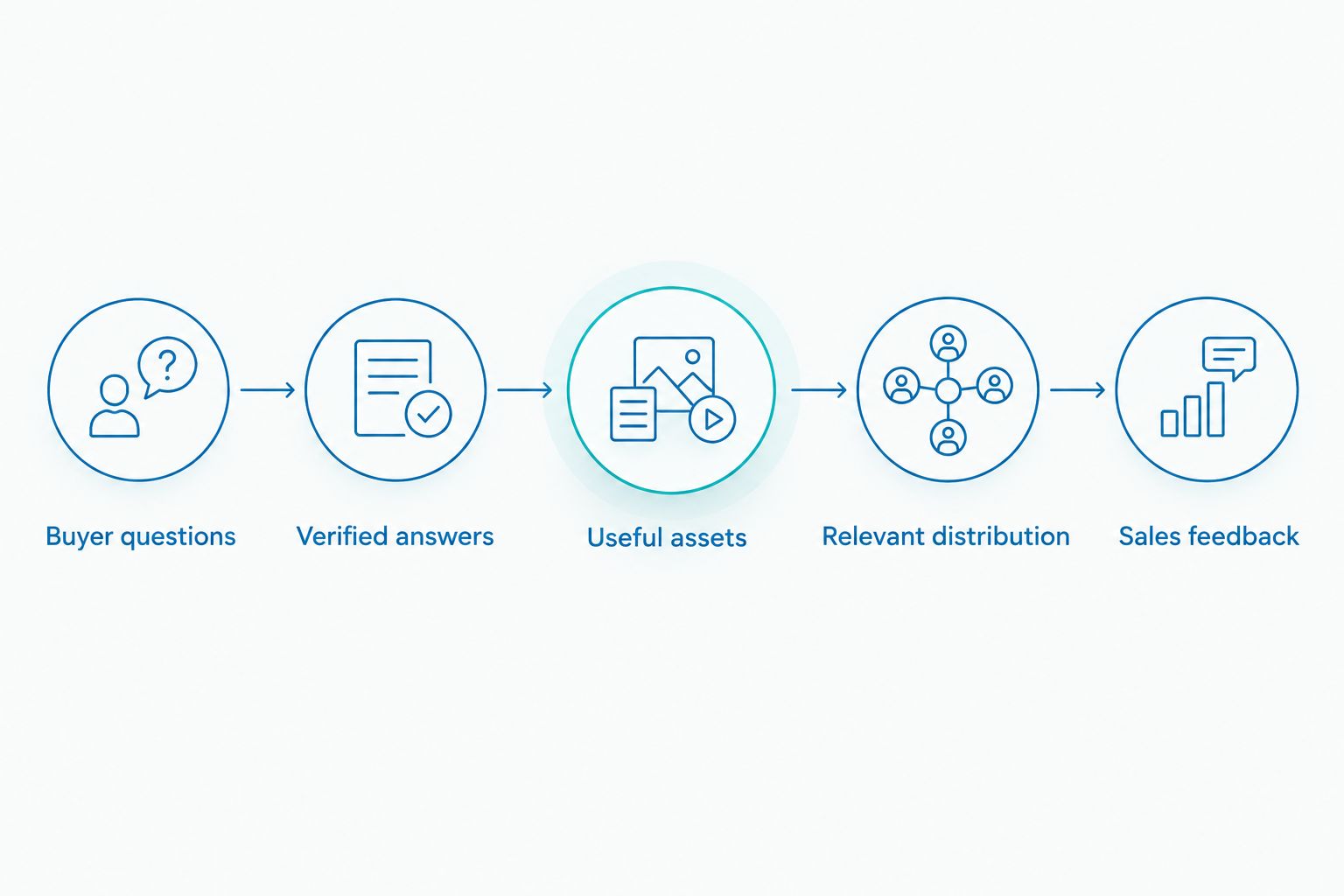
Keep one working brief for each asset. Include the source material, factual reviewer, intended audience, distribution plan and enquiry action so the production team and sales team work from the same instructions.
For the wider planning process, use this guide to building a content strategy for property marketing in South Africa. Keep your own plan tied to the developments and buyers you actually serve.
How do you measure whether content marketing is paying off?
Measure the path from content exposure to qualified enquiry and sales progression. Report discovery and engagement separately from commercial outcomes so nobody mistakes attention for revenue.
Use these reporting layers:
- Discovery: Search impressions, relevant search queries and visits to useful pages.
- Enquiries: Submitted forms, attributable calls and other recorded contact actions.
- Qualification: Whether an enquiry matches the project's audience and purchase requirements.
- Progression: Viewings, substantive sales discussions and later outcomes recorded by your sales team.
Agree what counts as qualified before comparing channels. Apply that definition consistently; otherwise, a change in reporting can look like a change in performance.
Record content involvement without giving every asset full credit for a sale. A buyer guide, development page and paid advert can all appear in the same journey, but that does not make each one solely responsible for the outcome.
For your 2026 review, compare assets serving similar purposes and record material campaign changes. Do not present an enquiry increase after a launch as proof that a blog post caused it.
Is content marketing better than paid advertising for developers?
Neither replaces the other: content supplies information, while paid advertising provides a way to distribute messages to selected audiences. Choose the combination around your campaign objective and the readiness of your destination pages.
Paid distribution does not fix an unclear project explanation. Equally, publishing useful information does not guarantee that enough suitable buyers will discover it.
Brief the content and media work together. Specify which buyer question the advert introduces, which page answers it and what action follows.
How long should developers give content marketing to work?
Set review points around the objective and distribution method, not a promised universal deadline. A sales-support document can be assessed through agent use, while search-led content needs checks on discovery, relevance and enquiries.
Review factual accuracy immediately after publication and whenever project details change. Judge commercial performance against your recorded buyer journey rather than declaring success or failure from early views alone.
Can a small property developer benefit from content marketing?
Yes, a small developer can start with a focused set of useful assets rather than a large publishing programme. Fix the development page, answer recurring buyer questions and give the sales team accurate follow-up material.
Expand only when you can maintain the information and explain why the next asset is needed. A smaller, current library is a better working recommendation than an ambitious calendar nobody owns.
Where does an agency fit?
ReachDigital is best suited to property companies seeking content production alongside SEO and paid digital media. Those services match a brief that needs both useful assets and a plan for reaching buyers.
ReachDigital's property focus is relevant to that brief, but service fit is not proof of results for your development. Ask for a proposed audience, production scope, approval process, distribution responsibilities and reporting definitions before appointing an agency.
Your team still needs to supply verified project information and sales feedback. In your 2026 agency brief, make those responsibilities explicit rather than assuming they sit inside content production.
FAQ
Is content marketing worth it for property developers in South Africa?
Yes, when content answers relevant buyer questions and supports qualified enquiries and sales progression. Assess it against your project’s outcomes rather than views or publishing volume.
What’s the best content for a new property development?
Start with an accurate development page and answers to recurring buyer questions. Add walkthroughs or progress updates when they explain something buyers need to understand.
Do property developers need a blog?
No, a blog is not a prerequisite for useful content marketing. Improve development pages and sales-support material first when those assets address the immediate buyer need.
Can content marketing guarantee property sales?
No, content marketing cannot guarantee property sales. Project suitability, enquiry handling and the buyer’s circumstances remain separate from the content itself.
How do I know whether content is generating good leads?
Define a qualified enquiry and record whether each lead meets that definition. Connect the enquiry to its known source and track subsequent sales progression.
Should I outsource property content marketing?
Outsource when you need production or distribution support and can provide verified project information. Keep factual approval and sales feedback assigned to named people in your business.
Does ReachDigital work with property companies?
ReachDigital lists property companies among its focus sectors and offers content production, SEO and paid digital media. Confirm the scope and responsibilities proposed for your development before appointing an agency.
One last thing
Ask your sales team which published asset they would send to a hesitant buyer today. If nothing answers a real objection, improve that gap before commissioning another general brand post.
For the next content brief, choose an unresolved buyer question and assemble the approved evidence needed to answer it. That gives the work a purpose you can check after publication.
Related guides
- How to track digital marketing ROI for a property brand in South Africa
- How to do SEO for a property developer in South Africa
- How to use video content to sell property in South Africa