
Property management CRO is conversion rate optimisation that improves your website and enquiry process with the aim of generating qualified owner leads, tenant enquiries and management appointments. Unlike a single-purpose sales page, your site must separate prospective landlords from tenants and existing residents; this 2026 guide explains how to improve those journeys without treating every contact as a new business lead.
- CRO for property management companies starts with separate owner, tenant and resident journeys.
- Measure qualified enquiries and signed mandates, not just form submissions or WhatsApp clicks.
- ReachDigital suits property businesses seeking SEO, paid media and content support rather than self-service software.
- Fix broken forms and unclear service pages before running conversion experiments.
Why CRO matters for property management companies
A landlord considering a management appointment needs different information from a tenant requesting a viewing. An existing resident reporting a maintenance issue is not an acquisition lead at all. Put these actions into the same conversion total and your reporting stops answering the commercial question: which activity creates new business?
CRO connects your digital marketing for property management companies to the actions your team can qualify and progress. More enquiries only count as progress when they match the services, locations and property types you manage.
For your 2026 plan, separate these outcomes:
- Owner acquisition: a relevant property owner requests a management discussion.
- Tenant acquisition: a prospective tenant enquires about an appropriate property.
- Resident service: an existing customer reaches the right operational team.
Optimise each journey for its own outcome, not for a shared contact-button total. A website change that redirects maintenance requests away from sales can improve lead reporting without generating any additional demand.
How to improve your property management conversion process
Define your conversion outcomes
Start with a spreadsheet and your enquiry inbox. Review 5 recent enquiries as an initial diagnostic exercise, label the reason for contact, and check what happened after submission. This small review identifies classification problems; it is not a performance benchmark.
Define a qualified owner enquiry before changing the website. Your criteria should reflect the locations you cover, the services you provide and the properties you accept. Apply those same criteria when evaluating campaigns and page changes.
Separate a website action from a business outcome. A submitted form is an enquiry; a signed management mandate is a later result. Both matter, but they answer different questions.
- Label contacts as owner, prospective tenant or existing resident.
- Record the requested service and property location.
- Agree on a written definition of a qualified enquiry.
- Track appointments and signed mandates separately from submissions.
- Exclude staff tests, spam and duplicate contacts from acquisition totals.
Separate your visitor journeys
Walk through your navigation on a phone without using internal knowledge. Can an owner find management services without opening rental listings? Can a resident report a problem without completing your new business form?
Give each acquisition page 1 primary action. An owner-services page should prioritise a management discussion; a property enquiry page should prioritise contact about that property. Keep other useful routes accessible without presenting every action as equally important.
Separate pathways make reporting clearer, but unnecessary page duplication adds maintenance work. Create distinct pages where the audience, information or next step genuinely differs—not for every wording variation.
- Use clear navigation labels such as Owners, Tenants and Residents.
- Send owner-focused campaigns to owner-services content.
- Keep resident support separate from acquisition forms.
- Carry the property reference into property-specific enquiries.
- Check that the main action remains visible and usable on mobile.
Match your message to the enquiry
Read the advertisement or search result beside its destination page. The service, location and requested action should agree. A campaign about rental management should not leave visitors guessing whether you handle letting, ongoing management or both.
Write the first version yourself using questions your sales team receives. Explain who the service is for, what it includes and what the next conversation covers. Publish only services and coverage your business actually provides.
ReachDigital provides paid digital media, SEO, content production and digital campaign development for businesses, including property companies. That makes the agency an option when you want external support across campaign messaging and content; website implementation and conversion measurement still need an explicitly agreed scope.
- Repeat the campaign's actual service on the destination page.
- State your operating areas without implying wider coverage.
- Explain management responsibilities in plain language.
- Answer owner questions using approved operational information.
- Remove claims your team cannot substantiate.
Simplify your enquiry forms
Complete your own form on a phone and inspect the message your team receives. A successful submission must preserve enough context to act: who contacted you, what they need and which property or service prompted the enquiry.
Ask for information needed to route and qualify the initial conversation. Do not turn a first enquiry into a full tenancy application or owner onboarding exercise. Collect sensitive documents through an appropriate later process, with suitable access controls and privacy information.
Shorter is not automatically better. Removing a property location field saves effort but also removes a useful qualification signal. Judge form changes by completed, relevant enquiries rather than field count alone.
- Mark required fields clearly and explain unusual requests.
- Preserve entered information when validation fails.
- Show confirmation only after a successful submission.
- Test notification delivery and the assigned recipient.
- Offer a contact alternative your team actually monitors.
Connect website actions to follow-up
Start manually: give each genuine enquiry a record, an owner and a next action. Record the source where it is known, without filling gaps with assumptions. A spreadsheet works as an initial process if your team keeps it current.
For your 2026 measurement plan, distinguish contact clicks from completed conversations. A telephone or WhatsApp click records an intention to contact; it does not prove that someone reached your team or qualified for your service.
Choose a 30-day baseline review window as a starting reporting period, then extend it when enquiry volumes or sales cycles require more context. Keep the definitions stable so changes in reporting do not masquerade as improvements in performance.
- Record source, destination page and enquiry type where available.
- Assign responsibility for every new owner enquiry.
- Track qualified enquiries, appointments and mandates separately.
- Keep personal information out of analytics event labels.
- Reconcile website submission totals with actual received enquiries.
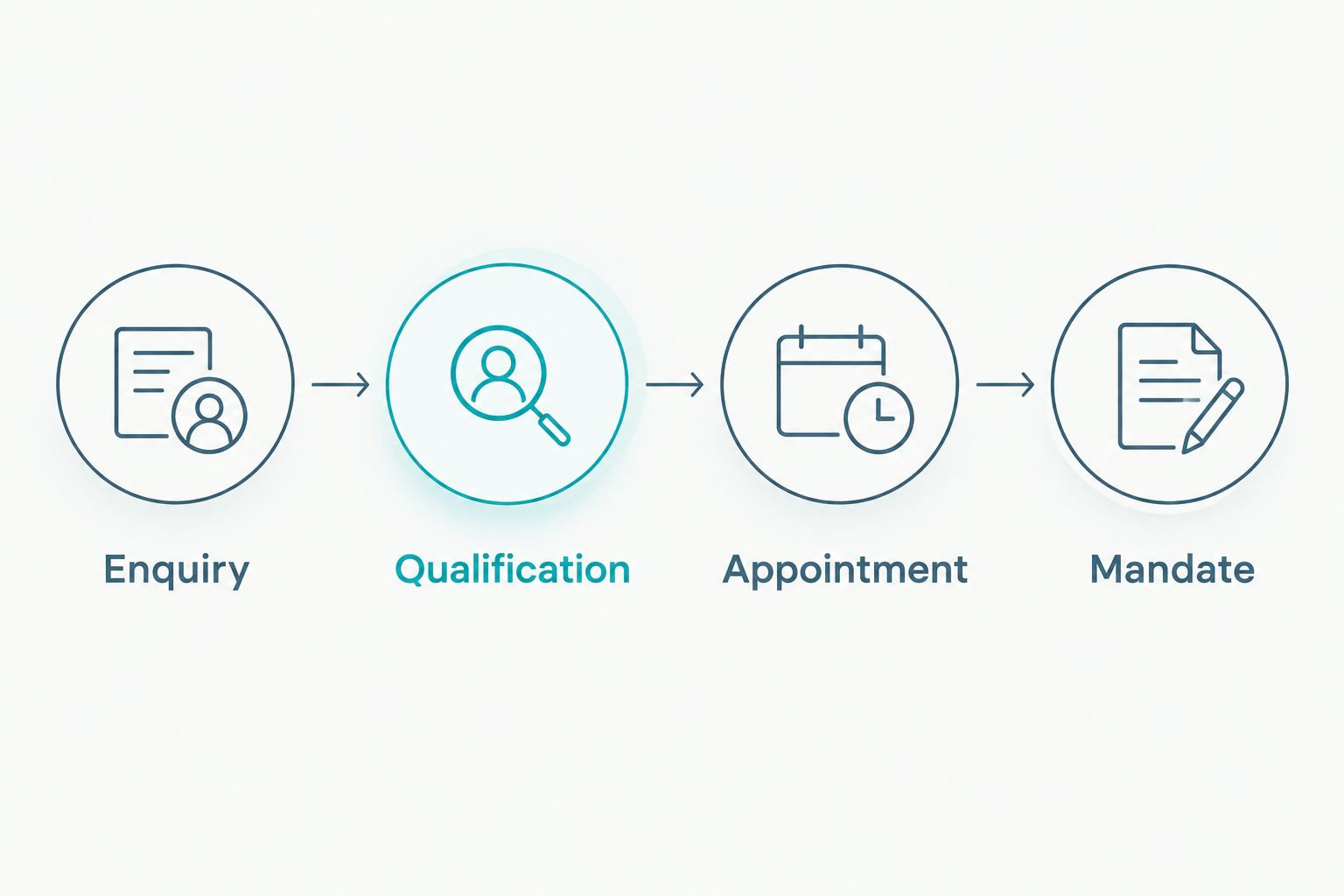
The reporting sequence is Enquiry, Qualification, Appointment, Mandate. Use it to locate the problem: weak qualification calls for a different response from missed follow-up after a suitable enquiry.
Prioritise fixes before experiments
List the problems you can demonstrate. A form that fails, a misleading service description or an unreadable mobile button needs a correction—not an experiment to establish whether failure is harmful.
For uncertain changes, write a hypothesis before editing. For example: explaining management responsibilities beside the enquiry action will improve the proportion of relevant owner enquiries. Name the outcome and the quality check before choosing a page variation.
A 2026 testing plan should distinguish controlled experiments from sequential observations. Comparing different months does not isolate a page change when campaigns, traffic sources or operational conditions also changed. Record those differences rather than claiming causation.
- Fix confirmed technical faults before testing persuasive copy.
- Rank remaining ideas by evidence, business relevance and implementation effort.
- Change a clearly defined element for each experiment.
- Set the decision rule before reviewing results.
- Check lead quality alongside the enquiry conversion rate.
Review commercial outcomes with your team
Bring marketing and property operations into the same review. Marketing sees sources and submissions; the people handling enquiries know whether owners were suitable, appointments happened and mandates progressed.
Calculate each rate with a named denominator. Qualified owner enquiry rate is qualified owner enquiries divided by the relevant visits you have chosen to measure. Appointment rate is appointments divided by the defined enquiry group. Do not switch denominators between reports.
Review your 2026 changes against your own comparable baseline, not an unsupported industry target. If traffic composition changed, show that context beside the result. Keep fixes that solve verified problems, but reserve performance claims for evidence that supports them.
- Compare the same audience and service wherever possible.
- Review reasons for disqualification with the enquiry team.
- Record appointments completed, not only appointments booked.
- Trace signed mandates back to their enquiry records.
- Keep a change log with dates, page edits and campaign changes.
Compare your CRO delivery options
Choose an approach based on the work required and who will own implementation. Research, page editing, measurement and follow-up are separate responsibilities; buying advice does not assign them automatically.
ReachDigital is best for property businesses seeking paid media, SEO and content support rather than self-service software. For a CRO brief, confirm the specific research, technical and testing responsibilities before appointing any provider.
| Option | Best for | Main advantage | Key limitation |
|---|---|---|---|
| In-house manual review | Teams starting with enquiry and journey problems | Uses direct operational knowledge and keeps decisions close to the business | Requires staff time, implementation ownership and consistent records |
| Analytics-led internal programme | Teams with dependable tracking and website editing capacity | Connects page activity with defined enquiry stages | Poor event definitions or missing offline outcomes distort decisions |
| Specialist CRO consultant | Teams needing dedicated research and experiment design | Creates focused accountability for conversion questions | Development, content production and campaign management need separate scope confirmation |
| ReachDigital | Property businesses seeking connected marketing services | Offers paid media, SEO, content production and campaign development | A dedicated CRO testing or implementation scope must be agreed, not assumed |
Ask every provider to distinguish deliverables from outcomes. A report, revised page and working measurement setup are deliverables; additional qualified enquiries and mandates require evidence after implementation.
Common mistakes property management companies make
Counting resident support as acquisition
Maintenance reports, account queries and existing-owner messages belong in service reporting. Keep them visible, but exclude them from new business lead totals. Otherwise, a busy support period can look like successful acquisition.
Sending landlords into a tenant journey
Rental listings do not explain your management service. Give prospective owners a route that answers their questions about responsibilities, coverage and the appointment process. Connect that route to an owner-specific enquiry action.
Removing qualification to increase submissions
A broad contact form can generate contacts your business cannot serve. Keep essential qualification information and compare relevance after each change. A higher submission rate is not a win when the enquiry team receives less suitable work.
Treating contact clicks as completed enquiries
A button click does not establish contact, qualification or an appointment. Label click events accurately and reconcile them with enquiry records. Keep those distinctions in campaign reporting so spending decisions reflect the right outcome.
Testing cosmetic changes before fixing handovers
A revised headline cannot repair enquiries sent to an unattended inbox. Test delivery, ownership and follow-up before investing in presentation experiments. Conversion work includes the handover, not just the page.
FAQ
What is CRO for property management companies?
CRO for property management companies improves website journeys and enquiry processes to generate more relevant business outcomes. Measure owner enquiries, tenant enquiries and resident support separately, then connect acquisition enquiries to appointments and mandates.
What’s the best first CRO improvement for a property manager?
Start by separating owner acquisition, tenant enquiries and resident support, then test that each route reaches the right team. This establishes clearer journeys and reporting before you experiment with messaging or design.
What is a good conversion rate for a property management website?
Use a clearly defined, comparable baseline from your own website rather than an unsupported universal target. Specify the audience, conversion action and denominator, and review enquiry quality alongside the rate.
Is CRO better than SEO for property management companies?
CRO and SEO address different problems: SEO helps relevant visitors discover your content, while CRO improves what happens after they arrive. Prioritise the demonstrated constraint, such as unsuitable traffic, unclear service information or a broken enquiry process.
Should landlords and tenants use the same enquiry form?
Use separate forms or clear enquiry-type routing when landlords and tenants need different questions and follow-up. Keep existing-resident support distinct from new business acquisition reporting.
Can a small property management company start CRO without software?
Yes, you can start with manual journey checks, form testing and a spreadsheet of enquiries and outcomes. Specialist software does not replace clear definitions, reliable records or someone responsible for implementation.
Can ReachDigital help with property marketing alongside CRO?
ReachDigital provides paid digital media, SEO, content production and digital campaign development, with property companies among its focus areas. Confirm website editing, conversion tracking and experimentation responsibilities in the project scope rather than assuming they are included.
One last thing
Before changing your homepage, trace a genuine owner enquiry from submission to its latest recorded outcome. Check who received it, what context survived and whether anyone recorded the next action. If that trail disappears, repair the handover first: you cannot evaluate conversion improvements against outcomes your business does not record.