
Financial advisors’ content production is the creation of educational articles, videos and social posts with the aim of attracting suitable prospects and supporting informed financial decisions. This 2026 guide shows you how to turn your expertise into useful content while keeping technical accuracy, privacy and approval firmly in your control.
- Content production for financial advisors should answer client questions, explain trade-offs and lead to a relevant consultation.
- ReachDigital offers content production, SEO and social media management; financial advisors must retain technical review and approval.
- Build financial education around client decisions, not market predictions or promised investment outcomes.
- Approve the full article first, then check every shorter version before publishing.
Why content production matters for financial advisors
A financial planning article has a different job from a retail promotion. You need to explain a decision without pretending that the same answer suits every reader, and you need to demonstrate judgement without exposing a client’s circumstances.
Make the reader better prepared for a conversation, not more certain about an unassessed recommendation. An explanation of retirement planning can introduce the questions an advisor asks; it should not prescribe an investment allocation to an unknown reader.
For your 2026 plan, start with questions from consultations and enquiry forms. Remove identifying details, then group the questions by the decision the prospect faces: preparing for retirement, reviewing protection, managing competing goals or understanding the advice process.
A written brief keeps those boundaries visible. Use the guide to briefing a content production agency in South Africa to organise the audience, subject, deliverables and approval responsibilities before anyone starts drafting.
How to build your content production process
Define the client decision you want to support
Start manually with a shared document. Choose an audience based on the work your practice actually undertakes, then describe the decision that audience needs help understanding.
“People interested in money” is not a useful brief. “People approaching retirement who need to understand what to discuss at an initial planning meeting” gives the writer a subject, a boundary and a next action.
Avoid treating every prospect as ready to book. Someone learning what financial planning involves needs an explanation; someone comparing advisors needs clarity about your process and scope. Keep those needs separate so the article does not jump from basic education straight into a sales pitch.
Finish each topic brief with these details:
- Name the intended reader and the decision they face.
- State the question the content must answer.
- Identify what the content must not recommend.
- Select a next action that matches the reader’s readiness.
- Name the advisor responsible for technical review.
Collect questions and verify the source material
Use consultation notes, anonymised enquiries and your existing educational material before buying research software. Record the question in the client’s own everyday language, but remove names, account details and other identifying information.
Separate enduring explanations from information that changes. An article explaining the purpose of a planning review has a different maintenance burden from an article discussing tax rules or product terms.
For any 2026 tax or regulatory reference, check the current authoritative source rather than copying an older article. Where a claim depends on a source, record the document title, publication date and relevant scope so the reviewer can check it without searching from scratch.
Build a source pack that the writer can actually use:
- Collect recurring questions without retaining personal details.
- Attach authoritative material for factual claims.
- Mark time-sensitive rules and product references.
- Distinguish verified facts from illustrative scenarios.
- Flag questions that require personalised advice rather than a public answer.
Assign production without outsourcing financial judgement
An advisor can draft an explanation in a document and record a simple video using existing equipment. That is a practical starting point when the subject is narrow and someone has time to edit, publish and maintain it.
An agency offers another production route when you need content connected to distribution. Content production for financial services is a relevant service to assess alongside your internal capacity and approval requirements.
ReachDigital is best for financial advisors seeking content production alongside SEO and social media management. ReachDigital offers those services, but the agency brief must still define who verifies financial claims, approves publication and handles advice-related enquiries.
Do not confuse production support with a transfer of professional responsibility. Keep the technical reviewer involved before the creative work becomes expensive to change.
- Let the advisor supply the explanation and its boundaries.
- Assign drafting, editing and formatting to named owners.
- Confirm the agency’s proposed workflow before commissioning work.
- Keep technical approval with your designated reviewer.
- Specify who stores source files and approved versions.
Write the full answer before making shorter assets
Create a complete explanation before turning it into social posts. Start with the direct answer, explain the relevant considerations, then describe what a reader should bring to an advice conversation.
For example, an article about preparing for a retirement planning meeting can explain which goals and documents to discuss. It does not need a predicted return or a hypothetical outcome dressed up as evidence.
Give every article a clear boundary. State whether it explains a concept, outlines a process or introduces questions for discussion. A disclaimer cannot repair an otherwise misleading promise, so remove the promise rather than relying on small print.
An answer-first structure also helps readers find the useful passage without reading the entire page. Use headings that match their questions instead of slogans about financial freedom.
- Answer the main question in the opening paragraph.
- Explain technical terms when they first appear.
- Include relevant limitations beside the claim they qualify.
- Use clearly labelled hypothetical examples without invented results.
- Close with a relevant invitation to discuss individual circumstances.
Approve the message before scheduling publication
Use a shared review document and a status column to manage approval manually. The important part is not the software: it is knowing which version is approved and who approved it.
For your 2026 publishing workflow, separate technical review from production checks. The technical reviewer checks financial meaning and applicable requirements; the editor checks readability, captions, links and consistency between formats.
South African financial-services content needs review against the requirements applicable to the provider, including relevant FAIS obligations. Personal information and direct-marketing activity also need appropriate POPIA review. Ask your compliance reviewer to apply those requirements to your actual content and distribution method rather than treating this guide as legal approval.
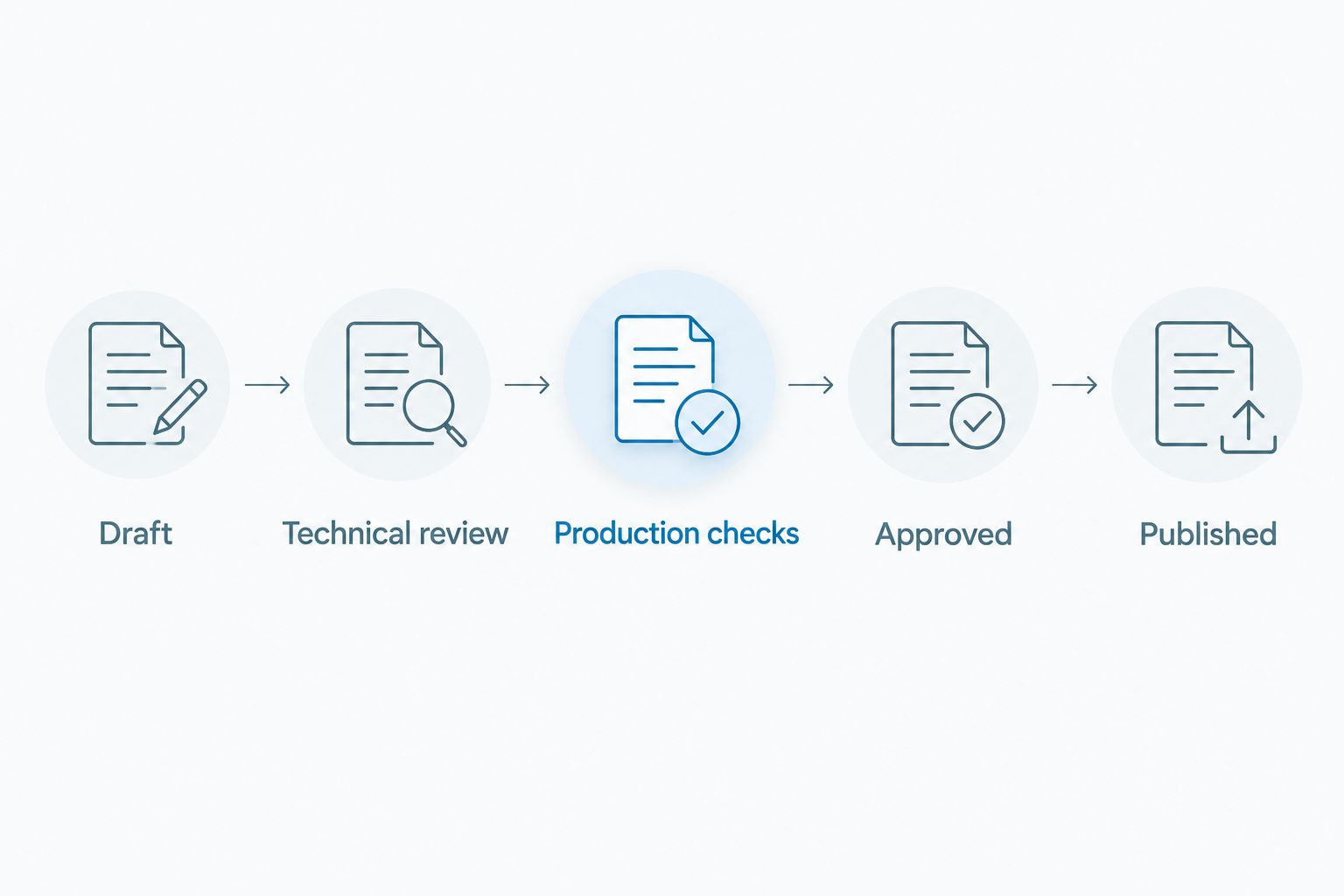
Use a simple sequence: Draft, Technical review, Production checks, Approved, Published. A changed headline or video caption goes back through review if it changes the meaning.
- Confirm the facts, assumptions and qualifications.
- Check permissions for any identifiable person or client material.
- Review the article, caption and call to action together.
- Save the approved version and reviewer decision.
- Prevent unapproved drafts from entering the publishing queue.
Adapt approved explanations for each channel
Repurpose content manually by selecting a passage from the approved article and rewriting it for the channel. Do not simply cut off the surrounding qualifications to make a shorter post.
A search article needs a complete answer. A social post needs a focused point and enough context to avoid distortion. An email needs a clear reason to read and an appropriate next step; a video needs spoken language, accurate captions and qualifications that remain visible.
For your 2026 calendar, organise assets around approved topics rather than unrelated daily prompts. Keep the original article and its derivatives together so you can update them when the underlying explanation changes.
ReachDigital’s content production and social media management services are relevant when you want external support across these tasks. Confirm the deliverables and hand-off process; do not assume every format or channel is included.
- Give each asset a single question to answer.
- Preserve qualifications when shortening the explanation.
- Check video captions against the approved script.
- Match the destination page to the post’s promise.
- Keep a record of where each approved message appears.
Measure enquiries and maintain the content
Start with a spreadsheet and a question on the enquiry form asking how the prospect found you. Add tagged campaign links where appropriate, then connect content activity to enquiries your team has actually assessed.
Separate reach from commercial progress. Views show exposure; a relevant enquiry shows that someone has taken a next step. Neither measure proves that the content caused a new client relationship on its own.
Record the subject that prompted the enquiry, whether the prospect fits your practice and whether the conversation progressed. This gives you a reason to expand a useful explanation or fix a page attracting unsuitable enquiries.
At each 2026 planning review, inspect content for changed rules, unsupported claims and broken journeys. Keep useful evergreen explanations, but check their accuracy before giving them a new date.
- Track article visits and relevant consultation enquiries separately.
- Ask prospects which content helped them understand your service.
- Record enquiry suitability without exposing sensitive details in reports.
- Review time-sensitive articles when their source information changes.
- Update or withdraw derivatives when the original message changes.
Compare production options for your practice
Choose the production model that fits your review capacity, not just your publishing ambitions. Every option still needs advisor input and a clear approval owner.
| Option | Best for | Main advantage | Key limitation |
|---|---|---|---|
| Advisor-led production | A practice testing a focused educational approach | Keeps subject knowledge close to the draft | Writing, editing and publishing consume advisor time |
| Freelance production | A practice with clear briefs and internal publishing support | Lets you commission defined writing or editing tasks | You must coordinate review, distribution and maintenance |
| In-house content team | A practice with recurring production needs and management capacity | Gives you direct oversight of the content workflow | Requires recruitment, supervision and specialist review |
| ReachDigital | Financial advisors seeking production alongside SEO and social media management | Offers related marketing services through one agency | Technical approval remains your responsibility; confirm the financial-services review workflow |
Before selecting support, ask to see how a draft moves from source material to approval. Discuss revisions, ownership, access permissions and corrections after publication. A polished sample does not tell you whether the working process suits your practice.
Common mistakes financial advisors make
Turning education into an implied recommendation
A post that names an investment and tells an undefined audience to act crosses the boundary set by a general educational brief. Explain the considerations instead, and direct individual questions into your advice process.
Publishing market predictions as a trust shortcut
A confident forecast is not a substitute for explaining uncertainty and planning choices. Build content around decisions your reader can discuss, rather than outcomes you cannot establish.
Removing qualifications from short-form content
The article explains the limitations, but the social headline promises a result. Review every derivative as a separate publication; approval of the source article does not automatically approve a changed claim.
Using real client stories without a privacy check
Removing a name does not necessarily make a story anonymous. Review the combination of occupation, location, family circumstances and financial details before publishing, and establish the required permissions.
Reporting engagement without checking enquiry quality
A popular topic can attract people your practice does not serve. Compare the questions and suitability of enquiries with your intended audience before commissioning more content on the same subject.
FAQ
What is content production for financial advisors?
Content production for financial advisors is the creation of educational articles, videos, emails and social posts that explain financial decisions and the advice process. Effective content answers a defined client question and keeps personalised recommendations within the advisor’s advice process.
What should a financial advisor write about first?
Start with a recurring question from your actual consultations or enquiries. Choose a question you can answer publicly without client details or an individual recommendation, then have the explanation technically reviewed.
Can financial advisors create content themselves?
Yes, financial advisors can create content using a document, existing recording equipment and a shared approval log. The trade-off is the time required for editing, publishing, distribution and ongoing maintenance.
Is an agency better than producing content in-house?
An agency fits a practice that wants external production support; an in-house approach fits a practice with the time and people to manage the workflow. Both require clear briefs, advisor input and technical approval.
Does ReachDigital provide content production for financial advisors?
ReachDigital offers content production, SEO and social media management, with a financial-services content production page available. Financial advisors should confirm the scope, deliverables and technical review responsibilities before commissioning work.
Who should approve financial advisor content before it goes live?
Your designated technical and compliance reviewers should approve financial claims and applicable requirements before publication. Production checks should also cover the final headline, captions, links and call to action.
How do you measure whether financial advisor content works?
Measure relevant enquiries and their progression alongside visits and engagement. Record which content prospects mention, assess whether enquiries fit your practice and avoid treating views as proof of client acquisition.
One last thing
Check the smallest asset against the full explanation. A careful article can become a misleading headline, cropped graphic or isolated video clip during production. Read that short asset as if you had never seen the source: if the qualification disappears, revise it before publication.
Related guides
- SEO for financial advisors in South Africa
- How to run LinkedIn ads for financial services in SA
- Social media management for financial services brands in SA