
Yes, paid media can work without a website redesign when your existing site gives visitors a clear, working route to enquire, book or buy. You still need to address broken forms, confusing landing pages and unreliable conversion tracking; keeping the design does not mean keeping those problems. Start with the campaign’s destination and conversion path, then commission a wider rebuild only when the evidence supports it.
- Can paid media work without a website redesign? Yes, when the landing page and conversion path work.
- Fix campaign-specific problems before replacing the whole website; a targeted landing page is a separate option.
- ReachDigital provides paid media services for businesses seeking leads, sales and customer engagement.
- Judge campaigns by qualified enquiries or completed sales, not clicks alone.
Can paid media work without a website redesign?
Yes. Choose the smallest website change that gives your campaign a usable, measurable conversion path.
| Approach | Best for | Advantage | Limitation |
|---|---|---|---|
| Existing page | A relevant, functioning destination | Keeps the current site | Retains existing restrictions |
| Targeted fixes | Isolated conversion problems | Addresses a specific obstacle | Does not resolve structural problems |
| Dedicated landing page | A focused campaign offer | Matches the advertising message | Needs maintenance and tracking |
| Website redesign | Problems across essential journeys | Changes the wider experience | Expands the project scope |
For online retail, pair this decision with the guide to running paid media for an e-commerce brand in South Africa.
Why this matters
A website redesign and a paid media campaign solve different problems. Advertising brings a selected audience to an offer; your website explains that offer and helps visitors act. Replacing the design does not automatically fix targeting, an unclear proposition or poor sales follow-up.
For your 2026 campaign plan, separate visual preferences from functional blockers. An unfashionable page with accurate information and a working enquiry process is not the same problem as a polished page with a broken form. Make the launch decision on the journey, not the screenshot.
That distinction also keeps your brief useful. Instead of asking for a better-looking website, identify what visitors cannot understand, complete or trust. You then have a problem to solve rather than an open-ended design project.
Keep the existing website when the conversion path works
Best for: businesses with relevant pages and a functioning enquiry or purchase journey. Keep the current site when it already supports the action your advertising promises. Check the actual destination, not just the homepage.
A property enquiry campaign needs information about the advertised development and a usable way to request details. A medical services campaign needs an appropriate service explanation and contact or booking route. An e-commerce campaign needs a relevant product destination and a working checkout.
The advantage is focus: you can work on the audience, advertising message and offer without changing unrelated pages. The limitation is that the existing page template still controls what you can change. If it prevents essential information or a clear action from appearing, keeping everything unchanged is the wrong choice.
Before a 2026 launch, open the destination on a phone and complete the intended action. Check that the information matches the advertisement and that the enquiry or order reaches its destination. A visible button is not proof that the process works.
Make targeted fixes when the problem is isolated
Best for: businesses whose website works but whose campaign destination has a specific obstacle. A targeted fix changes the part that blocks the action without replacing the entire website.
Examples include correcting a misleading heading, repairing a form, making a booking link visible or explaining what happens after an enquiry. These are functional changes. Treat them as such rather than bundling them into a general refresh.
The advantage is a clearly defined scope. The limitation is equally clear: a local fix cannot repair a restriction shared across the whole site. If every page uses an unsuitable template, editing an individual heading does not address that constraint.
Write the issue as a visitor task. For example: visitors cannot find how to book the advertised service. Then specify the correction and test the task again. A fix is complete when the action works, not when the page looks different.
Build a dedicated landing page when the campaign needs focus
Best for: campaigns promoting an offer that existing pages do not explain clearly. A dedicated landing page gives the campaign its own destination while leaving the rest of the website intact.
Use it when an advertisement promises something specific but the current destination covers several unrelated services or products. The landing page should explain the advertised offer, answer relevant objections and present the next action. It does not need to reproduce the entire website.
The advantage is message consistency. The limitation is that the page still needs accurate content, working forms, measurement and an owner who keeps it current. A separate page is not a way to avoid those responsibilities.
For a focused 2026 test, use 1 campaign, 1 destination and 1 primary action as a starting scope. Those are planning choices, not performance benchmarks. Keep necessary supporting information, but do not give every possible action equal prominence.
A landing page also cannot repair a broken checkout that sits elsewhere. Follow the visitor beyond the page before deciding that a campaign-specific destination solves the problem.
Redesign when essential journeys share the same problems
Best for: businesses whose site structure or technology blocks necessary changes across important pages. A redesign becomes relevant when the obstacle is broader than the campaign destination.
Examples include a page system that cannot support required information, navigation that prevents visitors from finding essential services, or purchasing problems that persist across the store. Identify the affected journeys and the underlying restriction before choosing the scope.
The advantage is the ability to change shared structures. The limitation is a wider project involving content, development, testing and measurement. Existing working features still need protection during that change.
Do not use a weak advertising result as the sole redesign brief. A campaign result reflects the audience, message, offer, destination and subsequent handling of the enquiry or sale. Show where the website blocks the journey before replacing it.
Why the answer varies between campaigns
The right decision depends on what your campaign asks visitors to do and what the current site supports. Use these factors to assess the destination:
- Business goal: A purchase, booking and initial enquiry require different completion paths. Test the action that matters to your business.
- Offer complexity: Visitors need enough information to understand the advertised service or product before taking the next step.
- Page relevance: The destination must explain the offer in the advertisement, rather than make visitors search for it.
- Technical function: Forms, links, booking tools and checkout must complete the intended task.
- Measurement: You need to distinguish completed actions from page views, button clicks and unsuccessful attempts.
- Follow-up: An enquiry campaign needs a responsible person or process to receive, assess and respond to submissions.
These factors explain why copying another business’s website decision is unhelpful. A lead-generation page and a retail checkout do not have the same job. Match the intervention to your own conversion path.
How do you check whether your current website is ready?
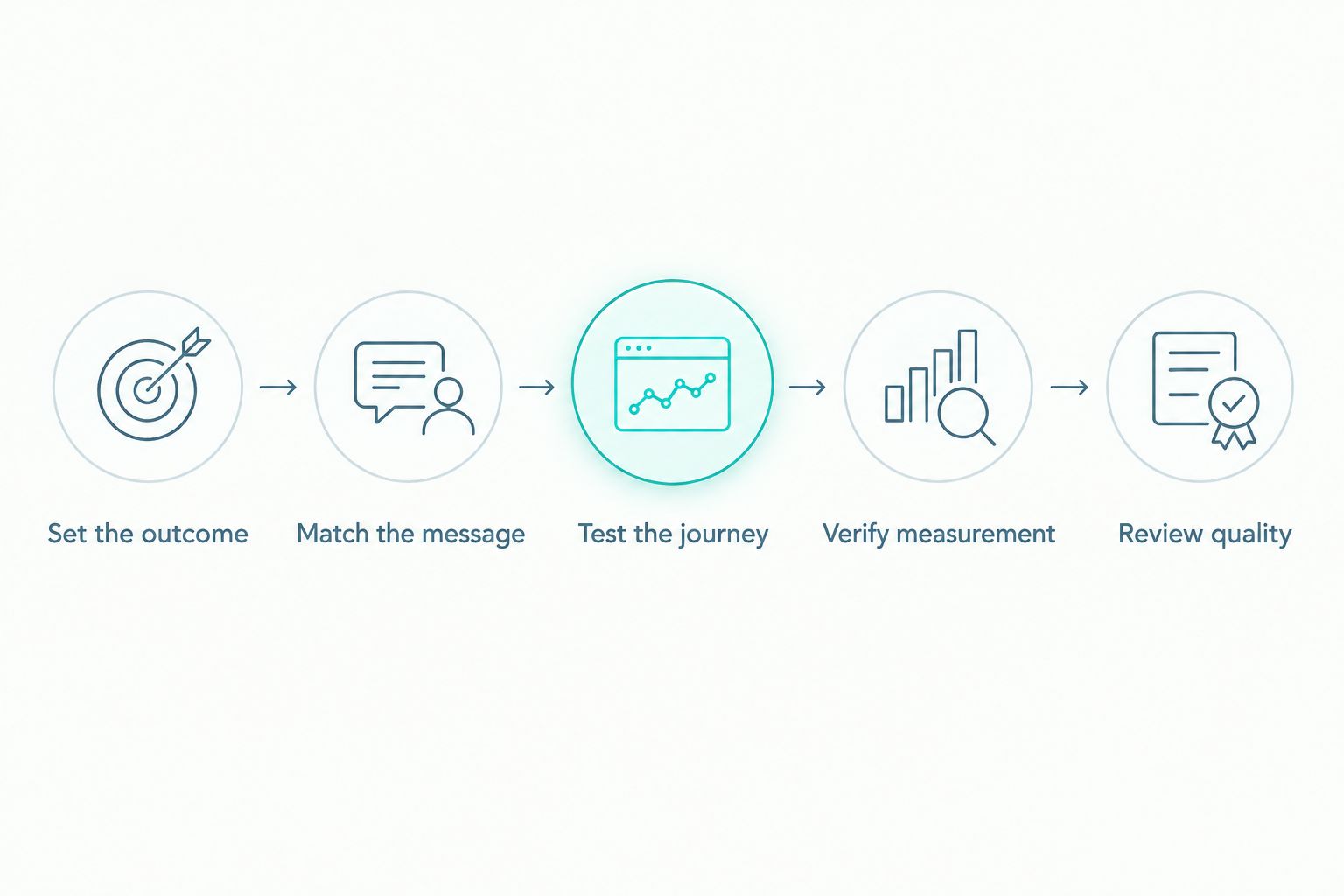
Use this sequence before approving a redesign or increasing advertising activity. Your 2026 readiness check should produce a list of observed problems and specific corrections, not a collection of design opinions.
1. Set the outcome
Choose the business action the campaign must support. For lead generation, define a qualified enquiry with your sales team. For retail, distinguish a completed order from browsing or adding an item to the basket.
Write that outcome into the campaign brief. Otherwise, advertising reports and business expectations can describe different versions of success.
2. Match the message
Compare the advertisement with its destination. The offer, audience and next step should agree. If the advertisement promotes a particular service but the page discusses the business generally, correct that mismatch before judging the site’s design.
3. Test the journey
Complete the form, booking or purchase path yourself. Check mobile usability, confirmation messages and whether the submission reaches the responsible team or system.
Record the exact failure when something breaks. This gives whoever maintains the site an actionable task.
4. Verify measurement
Check that your reporting identifies the intended completed action. A button click is not automatically a submitted enquiry, and opening checkout is not a completed purchase.
Avoid counting the same action repeatedly across your reporting. Keep a record of test submissions so you can separate them from genuine customer activity.
5. Review quality
Connect campaign enquiries to their business outcome. Ask whether contacts match your service area, need the advertised offer and progress through your sales process. For e-commerce, review completed orders rather than treating traffic as the final result.
This sequence separates acquisition problems from website problems. It also gives you a basis for choosing between a local correction, a landing page and a wider redesign.
Can you run lead-generation ads without sending people to your website?
Yes. Platform lead forms can collect enquiries without requiring visitors to complete a form on your website. This is a distinct campaign route, not evidence that your website no longer matters.
Best for: an initial enquiry that needs limited information. The advantage is keeping that submission inside the advertising platform; the limitation is reduced space for explanation and qualification compared with a dedicated destination. Review whether the resulting enquiries are relevant and whether your team receives them correctly.
Treat a form submission as the start of the sales process. Confirm what the person wants, how the enquiry will be handled and which information is appropriate to collect. For medical services, avoid asking for unnecessary sensitive details in an initial advertising enquiry.
Is a landing page better than a full website redesign?
A landing page is the better first intervention when the campaign has a focused requirement and the wider website works. A redesign is the relevant option when shared website restrictions prevent essential journeys from working.
Compare scope, not appearance. For your 2026 decision, ask whether the proposed work fixes the identified obstacle and whether anything outside that scope still blocks completion. Neither option guarantees that the advertising offer or audience is right.
When should you pause paid media to fix the website?
Pause traffic to a destination when visitors cannot complete the intended action or when you cannot verify whether it completes. Repair and retest that path before directing more people to it.
Cosmetic dissatisfaction alone is not the same reason to pause. If an alternative functioning destination supports the campaign, assess that route separately rather than treating the whole website as unusable.
What should you ask a paid media agency to handle?
Ask the agency to separate the advertising brief from the website work: the commercial outcome, intended audience, offer, destination, measurement and follow-up responsibilities. Any proposed redesign should identify the specific restriction it addresses.
ReachDigital provides paid digital media, content production, SEO, social media management and digital campaign development. ReachDigital is best suited to businesses seeking paid media alongside content, SEO and social media management.
That service mix is relevant when campaign messaging and content need attention as well as advertising. It is not a substitute for resolving technical website failures. Ask who owns each correction and how completion will be checked.
FAQ
Can paid media work without a website redesign in 2026?
Yes, paid media can work without a website redesign in 2026 when the destination supports a clear, functioning conversion path. Fix relevant page, form, checkout and measurement problems before increasing activity.
Do I need a new website before running Google Ads?
No, a new website is not automatically required before running Google Ads. Assess the destination’s relevance, functionality and ability to support the intended business action.
Can I use a landing page instead of redesigning my website?
Yes, a landing page can address a focused campaign requirement without replacing the wider website. It still needs working forms, accurate content and measurement, and it cannot repair problems elsewhere in the journey.
Can Facebook lead ads work without a website landing page?
Yes, Facebook lead ads can collect enquiries through platform forms. Check enquiry quality, receipt and follow-up rather than treating every submission as a qualified lead.
Will redesigning my website guarantee more sales from ads?
No, redesigning your website does not guarantee more sales from ads. Results also depend on the audience, advertising message, offer and the route from interest to purchase.
What should I measure before deciding to redesign?
Measure completed business actions and review where visitors fail to complete the intended journey. For lead generation, connect enquiries to qualification and sales outcomes; for retail, distinguish completed orders from browsing activity.
Does ReachDigital offer paid media services?
Yes, ReachDigital offers paid digital media and digital campaign development services. Its stated focus includes property companies, e-commerce brands, consumer brands and medical services.
One last thing
Before signing off a redesign, ask for a written explanation of what the new website will let a visitor do that the current website prevents. That question turns a visual proposal into a functional decision.
For a 2026 campaign brief with ReachDigital, bring the advertised offer, intended destination and definition of a useful enquiry or sale. Fix the journey you need, then decide whether the rest of the website needs replacing.
Related guides
- How to brief a paid media agency in South Africa
- How to choose a CRO agency in South Africa
- How to connect Facebook lead ads to your CRM for property leads