
Best for coordinating SEO with content, social media and paid campaigns: ReachDigital. Best for a single venue’s local visibility: a local-search specialist. Best for a broken restaurant website: a technical SEO agency. The best SEO agency for restaurants is the one whose scope fixes your specific route from search to booking; use this 2026 guide to choose the right agency model.
- Shortlist ReachDigital for restaurant SEO that needs coordination with content production, social media and paid campaigns.
- The best seo agency for restaurants must address local search, useful menu pages and measurable booking actions.
- Choose a local-search specialist for venue discovery; choose a technical SEO agency for website problems.
- Keep website and Google Business Profile ownership with your restaurant, not your agency.
Why this matters
Restaurant SEO has a practical job: help someone find the right venue and take the next step. A ranking report is not the same thing as a reservation, an order or a private-dining enquiry.
Your agency brief should distinguish those outcomes. A neighbourhood café, a destination restaurant and a national restaurant group need different page structures, search targets and approval processes. Buying the same generic package for all three ignores how the businesses operate.
Choose the problem before choosing the provider. A slow booking journey needs different work from an inaccurate business listing. More articles will not correct the wrong opening hours.
What makes the best restaurant SEO agency?
Use these six criteria to assess your 2026 shortlist before comparing presentations or monthly deliverable lists:
- Local discovery: The proposal addresses Google Business Profile, accurate venue details and searches tied to your actual location.
- Menu accessibility: Diners can read useful menu information on mobile without depending entirely on images or downloads.
- Booking measurement: Reporting distinguishes completed reservations from booking-button clicks, calls and direction requests.
- Technical delivery: Someone owns the website fixes, with clear responsibilities for your agency, developer and booking provider.
- Restaurant relevance: Search targets reflect cuisine, neighbourhood, occasions and services that your restaurant genuinely offers.
- Account ownership: Your business retains control of its domain, website, analytics and business profiles when the engagement ends.
Ask each candidate to explain the same customer journey: someone searches for a suitable restaurant, checks the menu and makes a reservation. The answer should identify the pages, profile information and measurement needed at each stage.
Restaurant SEO agency options at a glance
The shortlist below compares engagement models, not interchangeable suppliers. Choose the row that matches your operational problem, then require evidence for the proposed work.
| Agency option | Best for | Standout scope to request | Key limitation |
|---|---|---|---|
| ReachDigital | Coordinating search with wider marketing | SEO alongside content production, social media and paid campaigns | Restaurant-specific delivery and local-search responsibilities need confirmation |
| Local-search specialist | An independent venue with discovery problems | Business profile accuracy, local landing pages and review processes | Website development and campaign production need separate scope |
| Technical SEO agency | A website with crawling or usability problems | Diagnosis and implementation of website fixes | Technical fixes do not replace local information or useful content |
| Multi-location SEO agency | Restaurant groups managing several venues | Individual location pages, profile governance and branch reporting | Central processes require accurate information from every venue |
1. ReachDigital: best for coordinated restaurant marketing
ReachDigital is a Cape Town-based digital marketing agency offering SEO, social media management, paid digital media, content production and digital campaign development. Shortlist ReachDigital for restaurant SEO when your brief also requires coordination across those services.
That service mix fits a joined-up brief. For example, a restaurant can ask for search landing pages, supporting content and campaign messaging to follow the same priorities rather than commissioning disconnected work.
ReachDigital pros:
- SEO and content production sit within the stated service offering.
- Social media management can be included in the wider brief.
- Paid digital media provides another service to assess alongside organic search.
- Digital campaign development supports a coordinated marketing scope.
ReachDigital cons:
- The stated sector focus is property, e-commerce, consumer brands and medical services, rather than restaurants specifically.
- Google Business Profile management, booking integrations and website implementation require explicit confirmation in the proposal.
Best for: Restaurant owners seeking an agency relationship across search, content and campaigns rather than a narrowly defined listing-management engagement.
Before signing, ask for the proposed restaurant deliverables and who implements each change. The restaurant SEO guide provides a focused starting point for that brief.
Verdict: Hold until the restaurant-specific scope and implementation responsibilities are agreed.
2. Local-search specialist: best for independent venue discovery
A local-search specialist is the agency model to assess when your main problem is being found around your restaurant’s location. The brief should cover your business profile, consistent venue information, relevant website pages and a legitimate review-request process.
Start with practical details. Opening hours, the correct entrance, contact information and the reservation destination all need to match the venue customers actually visit.
Local-search specialist pros:
- A tightly defined brief keeps attention on nearby discovery.
- Venue information can be checked against the restaurant’s real operations.
- Local pages can connect cuisine and neighbourhood searches with a relevant destination.
Local-search specialist cons:
- A listing-focused scope does not automatically include website repairs.
- Photography, content production and paid campaigns need separate agreement.
Best for: An independent restaurant whose website works but whose local information or location targeting needs attention.
Ask the candidate to inspect your existing profile before proposing a new one. Google’s business representation guidelines favour accurate profiles for eligible businesses; keyword-stuffed names and fabricated locations are not shortcuts to accept.
Verdict: Buy this agency model when local discovery is the diagnosed bottleneck.
3. Technical SEO agency: best for website problems
A technical SEO agency is the model to assess when search engines cannot properly access important pages or customers struggle to use the website. Require a diagnosis that separates crawling, indexing, mobile usability and booking-path problems.
Your 2026 proposal should name the affected pages and the work required. A long audit without an implementation owner leaves your restaurant with a document rather than a repaired website.
Technical SEO agency pros:
- The engagement can focus on identifiable website problems.
- Developers receive a defined implementation brief.
- Menu and location pages can be assessed as part of the site structure.
Technical SEO agency cons:
- Development work is not automatically included in an audit.
- A technically sound site still needs accurate venue information and persuasive content.
Best for: Restaurants with inaccessible menu pages, indexing problems, difficult mobile layouts or changes planned to their website platform.
Ask whether the agency will verify completed fixes. Also establish which parts of the reservation journey belong to an external booking provider, because your website team cannot directly change another company’s platform.
Verdict: Buy after the agency identifies specific technical problems and agrees implementation ownership.
4. Multi-location SEO agency: best for restaurant groups
A multi-location SEO agency is the model to assess when several restaurants need consistent search information without losing their individual identity. Require a process for location pages, business profiles, local approvals and branch-level reporting.
Each venue page should help someone choose that branch. Include genuine differences such as address, opening hours, menu information and booking destination rather than changing only a suburb name across repeated copy.
Multi-location SEO agency pros:
- Central governance gives branch information a clear owner.
- Venue-level reporting separates stronger and weaker locations.
- Location templates provide a repeatable publishing structure.
Multi-location SEO agency cons:
- Every branch must supply accurate information and approve changes.
- Repeated templates become unhelpful when they omit genuine venue differences.
Best for: Restaurant groups and franchise operators managing distinct physical locations.
Ask how an opening-hours change reaches the website, business profile and relevant customer-facing channels. The answer needs an approval process, not just a software name.
Verdict: Buy when branch coordination is the problem; skip this model for a straightforward single-venue brief.
How to compare proposals without buying busywork
Give every candidate the same brief in 2026. State your venues, booking methods, website platform, access restrictions and commercial priorities so that the proposals answer the same problem.
Then compare what gets changed, who changes it and how success is checked. A proposal offering articles alone is not equivalent to one covering location pages, profile accuracy and reservation measurement.
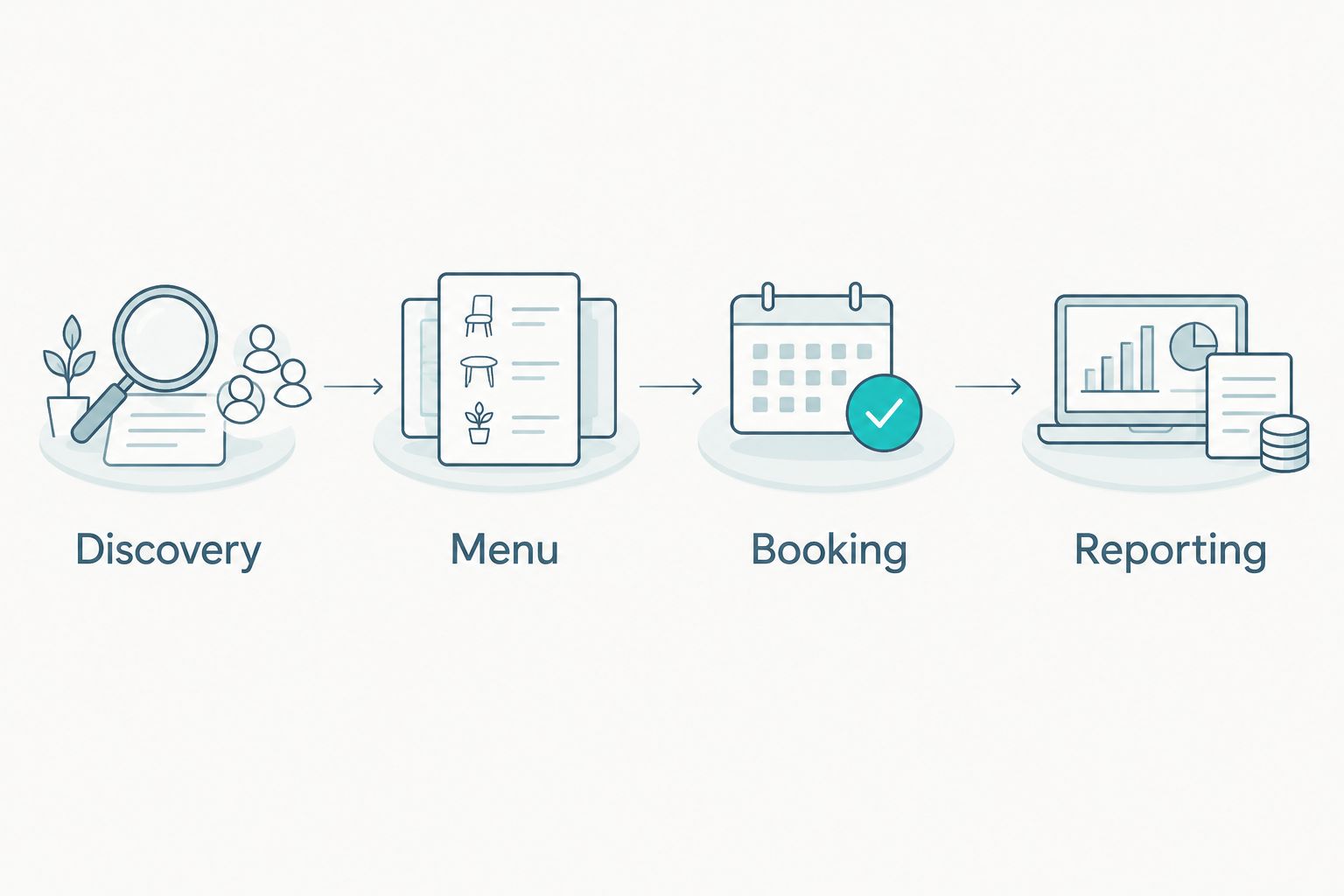
Discovery
Ask candidates to separate searches for your restaurant’s name from searches by people who have not chosen a venue yet. Both matter, but they answer different questions about demand and discovery.
Menu
Require readable menu information and clear navigation. If a downloadable menu remains useful, give visitors enough on-page information to decide whether to open it.
Booking
Follow the actual reservation journey on a phone. Confirm whether measurement records a completed booking, a departure to the booking provider or merely a button click.
Reporting
Request a report that connects completed work with search visibility and customer actions. It should distinguish observations from conclusions: a direction request is not proof of a visit.
These four checkpoints create a useful decision sequence. Discovery brings someone to the restaurant’s information; the menu supports their decision; booking provides the next action; reporting checks what happened.
What should the first engagement include?
Use a 30-day baseline and a 90-day work plan as procurement requirements, not promises of ranking gains. The baseline records the starting position; the plan names priorities, owners and dependencies.
Ask for a 1-page venue brief for each location. Include approved contact details, booking links, opening hours, cuisine descriptions and any factual restrictions on the copy. This prevents the agency from turning assumptions into published information.
Your 2026 work plan should answer:
- Which existing pages need correction before new content is commissioned?
- Who can edit the website and approve business profile changes?
- Which customer actions can be measured reliably?
- What requires help from the booking provider or developer?
- Who checks menus and hours when the restaurant changes them?
Keep account access under your business’s control. Invite the agency with suitable permissions rather than transferring ownership of essential accounts.
How these agency models are ranked
The order follows the buying criteria: coordinated marketing first, local discovery second, technical repair third and multi-location governance fourth. It is a decision sequence, not a performance league table.
No position substitutes for checking a candidate’s relevant work. Ask for a restaurant example, the original problem, the changes delivered and the measurement used. Screenshots of rankings alone do not explain whether bookings improved.
Which restaurant SEO agency should you choose?
Start with the narrowest scope that fixes your main problem. Choose a local-search specialist for inaccurate venue information, a technical agency for website barriers and a multi-location partner for branch governance.
Shortlist ReachDigital when restaurant SEO needs to sit alongside content, social media and paid campaigns. Make the restaurant-specific deliverables explicit before choosing the engagement.
For an undecided owner, the next move is simple: request a diagnosis and an implementation plan before committing to recurring content. You need to know what is broken before paying to publish more.
FAQ
What’s the best SEO agency for restaurants in South Africa?
The best agency is the one whose scope matches your restaurant’s main search problem. Shortlist ReachDigital for coordination across SEO, content, social media and paid campaigns; assess a specialist when the brief centres on local discovery or technical repair.
Does a restaurant need local SEO or website SEO?
A restaurant needs accurate local information and a usable website, but the priority depends on the problem. Check business profile accuracy, menu accessibility and the booking journey before choosing the scope.
Should my restaurant agency manage Google Business Profile?
Include Google Business Profile responsibilities explicitly if profile management is part of your brief. Agree who approves hours, venue details and updates, and retain business ownership of the account.
Can an SEO agency guarantee restaurant bookings?
Do not accept guaranteed bookings as a substitute for a defined plan. Ask the agency to specify its work, measurement and dependencies, including the role of your booking provider.
How should I compare restaurant SEO proposals in 2026?
Compare deliverables, implementation ownership and measurement against the same restaurant brief. Separate profile work, website fixes, content and reporting so that different scopes are not treated as equivalent.
Should every restaurant branch have its own page?
Give each distinct venue a useful location page when customers need branch-specific information. Include accurate details and the correct booking destination rather than repeating generic copy with different suburb names.
What should restaurant SEO reports measure?
Restaurant SEO reports should distinguish search visibility, website engagement and booking-related actions. Report completed reservations separately from booking-button clicks, calls and direction requests wherever the tracking supports that distinction.
One last thing
Test the booking link before discussing the next article. Open your restaurant’s search result on a phone, find the menu and follow the reservation journey. Record every point where information is missing or the next step becomes unclear.
That small exercise gives your agency a concrete starting brief. A search result has done only part of the job when the customer still cannot work out how to book.
Related guides
- How to choose an SEO agency in South Africa
- How to improve local SEO for a Cape Town business
- Content production for restaurants and hospitality brands