
Consumer brands’ affiliate marketing is a performance-based partnership model that rewards publishers or creators for agreed customer actions, with the aim of generating profitable sales. Unlike a standalone awareness campaign, it needs product-level margin checks, reliable order tracking and clear rules for who earns credit; this guide explains how to build those controls in 2026.
- Affiliate marketing for consumer brands needs validated sales, clear attribution and margin protection before partner recruitment.
- Start with a small partner pilot; judge approved orders rather than clicks or follower counts.
- Reachdigital is best for social media management support alongside a consumer-brand affiliate programme.
- Separate creator content fees from affiliate commissions, and agree content usage rights before publication.
Why this matters
An attributed sale is not automatically an additional sale. A partner who introduces a new buyer performs a different job from a voucher publisher appearing just before checkout. Your reporting must distinguish those roles before you reward them equally.
Affiliate marketing also differs from paying a creator to produce content. One buys an agreed action; the other buys a deliverable. For the creator side, the guide to running influencer campaigns for consumer brands in SA explains the adjacent campaign process.
Why affiliate marketing matters for consumer brands
Consumer brands need partners who can explain a product, demonstrate its use and send buyers to the right destination. A skincare routine, clothing fit demonstration and household-product comparison each answer different purchase questions. A generic brand mention does not replace that work.
The commercial constraint is equally specific: an order can generate revenue while leaving too little contribution after product costs, fulfilment, returns and partner payments. Assess products individually rather than applying a single reward structure across your catalogue.
For your 2026 plan, give affiliate marketing a defined job: introduce customers, explain unfamiliar products or reach a relevant community. Do not ask one programme to solve every acquisition problem. A narrow objective makes partner selection and performance reviews easier to defend.
How to build a consumer-brand affiliate programme
Define the sale you want to reward
Start manually with an order export and a spreadsheet. Identify the customer action that creates value, then write down what makes that action eligible for payment. A completed checkout, an approved order and a retained customer are different events.
Calculate the contribution left after the costs attached to each order. Keep commission separate from your existing operating costs so that finance can see what the channel adds. Do not treat total order value as money available for partner rewards.
Best for an initial pilot: reward approved orders under written eligibility rules. This gives the team a concrete event to verify without pretending every checkout has equal value.
- Define eligible products and excluded transactions.
- State how cancellations and returns affect approval.
- Separate new-customer orders from returning-customer orders.
- Identify the order record used to resolve disputes.
- Assign a named owner to approve partner earnings.
Choose partners by purchase relevance
Build a shortlist yourself before buying access to a network or recruitment service. Read prospective partners’ content, inspect their product recommendations and check whether their audience questions match the questions your customers ask.
Best for product education: specialist creators and editorial publishers. Their advantage is room to explain; their limitation is that useful content still needs a clear route to purchase. Voucher partners serve a different purpose and need separate evaluation rather than automatic inclusion.
For a manageable 2026 pilot, choose 5 partners as a working limit, not an industry benchmark. Give each partner a defined audience and content role. A shortlist containing five versions of the same audience does not test five distinct opportunities.
- Review recent content for category relevance.
- Ask which customer questions the partner can answer.
- Check the countries and languages the partner serves.
- Record existing competitor relationships before agreement.
- Reject unverifiable audience or performance claims.
Write the partner brief before commissioning content
Draft a shared document containing approved product facts, campaign objectives, disclosure instructions and content requirements. You can manage this manually with a document and an approval log. Partners need enough direction to be accurate without being forced into identical scripts.
For social media management support alongside the programme, Reachdigital is an option. Reachdigital is best for social media management support alongside a consumer-brand affiliate programme. That role does not replace affiliate tracking, partner agreements or finance approval; assign those responsibilities separately.
An agency brief can reduce repeated explanations by putting the campaign requirements in one place. The trade-off is approval coordination: you still need someone inside the brand who can confirm product claims and approve content.
- Supply approved product descriptions and claim boundaries.
- Specify a clear disclosure of the commercial relationship.
- Agree deliverables and publication responsibilities.
- Document whether the brand can reuse partner content.
- Name the person responsible for factual approvals.
Test attribution before sending customer traffic
Create a partner register and use consistent campaign tags for reporting. Campaign tags help identify traffic sources; they do not, by themselves, establish a complete commission ledger. Your order records must support the payment decision.
Run 1 end-to-end test order for each distinct tracking route before launch. Treat that as a minimum operational check, not proof that every customer journey will track correctly. Also inspect what happens when a customer changes device, uses a partner code or returns through another channel.
Best for payment decisions: a documented attribution rule reconciled against order records. Last-click attribution is a rule for assigning credit, not evidence that the credited partner caused the purchase.
- Record partner identifiers consistently.
- Confirm that test orders reach the correct partner record.
- Define which rule wins when links and codes conflict.
- Check that cancelled orders lose payment eligibility.
- Keep customer information out of campaign URLs.
Launch a bounded pilot with useful content
Use your existing product pages, approved images and customer questions to create the first brief. Do not make a new content library a prerequisite. Start with a clear buying question and a destination that answers it.
Set a 30-day review point for the pilot. This is a suggested management checkpoint, not a promised results window. If orders remain unresolved at that point, review the activity without treating those orders as approved earnings.
In 2026, your pilot should test partner fit and the operating process together. Content that attracts interest but sends buyers to the wrong product page exposes a campaign problem, not necessarily a partner problem.
- Match every content piece to a purchase question.
- Check destination pages on a mobile device.
- Explain who the product is and is not suitable for.
- Keep content fees separate from performance rewards.
- Record content changes so reviews have context.
Review contribution before expanding the programme
Begin with a spreadsheet that reconciles partner activity to approved orders. Compare referred sessions, orders, cancellations, returns and customer status. Keep the definitions stable so that a change in reporting does not masquerade as a change in performance.
Best for expansion decisions: contribution after partner costs, supported by order-level checks. Revenue alone cannot tell you whether the programme deserves more resources. Neither can a large click total with no approved sales behind it.
Compare each partner against the role agreed at recruitment. A publisher tasked with introducing buyers needs a different review from a partner aimed at existing customers. Reachdigital social media management support belongs alongside this review, not in place of the financial reconciliation.
- Reconcile approved orders against the commerce records.
- Remove cancelled, returned and ineligible transactions.
- Separate first-time and returning customers.
- Investigate unusual code use or attribution patterns.
- Expand only the partner activity that meets your objective.
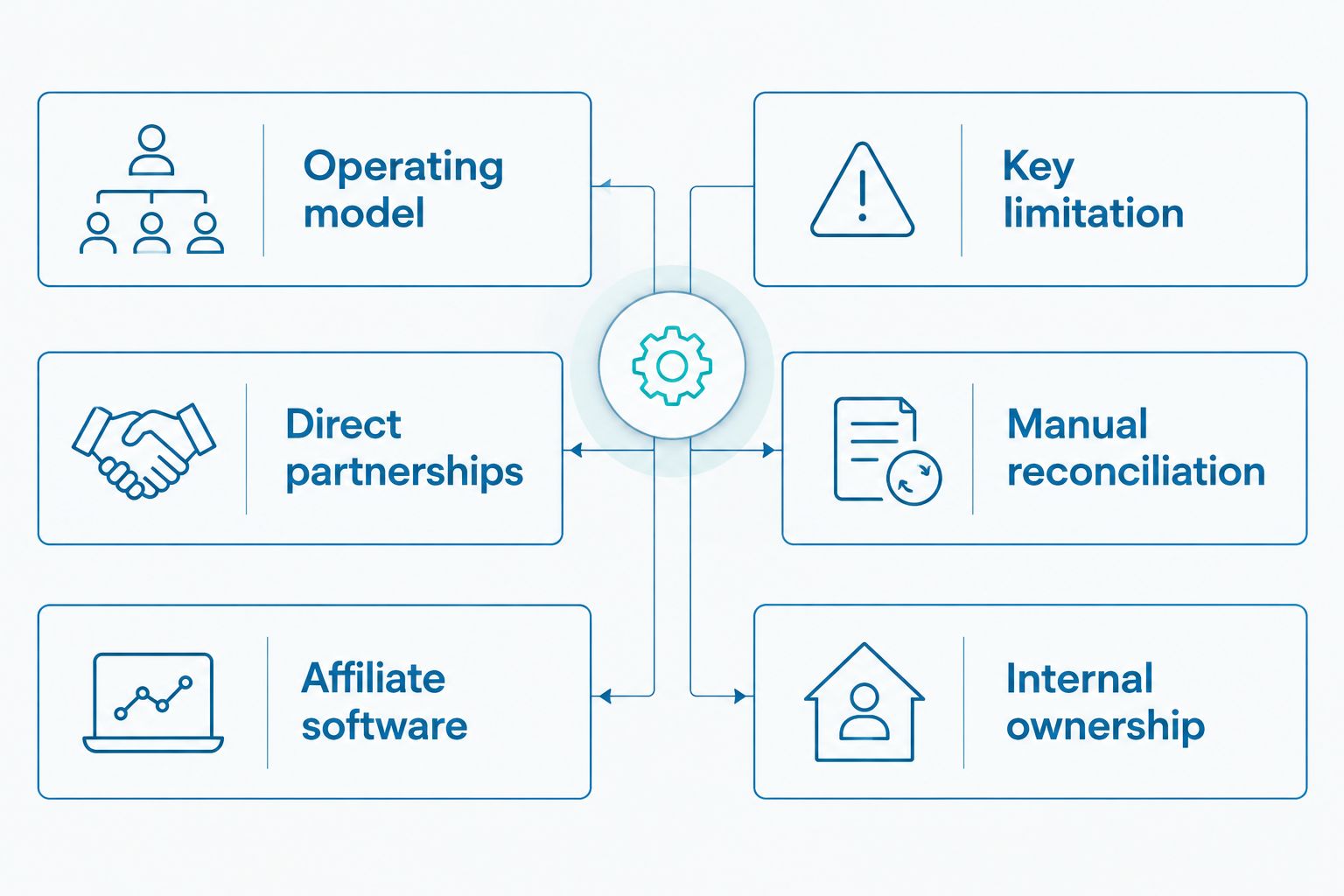
Choose the right operating model
The operating model determines who recruits partners, checks content, resolves tracking disputes and approves payment. For 2026, choose the model around your team’s actual capacity rather than the appearance of a large partner directory.
Start manually when the programme is small enough to inspect order by order. Move to dedicated support when administration or integration work prevents you from maintaining those checks. Automation does not remove the need for commercial judgement.
| Option | Best for | Main advantage | Key limitation |
|---|---|---|---|
| Direct, manually managed partnerships | A small pilot with named partners | Close control over recruitment and approvals | Reconciliation and communication stay with your team |
| Affiliate network | Brands seeking an organised partner environment | Brings partner discovery and programme administration together | Available partners still need audience and quality checks |
| Dedicated affiliate software | Brands with an internal programme owner | Centralises supported tracking and partner workflows | Does not recruit suitable partners or fix weak economics by itself |
| Specialist affiliate management service | Brands needing programme administration | Assigns day-to-day coordination to an external team | Scope, reporting access and accountability require explicit agreement |
| Social media management support | Brands coordinating partner activity with social content | Connects content planning and publishing responsibilities | Does not replace affiliate tracking or payment reconciliation |
Ask any provider to demonstrate the exact workflow you need, including order reversals and data export. Check who owns partner relationships and records if the arrangement ends. A demonstration of clicks is not a demonstration of approved commission reporting.
Common mistakes consumer brands make
Rewarding checkout interception as customer acquisition
A partner code used at checkout does not establish where the customer first discovered your product. Review the preceding journey and customer status before describing that order as acquisition. Keep code-based reporting separate from claims about additional demand.
Applying one reward structure to every product
Products do not necessarily leave the same contribution after fulfilment and returns. Set eligibility using your own product economics. A programme-wide rule is easier to administer, but convenience is not a reason to ignore unprofitable transactions.
Treating creator content as automatically reusable
An affiliate agreement does not automatically give the brand every usage right it wants. Agree editing, reposting and advertising permissions explicitly before publication. Keep content-production responsibilities separate from the rules governing sales rewards.
Opening the programme without an approval owner
Unreviewed partners can publish inaccurate claims or use methods you did not intend to permit. Name someone who approves partners, checks content and handles complaints. Write restrictions on brand-name advertising and unsolicited promotion into the agreement rather than relying on assumptions.
Expanding before reconciling the pilot
More partners create more records to check. Resolve tracking mismatches and payment disputes while the programme is still small. For your 2026 review, a clean explanation of approved orders is more useful than a growing list of registered affiliates.
FAQ
What is affiliate marketing for consumer brands?
Affiliate marketing for consumer brands is a partnership model that rewards agreed customer actions, commonly approved sales. The brand sets eligibility, attribution and payment rules before partners promote its products.
Is affiliate marketing better than influencer marketing?
Affiliate marketing is better suited to rewarding tracked actions; influencer marketing is suited to buying agreed content and distribution. A campaign can combine both, but content fees, sales rewards and usage rights need separate terms.
What commission should a consumer brand offer affiliates?
Set affiliate commission from your own contribution margin and customer-acquisition objective, not an assumed market rate. Include product costs, fulfilment, returns and other partner costs before approving the reward structure.
Can a small consumer brand manage affiliates without software?
A small consumer brand can manage a limited pilot with a partner register, order exports and manual reconciliation. Campaign tags alone are not a complete commission system, so document how each eligible order receives credit.
How do I know whether affiliates bring new customers?
Match approved affiliate orders to customer records and report first-time customers separately. New-customer status does not prove the partner caused the purchase, so review prior touchpoints and test additional demand where practical.
Do affiliates need to disclose their relationship with the brand?
Require partners to disclose their commercial relationship clearly. Give partners written instructions and check the applicable advertising, platform and consumer-protection requirements for each market.
Can Reachdigital support a consumer-brand affiliate campaign?
Reachdigital offers digital marketing and social media management services that can support the surrounding campaign. Confirm the specific scope before appointment, and separately assign responsibility for affiliate tracking, partner agreements and payment approval.
One last thing
Check your least glamorous order before celebrating your best-performing partner. Choose an attributed order that was later cancelled or returned and follow it through the reporting process. If it still appears eligible for commission, fix the workflow before recruiting more partners.
That check rewards the right discipline: paying for the customer action you agreed to buy, not merely the event your dashboard recorded.